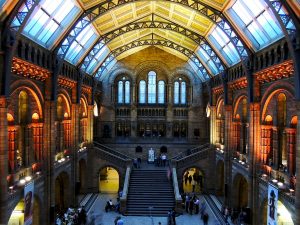
At least, that’s what I prefer to call it, even though it is meant to be a science museum, and seemingly once was. I am going to begin a series of posts which will describe its transformation, and therefore explain my reasons for calling it that. This should interest anyone following the debate between Darwinian evolutionary theory and theistic alternatives, including Intelligent Design. This is just a brief introduction.
In my opinion the Darwinian theory of evolution has become equivalent to a religion. Its believers do not think that, obviously, because they have convinced themselves that it is science. It perhaps takes an outsider to see what is going on, hence the philosopher Mary Midgley’s book Evolution as a Religion (1). Words like dogma, creeds, heresy, Inquisition have become relevant, as I hope to show.
In 2009 there was a special Darwin exhibition there, timed to coincide with the bicentenary of his birth. My wife and I decided to visit it, and naïvely assumed that we would be able to just turn up and get in; after all, it wasn’t going to be a sell-out, or so we thought. To our surprise, it was fully pre-booked and we couldn’t get in. We therefore spent the time looking at the exhibits in the rest of the Museum. As a sceptic, I found the experience an oppressive attempt at indoctrination, and would probably have felt the same if I had managed to get into the exhibition, since one review described it as having “an unambiguous militant tone” (2).
The Museum was founded in 1881. Richard Owen was the person primarily responsible and its first director. He was an outstanding naturalist, comparative anatomist, and a lifelong opponent of Darwin’s theory. He was apparently a devout Christian, which may have influenced his views; it is also possible that his religious views were inspired by his observations. Owen agreed with Darwin that evolution occurred, but saw nature as a series of experiments by a Creator. (Divine Imagination! You don’t have to be a conventional Christian to believe that.) For at least part of his career Owen believed that living matter had an “organising energy”, a life-force that directed the growth of tissues, a viewpoint that is called vitalism. In case anyone thinks this is an antiquated idea, smacking of mysticism and the supernatural, let me assure you that the debate continues. As recently as 1989, physicist Paul Davies, not someone likely to indulge in fanciful speculation, while not himself endorsing vitalism or animism, nevertheless outlined in The Cosmic Blueprint (3) the difficulties encountered when trying to explain life, specifically morphogenesis, by ordinary physical laws, and included vitalism and animism as part of the discussion.
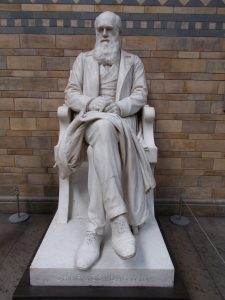
I am not saying that this science museum began under the influence of Christianity, but I do think that it was a genuine science museum, i.e. open-minded and objective, showing exhibits, not promoting one particular line of thought. In the following articles, I’ll relate some of the moments which were significant in its transformation into a Temple of Darwinism. For the time being I’ll just note that at the time of the exhibition in 2009, the statue of the founder Richard Owen was replaced by one of Darwin, at which time the transformation from museum to temple was complete.
Footnotes:
(1) Routledge, 1985, new edition 2002
(2) Darwin review http://www.victorianweb.org/science/darwin/capet.html. I believe the reviewer thought this approach appropriate
(3) Unwin Hyman Ltd., 1989