Spirituality In Politics

  • Home
  • Intro
  • Articles Index
    • Introductory
      • 1. Metaphysics in a Spiritual Society
      • 2. The Spirit of Guidance
      • 3. Divination
      • 4. Raynor C. Johnson: The Imprisoned Splendour
    • Articles 2: Headline Policies for a Spiritual Society
      • Education
        • The Importance of Fairy Tales
        • The Importance of Fairy Tales, Part 2 – Fairy Tales and Feminists
        • Fairy Tales and Feminism – the Story of Psyche
        • Fairy Tales and Feminism — the Story of Psyche, Interpretation
        • Save Our Fairy Tales — Concluding Remarks
    • ARTICLES 3: MORE DETAILED IDEAS
      • Politics from a Taoist Perspective – Arguing for the Centre
      • Politics from the Centre — Is that the only way forward?
      • Changing the World – Spirituality or Socialism?
      • The Superorganism – a Challenge to Materialist Science
      • Is the Earth a Superorganism?
      • Humanity as Part of the Superorganism
    • Articles 4 The Role of the Citizen
      • The Role of the Citizen in a Spiritual Society
      • Reflections on Eastern and Western Spirituality
    • The Superorganism Question and the European Union
    • A Vision for a Spiritual United Kingdom Outside the European Union
    • Consciousness
      • Is the Self an Illusion – Series Introduction
        • Is the Self an Illusion? – Neuroscience, Gurdjieff and Buddhism
        • Is the Self an Illusion? – The Opposing Viewpoint
        • Is the Self an Illusion? — Yes and No
        • Is the Self an Illusion? — Summary and Conclusions
      • The Hidden, Deeper Self - Introduction
        • The Hidden, Deeper Self - Freudian Slips
        • The Hidden, Deeper Self - Dreams
        • The Hidden, Deeper Self – Synchronicity
        • The Hidden, Deeper Self - Automatic Writing
        • The Hidden, Deeper Self – Divination
    • Why Christianity Must Change or Die – Introduction
      • Christianity Must Change or Die — Gnosticism and Carl Jung
      • Significant Moments in Church History – Introduction
        • Number 1, The Council of Nicaea, 325AD
        • Number 2 – The Anathema Against Origen, 553 A.D.
          • Reincarnation and Christianity
    • Was Jesus Divine? – Introduction
      • Was Jesus Divine, the Son of God? – 1. The Adoptionist Problem
      • 2. The Jewish Messiah
      • 3. The Eschatological Prophet
      • 4. Shakespeare’s Heretical Play
      • 5. The Resurrection of Jesus – part 1
      • Was Jesus Divine, the Son of God? - Summary and Conclusions so far
      • 6. Was Jesus Married?
      • 7. Was Jesus Married? — part 2
      • 8. Was Jesus Married? — part 3
  • Blog Introduction
    • Blog Index
    • Religion and Spirituality
    • Politics
    • Science
    • Mythology
    • Miscellaneous
  • Contact

Atheist Spirituality — Thought for the Day, number 2

7th May 2020

    This is the third in a series of articles, and is really a continuation of the second which discussed the nature of God. (It would be helpful to be familiar with that before continuing.)

    There I concluded that God should be considered as an impersonal, cosmic, creative mind, rather than a personal father figure and literal Creator, which is how God is understood in Christianity. Here I’m going to consider how such an error, if that’s what it is, might have arisen.

    Mystics, Eastern gurus, and esotericists are frequently quoted as saying that no words can describe the ‘Ultimate’, or similar term; it is beyond Existence, Absolute Nothing, ineffable, it is beyond all attribution, and so on. If that is true, then it is clearly impossible to describe God as ‘He’, loving, merciful, a law-giver, a judge, and so on. If any being with such personality traits exists, then he could only be a god, a deity, a lesser figure, not the ultimate GOD.

    Why then do Christians believe that this being is GOD? I suspect that they have confused ‘God’ with the archetype, in the Jungian sense, of the Good Father, or the Wise Old Man. Such archetypes have a deep, shaping influence upon human affairs, without most people even being aware of them. This is more likely than Freud’s simplistic idea that humans have created and imagined these ‘heavenly’ figures, based on their experiences with their own parents. (Freud’s thinking was very limited, given that he was a dedicated materialist, and would not be able to contemplate the Jungian idea.)

    There is also the problem that strict monotheistic traditions may have an inadequate understanding of cosmology — how the complex, multi-levelled universe really works. For example, Christians may believe in angels in addition to God (perhaps as a way of avoiding polytheism?), but there may be much more that needs to be taken into account. If it seems to a monotheist that a prayer has been answered, that some form of guidance has been received, that something extraordinarily fortunate has happened to them, then they are likely to attribute their luck to a personal God. Other lower beings in the hierarchy might be a more accurate explanation, however: their own Higher Self, a guardian angel, spirit guide, or what the ancient Greeks, including Socrates and Plato, called the daemon.

    Christianity is an offspring of Judaism, so must have inherited many ideas and attitudes. I think that it is reasonable to describe everyday Judaism as exoteric. There are also, however, various Jewish mystical and esoteric traditions. This may be only my opinion, but these are likely to have a much deeper understanding of the issues than mainstream Judaism.

    Perhaps the best known of them is the Kabbalah. Here is how a modern Kabbalist understands these issues: “God the Transcendent is called in Kabbalah, AYIN. AYIN means No-Thing. AYIN is beyond Existence, separate from any-thing. AYIN is absolute Nothing… Out of the zero of AYIN’s no-thingness comes the one of EN SOF… EN SOF is the Absolute All to AYIN’s Absolute Nothing. God the Transcendent is AYIN and God the Immanent is EN SOF. Both Nothing and All are the same. Beyond the titles of AYIN and EN SOF no attributes are given to the Absolute. God is God and there is nothing to compare with God”¹.

    No use of the word ‘He’ there. Instead we have the En Sof as an Absolute Oneness, which is what I mean by the impersonal, cosmic, creative mind.

    Another series of articles I’m currently writing is called Why Christianity Must Change or Die, inspired by the writings of John Shelby Spong. (For a guide to that, and my other writings on Christianity, please see this page of my website, about half way down.) He contemplates exactly the same issues I’ve been discussing here. In a chapter entitled The Future Church: A Speculative Dream, he says that he wants to challenge the concept of God as understood in traditional Christianity, which is theistic, or “an intervening, personal, supernatural presence who can invade history to make a specific difference”. He later says that he wants to redefine God in nontheistic terms, to dismiss “the supernatural, external God of theism in favour of an understanding of God as the Ground of all Being, the source of life, and the source of love”².

    Spong seems to be waking up to the deeper, esoteric version of Judaism, which is one branch of the tree known as the Perennial Philosophy, the idea that at their core all religions are saying the same thing. Perhaps Christianity as a whole would have been better served if it had also sought its inspiration in the Jewish Kabbalah and the Perennial Philosophy. This leads to a further thought on Christianity’s monotheism; could “there is only one God” be a misunderstanding of what was originally intended “God is one”?

    For anyone who has been following this series since the introduction, my opening statement is becoming clearer. There I said that I thought the term ‘spiritual atheist’ is an oxymoron. It seems, rather, that there are two meanings of the word atheism, which should not be confused. One would be a hard atheism, which denies God and anything supernatural (e.g. Richard Dawkins, Daniel Dennett). The other would be a soft atheism, which can be very spiritual, but merely against theism, and wants to redefine how we think of God. That form of spiritual atheism would obviously not be an oxymoron, but I still don’t want to lose the word God.
==========================================================================================

Footnotes:

1. Z’ev ben Shimon Halevi, A Kabbalistic Universe, Rider & Company, 1977, p7

2. Why Christianity Must Change or Die, HarperSanFrancisco, 1998, p186, p209
· Religion and Spirituality, Uncategorised

Atheist Spirituality — Introduction

26th April 2020

    I’m writing this, not because I am a spiritual atheist; I actually think that the two words are contradictory, therefore that the term is an oxymoron. My title is rather a reference to a book by André Comte-Sponville called The Little Book of Atheist Spirituality¹.

    I am grateful to Isak Dinesen on Medium.com for introducing me to it. The correspondence leading up to that was interesting. I had read an article by Harry J. Stead on the theme of Carl Jung’s concept of synchronicity. I then noticed her response: “Thank you for this cogent erudite piece. As an atheist scientist I am fully participatory in Jung’s synchronicity. It is one of the most transcendent gifts I receive; being open to serendipity, vast vistas with gratitude for the insatiable curiosity to forge connections”.

    I found this fascinating. For me, synchronicity is powerful evidence against materialism, since it suggests that there are mysterious, hidden intelligences organising extraordinary, often life-changing, coincidences. In other words, it is evidence of something supernatural going on, and I thought that one of atheism’s main preoccupations is to deny the existence of anything supernatural. Ms. Dinesen had herself called synchronicity transcendent!

    I therefore responded: “How do you accommodate synchronicity within an atheistic worldview?”

    She replied: “We cannot give orders to the wind, but we must leave the windows open. The Absolute is the wind; our spirit is the window”, which is a quote from Krishnamurti, contained in André Comte-Sponville’s book.

    This was intriguing. I felt compelled to buy the book, to see what this was all about. So this is the first in a series of brief articles, some random thoughts as I work my way through it.

    Here is the first one. Atheism is a denial of the existence of God. Yet a quote intended to support this position contains the words “The Absolute”. What is God if not the Absolute? The quote continues: “The Absolute is the wind”. Now Genesis 1.2 says “…a wind from God swept over the face of the waters”. So how is this quote meant to demonstrate atheism? It could just as easily be an argument for theism. Of course, it all depends on how you define ‘God’. More of that later.

Footnote:

1. Viking, 2007

· Religion and Spirituality

Soul or No-Soul

4th April 2020

    This article is a response to a recent one on Medium.com by Allison J. van Tilborgh, which discussed the absence of the concept of soul in Buddhism. She says that “this is quite a depressing prospect and may even cause a dash of existential dread for some”. I am not one of those. I would always prefer the truth, and would not want to seek false comfort in an illusion, if that is indeed what it is. I do believe in the soul, however, so am here going to argue against this Buddhist way of thinking.

     Here is the key statement on which her argument is based: “Buddhism opts for a different view. We are a series of interrelated processes of momentary events (her italics). In no one moment are we the same as the next, so we cannot have just one unchanging soul”.

    The italics are presumably intended to emphasise the truth of the statement, but this is not necessarily the truth of how we are; it is only one interpretation of how we are. An alternative interpretation would be that we are individual consciousnesses experiencing a series of interrelated processes of momentary events. It is not necessarily ‘we’ who are changing, rather the contents of our consciousness. These unchanging consciousnesses are what I would call souls, or more accurately, aspects of souls. (Who exactly are the “we” in her final sentence, if we have no real, independent existence?)

    The personal psyche is indeed very complicated. Some of these ‘momentary events’ are instincts, emotions, thoughts, intuitions, what Carl Jung called autonomous complexes, what in Roberto Assagioli’s Psychosynthesis are called sub-personalities — the inner child, the inner critic, the rebel, and so on. Consciousness can certainly become immersed in all of these, taken over by them, can identify with them. All this would be impossible, however, if there were no individual consciousness to experience and relate to them.

    She continues: “We are continually evolving, and so is the world around us”. Her implication is that because there is constant change, there is therefore nothing permanent. That may be true of the (apparently) material universe, but not necessarily true of the multi-level universe. Theologians sometimes speak of Being (transcendence) and Becoming (immanence). The ‘Becoming’ aspect to which she is referring, the eternal flux, may be only one part of the complete picture. As Shelley said in his poem Adonais: “The One remains, the many change and pass; Heaven’s light forever shines, Earth’s shadows fly; Life, like a dome of many-coloured glass, Stains the white radiance of Eternity”.

    She continues: “From a Buddhist perspective, the absence of an innate identity is something to be optimistic about. Even the worst of people, beings, and situations have the opportunity to change for the better”. What exactly does the word ‘opportunity’ mean in this context? Is this going to be merely some random, fortuitous event, or is there some will involved which wants things to change for the better? If so, in the absence of individual souls, does it come from some divine entity? Buddhism does not believe in that, in which case we can only hope for some random movements in the ‘body of the universe’ (her phrase). This may be a forlorn hope. I would suggest, rather, that it is human consciousness which is dissatisfied and wants change, so that it is the presence, not the absence, of an innate identity which gives us reason for optimism.

    Ms. van Tilborgh contrasts Buddhist ideas with the Judeo-Christian tradition, and finds them superior. I have no problem with that; Christianity is in need of a major overhaul (a theme I’ve addressed in earlier articles and which I’ll return to soon). Some of the ideas she favours are: the “exchange of self and other”, the “body of the universe”, all beings “are connected to the vast body of life”. These are not exclusive to Buddhism, however, but can be found in other traditions which do include the concept of soul, for example Hinduism, Gnosticism, and Western spiritual traditions alternative to Christianity (e.g. Theosophy), based as they often are on Eastern systems. I agree with all three of her favoured ideas, so they cannot be said to be connected to a belief or non-belief in soul.

    Briefly, the foundation of Gnosticism is the idea of a soul trapped within a body, seeking liberation. Western spiritual traditions understand that a soul ‘descends’ into the material world acquiring different ‘bodies’ on its journey (these are responsible for the complexities of the personal psyche described above). One of the foundational statements of Hinduism is “Tat twam asi”¹, roughly translated as “you are the same as the universal essence”. I take the ‘you’ here to be what we in the West call the soul. Why should we believe Buddhism rather than these traditions?

    Buddhism believes in reincarnation, so we have to ask, who or what exactly is reincarnating? The following quote comes from an online source: “Reincarnation is the belief the soul cycles in and out of physical bodies. When you die in this life, your soul will return to the earth in another body. This concept is worldwide and ancient. Reincarnation can be found in Hinduism, Buddhism, Sikhism, Jainism, and other far east religions”. This may be simplistic, a false understanding, and I’m happy to concede that Buddhism may have a more subtle and sophisticated knowledge. The onus, however, is on Buddhism to explain this apparent contradiction.

    On the subject of meditation, who or what is that ‘I’ which wants to silence the chattering mind, which wants to liberate itself from the personal psyche, to reconnect with the greater universe? Could it really be a non-existent, illusory non-entity?

    Ms. van Tilborgh concludes: “The constructed idea of self, in fact, creates an artificial boundary between the sanctity of human life and the sanctity of all other sentient life. It divides where Buddhism unites; life is viewed as a communal gift instead of an individualistic right. It is sanctified in a broad sense, stretching eons and space”. I’m not quite clear what ‘constructed’ means here. I assume she means something like ‘fictitious’, a construct rather than truth. In my view, the boundary between human consciousness and all other sentient life does not arise from a false belief in a soul. It is a result of something called the Transmission Model, following William James. This conceives the brain as a reducing valve which limits consciousness. Believers include:

  • Aldous Huxley, author of The Doors of Perception
  • famous mythologist Joseph Campbell, saying that “each one of us is potentially Mind at Large”²
  • Frederic Myers, a founder of the Society for Psychical Research
  • the Cambridge philosopher C. D. Broad
  • the French philosopher Henri Bergson, who said: “The function of the brain and nervous system and sense organs is in the main eliminative and not productive. Each person is at each moment capable of remembering all that has ever happened to him and of perceiving everything that is happening everywhere in the universe”³.

    A highly relevant book is Beyond Physicalism: Toward Reconciliation of Science and Spirituality⁴, chapter 3 of which is called ‘The “Transmission” Model of Mind and Body: a Brief History’. Its author Michael Grosso says: “What emerges is a picture, deeply embedded in the historical psyche of an intuition of mind as primordial and transcendent, mind interactively interwoven with and essentially pervading physical nature”.

    What emerges here is an understanding completely consistent with the Buddhist ideas of which Ms. van Tilborgh approves, but which in no way contradicts belief in the soul. My assumption is that it is the soul which is being limited by the brain. (It can temporarily escape from this bondage through spiritual experiences, ESP, and altered states induced by psychoactive drugs.) It is fitting therefore to conclude with this quote: “The brain is not the mind; it is an organ suitable for connecting a mind to the rest of the universe”. I think Ms. van Tilborgh would agree that this sentence agrees with the Buddhist idea she is expressing. It is interesting, therefore, that I’ve taken this from a book with the title The Spiritual Brain: a Neuroscientist’s Case for the Existence of the Soul⁵.

    Buddhism may, of course, be correct in its understanding, but we should certainly not rush to think so. There are other possibilities. According to the Psychosynthesis mantra “I am a centre of pure consciousness, and of will”. Could that be another way of saying the soul?

===================================================================================================

Footnotes:

1. Chandogya Upanishad, VI, viii, 7, as found in Hindu Scriptures, Dominic Goodall, Phoenix Giant, 1996. The full quote is: “This finest essence, — the whole universe has it as its Self: That is the Real: That is the Self: That you are, Svetaketu!”

2. Myths To Live By, Souvenir Press, 1973, reissued 1991, p263

3. quoted in The Doors of Perception, Aldous Huxley, Vintage Classics, 2004, p10

4. Edward Kelly and others, Rowman and Littlefield, 2015

5. Mario Beauregard and Denyse O’Leary, HarperOne, 2007, Introduction, Pxi


· Religion and Spirituality

The Power Of Symbolism — For Good and Bad

1st April 2020

    I don’t think that I’m putting it too strongly if I say that it is a tragedy that many modern people are losing the ability to understand symbols, and therefore to think symbolically. It is a tragedy because, as Paul Levy says: “The universe is itself a primordial revelation that is speaking in the language of symbols, a living symbolic scripture, the literal and symbolic book of life. The whole of creation is a cosmic text thirsting for interpretation” ¹. Levy is a follower of Carl Jung, and says that “because of the extremely therapeutic and healing benefit of symbolic awareness, Jung spent his entire life fighting for the reactivation of symbolic thinking” ². We need to continue that fight because the loss of symbolic thinking has become part of a modern sickness — the loss of connection with our roots in nature, in the unconscious psyche, and with the universe as a whole.

    Two obvious manifestations are the inability of most people to interpret their dreams, and the obsession with reading myths and religious texts literally, when they are clearly intended to be understood allegorically and symbolically. There is, however, a strange side to all this, because people’s behaviour is often strongly controlled by symbols, even when they seem in general incapable of understanding symbolism.

    A simple example would be that Hindus are forbidden to kill cows or eat beef, because cows are symbols of the Great Mother goddess, the source of food and symbol of life — not because the goddess is actually incarnated in their flesh, or anything like that. Indian cows are presumably very grateful, and I don’t suppose the Great Mother, creatress of the material universe, is especially grateful for this respect, is bothered much one way or the other. It does, however, demonstrate the enormous power of symbols to rule the lives of humans.

    I’ll look in more detail at another very powerful symbol in the lives of humans, hair.

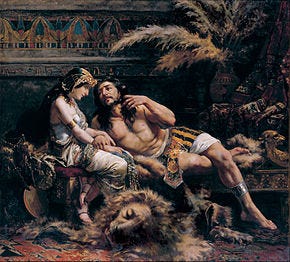
    I’m sure everyone is aware of the biblical story of Samson and Delilah. This begins in Judges chapter 13, where an angel tells the wife of Manoah that she will bear a son and that “no razor is to come on his head, for the boy shall be a nazirite to God from birth” (v5). His uncut hair is a source of great strength for him, because he is later able to kill a thousand men with the jawbone of a donkey (15.15), and to pull up the doors of a city gate and two posts with his bare hands and carry them up a hill (16.3).

    Unfortunately for him, he then falls in love with Delilah, who is instructed by the enemy Philistines to discover the source of his strength. He eventually gives away the secret that it is his uncut hair (16.17). His hair is shaved while he is asleep, and the Philistines are then able to subdue him.

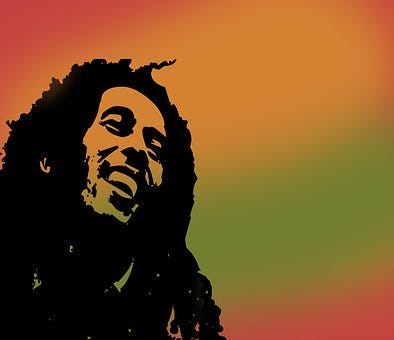
    Rastafarians wear their hair in long dreadlocks. According to an online source, one of the reasons is that this gives “the appearance of a lion’s mane, representing strength, Africa, Ethiopia, and the Lion of Judah” ³.

    I would be extremely surprised if there were any scientific evidence connecting loss of hair with lack of strength, yet we persist in believing something along these lines because of the power of hair as a symbol.

    Long hair is most obviously symbolic of rebellion, teenagers against the authority of their teachers and parents, and for rock stars it is de rigueur. The rebellious, anti-Establishment 1960s hippy musical was actually called Hair; the writers obviously thought that this was the most suitable choice to express the underlying sentiments. (The lyrics to the title song, click here, are worth checking out, if you don’t know them already, since they endorse the point I’m making — and are very funny.)

    I once heard a radio presenter describe hair as “an integral part of your identity and self-worth” ⁴.          I don’t dispute what she said; having a good head of hair offers much opportunity for individuality and styling. But does being bald really diminish your sense of identity? Authorities certainly seem to think so. When the American government imprisoned captives in Guantanamo Bay, one of the first things they did was shave their heads, clearly intended as a humiliation, an attack on their sense of identity. From a different point of view, certain Buddhist sects require a shaved head at joining, as a sign of submission, of surrendering one’s individuality.

    This way of thinking can assume grotesque levels. Robert Temple reports the following: “However, although life became better under the early Qing Dynasty than it had been during the end of the Ming Dynasty, there was another problem. That problem was that the Manchus, as foreigners, wished to enslave the Han people. All Han Chinese males were required to have their heads shaved as a sign of their status as slaves. In the early Qing Dynasty, official barbers toured the countryside shaving the heads of all the Han Chinese, and these barbers were given the power of life and death. If any Han Chinese man refused to let a barber shave his head, the barber had the legal right to execute him immediately without a trial” ⁵.

    Is it true that losing one’s hair involves an actual loss of identity? Has someone with a shaven head in reality submitted to authority? I doubt it, but if the person in question feels that this is true, then that merely goes to show how extraordinarily powerful symbols can be.

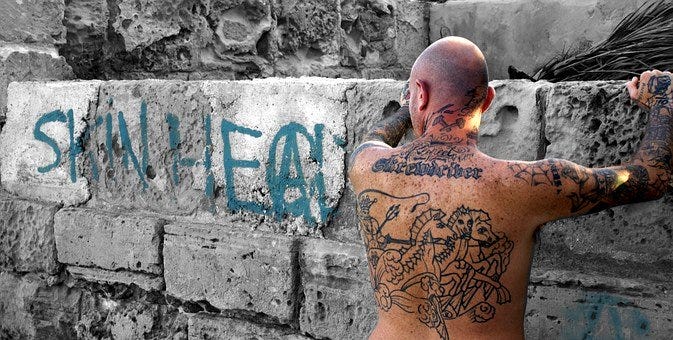
    So, are we all now convinced that having a healthy head of hair is believed to indicate genuine strength? Perversely, the opposite can also be considered true. Being bald is sometimes considered to be symbolic of power, virility, rebellion, aggression, the most obvious example being the skinheads.

    On a more humorous note, the English cricketer Chris Lewis once shaved his head, so that he would appear harder, more aggressive, when bowling during a tour of the West Indies. Ironically, he then suffered from sunstroke, and was confined to his bed for two days. This earned him the nickname ‘the prat without a hat’ ⁶. Perhaps he should have modelled himself on Samson instead.

    Even though most people don’t seem able to understand symbols, isn’t it strange the extent to which they allow them to control their lives?

=====================================================================================================

Footnotes:

1. Dispelling Wetiko, North Atlantic Books, 2013, p79

2. ibid., p80

3. http://www.religionfacts.com/rastafarianism/dreadlocks

4. Clare McDonnell, BBC Radio5live, May 9th 2018

5. from an article on his website entitled ‘The Modern World: a Joint Creation of China and the West’

6. https://www.espncricinfo.com/story/_/id/22840732/the-prat-hat

· Religion and Spirituality

Synchronicity — the Universe is NOT Indifferent

28th March 2020

    I came across the following quote from Stanley Kubrick as the epigram to a recent article at Medium.com: “The most terrifying fact about the universe is not that it is hostile but that it is indifferent, but if we can come to terms with this indifference, then our existence as a species can have genuine meaning. However vast the darkness, we must supply our own light”¹. (Richard Dawkins, however, does seem to think that the universe is somewhat hostile, because he likes to add ‘pitiless’ before ‘indifference’.)

   You frequently find statements like this in modern scientific and humanist literature, and their truth is considered by those who make them to be almost self-evident, beyond challenge. This is because an indifferent universe is the logical deduction from the belief that it is nothing but the interactions of unintelligent subatomic particles driven by unfeeling laws of nature.

    The most obvious evidence that the universe is not indifferent to us humans is the occurrence of synchronistic events. (If anyone needs an explanation of this term, please see this excellent article by Harry J. Stead.) There are many books on this subject, so many that I won’t bother to list them. However, they overflow with examples of how the universe somehow conspires to help and guide people, assist them when they are in need. There is therefore a strong suggestion of invisible intelligence at work behind the scenes, by which I mean something beyond space-time. (This is why Carl Jung, who coined the term synchronicity, described such events as acausal.) Our sceptical scientific friends will tell us, of course, that such a suggestion is nonsense, that all this is merely chance at work, that the coincidences are random and unplanned, not meaningful. They will say that such things are bound to happen occasionally, even in a pitilessly indifferent universe.

    A detailed explanation of how synchronistic events are achieved is an unfathomable mystery, at least to me, so I won’t linger on it. Briefly, however, I tend towards the philosophies of animism and panpsychism, so I believe that even what seems to be an inanimate object is in some sense alive. That still does not lead me to believe that so-called ‘inanimate’ matter, nor the scarab beetle in Carl Jung’s famous example, are aware of their role in synchronistic events. This leaves the more likely explanation that some organising power, a supernatural intelligence is responsible.

    So, if I may take the liberty of correcting Stanley Kubrick, we humans do not have to supply our own light; the animated, intelligent universe is shining very brightly without any help from us. We only need to take notice of it.

=====================================================================================

Footnote:

  1. I don’t know the original source, but this can be found at: https://www.goodreads.com/author/quotes/5737.Stanley_Kubrick

· Religion and Spirituality

How Old is the Tarot? Part 1

21st March 2020

    I imagine that many readers’ first response to that question might be ‘What does it matter?’, or even ‘who cares?’. It depends, I suppose, on how much value one assigns to this mysterious deck of cards. Along with many others, I believe that it contains great depths of wisdom. (In a recent article, I described the journey through the major arcana, click here if interested.) If the Tarot is much older than is usually believed, that would mean this wisdom has survived for perhaps thousands of years rather than hundreds. This would give it even greater weight, if it has impressed people for so long.

    The conventional viewpoint has been expressed clearly on Medium.com by Joshua Hehe¹: “The speculations about the creators of Tarot cards include the Sufis, the Cathars, the Egyptians, Kabbalists, Gypsies, and more. However, all of the actual historical evidence points to northern Italy sometime in the early part of the 1400s. Contrary to what many have claimed, there is absolutely no proof of the Tarot having originated in any other time or place”.

    Of course, this leaves open the question of who originated the Tarot in Italy, and what their sources, background and inspiration were.

    So, I’m going to do a brief series of articles on the age of the Tarot. This is intended neither as a criticism, a response, nor a refutation of what Joshua Hehe says. I am happy to agree that there is “absolutely no proof” that the Tarot cards originated earlier. My intention is merely to explore some of these “speculations”, to see whether they might have any validity and, if so, how much. The main question will be, even if the Tarot cards did not exist, were their images and the underlying philosophy established in earlier times? The later cards may merely be one manifestation of this philosophy.

    In criminal trials different types of evidence are allowed; the best is direct, that which constitutes conclusive proof, but circumstantial evidence is also allowed. If enough convincing circumstantial evidence is brought forward, then this can be considered important enough to be included when arriving at a verdict. So, is there any circumstantial evidence that the Tarot goes back earlier?

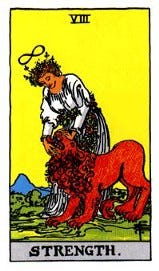
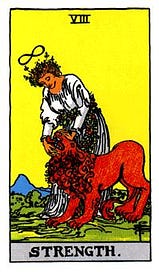
    My first observation relates to card 8 from the major arcana, Strength, which depicts a spiritual female figure apparently trying to close a lion’s mouth. This is about developing a right relationship with, learning to control, one’s passions, desires, biological drives (what Sigmund Freud called the id), symbolised by a lion. It is important that we all tame our wild side, and not allow the lion within us to take us over.

    Compare this to logia 7 of the gnostic Gospel According to Thomas: “Jesus said, ‘Blessed is the lion that the human being will devour so that the lion becomes human. And cursed is the human being that the lion devours; and the lion will become human’ ”².

    I hope I’m not reading too much into this, but ‘Jesus’ here seems to be referring to the theme of this Tarot card, saying that humans must not allow themselves to be taken over by their leonine wild nature. It is irrelevant whether or not any historical Jesus ever said these words; what is clear is that the lion as a symbol of our biological drives was current whenever this gospel was written, let’s say no later than the 2nd century. This obviously does not mean that the Tarot card existed at that time, only that its theme, and the same imagery were current.

    I’ll make further observations in later articles.

======================================================================================================

Footnotes:

1.‘The Real History of Tarot Cards’, click here.                                                                                                                                                      2. The Gnostic Scriptures, translated by Bentley Layton, Doubleday, 1987, p381

· Religion and Spirituality

The Aquarian Conspiracy Revisited

21st March 2020

    It is now nearly forty years since Marilyn Ferguson’s best-selling book The Aquarian Conspiracy1 was published. I’ve owned a copy for several years, but never got round to reading it. I’ve recently just started it, and have realised belatedly how significant it was. So, as younger readers may no longer be aware of it, I thought it would be a good idea to write an article, or perhaps a brief series, to try to bring it to the attention of a new generation, since they are the ones who will have to bring this conspiracy about.

    The meaning of the word ‘conspiracy’ has changed somewhat, especially in recent times, now that everyone associates it with the abundance of political conspiracy theories circulating. Ferguson, however, uses it in its original sense of breathing together; she is therefore talking about a positive movement of like-minded people.

    This new movement she is talking about has connections with some of the themes of my writing: New Paradigm science, Ancient Wisdom traditions, the Reunification of Science and Religion. Here are some key statements on those themes:

  • “… this conspiracy, whose roots are old and deep in human history…” (p21).

  • “the conspiracy only makes visible a light that has been present all along but unseen because we didn’t know where to look” (p21).

  • “It is a new mind – the ascendance of a startling worldview that gathers into its framework breakthrough science and insights from earliest recorded thought” (p23).

  • “it expresses deep principles of nature that are only now being described and confirmed by science” (p25).

    That is why I’m now so interested in her book.

    The word Aquarian is controversial, in that it is has astrological connotations. We are supposedly at the end of the Age of Pisces and awaiting the Age of Aquarius. And Astrology, as we all know, is described by many modern people, especially scientists, as ‘bunk’.

    ‘Aquarian’ is also in the title of another book I’ve referred to frequently in past articles, A Vision of the Aquarian Age: the Emerging Spiritual World View, by George Trevelyan2. If these two writers have got it right, we are therefore moving towards a new Aquarian age, which has in modern times the same meaning as ‘New Age’, without the ‘Aquarian’.

    The New Age movement is not very popular with Fundamentalist Christians. I own several books by one especially enraged Fundamentalist by the name of Roy Livesey, who fulminates against everything to do with the New Age, from what he perceives to be the truth of his version of Christianity3. That is perhaps Why Christianity Must Change or Die, which is another theme of my writing, and the title of a book by Bishop John Shelby Spong4. I’ll be writing about him and his views shortly.

    As a brief aside, I’ll just mention that Fundamentalist Christians like Livesey, who are opposed to astrology, should take note that fish symbolism was widely used in the early days of Christianity, which suggests that Jesus might have been the prophet announcing the Age of Pisces5.

    The most alarming thing about Ferguson’s book is that, in the early 1980s, she seemed to think that the needed transformation was imminent. Here are a few key sentences which stand out:

  • “The social activism of the 1960s and the ‘consciousness revolution’ of the early 1970s seemed to be moving towards an historic synthesis”.

  • She says that in 1976 she had written: “Something remarkable is underway. It is moving with almost dizzying speed, but it has no name and eludes description”.

  • “Perhaps the indefinable force is an idea whose time has come” (all three, p18).

  • “As its network grew, the conspiracy became truer with every passing week. Groups seemed to be organizing spontaneously all over the United States and abroad. In their announcements and internal communications, they expressed the same conviction: ‘We are in the midst of a great transformation‘ ”(p20).

    Forty years later, perhaps more people are coming around to this new way of thinking, but we cannot really say that the Aquarian Conspiracy is driving society and civilisation. We somehow need to find a way to put this new paradigm at the heart of politics. Ferguson said at her time of writing: “There are legions of conspirators. They are in corporations, universities and hospitals, on the faculties of schools, in factories and doctors’ offices, in state and federal agencies, on city councils and the White House staff… in virtually all arenas of policy-making in the United States” (p23). Perhaps American readers are currently wondering, therefore, why so little has changed, and what on earth has gone wrong in the last 40 years.

    She further says that the Aquarian Conspiracy “is a conspiracy without a political doctrine. Without a manifesto” (p23). She seems, if I understand her correctly, to be saying that this is a positive feature. Perhaps, on the other hand, that is actually the problem, the reason why nothing significant has happened since she wrote. Perhaps the Aquarian Conspiracy needs to become a political movement.

    That is why my website is called Spirituality in Politics. I have the vision, perhaps Utopian, that at some point, in the not too far distant future, civilisation will be founded on the ideas of ancient spiritual traditions, new paradigm science, and the Aquarian Conspiracy. I live in hope that there are enough like-minded people out there to join such a movement. 

    Further articles may follow, as I delve more deeply into Ferguson’s book.

=======================================================================================================

Footnotes:

1. Routledge & Kegan Paul, 1981, my copy Granada 1982

2. Coventure Ltd., 1977, my copy Gateway Books, 1994

3. for example: Understanding the New Age: New World Order, More Understanding the New Age, Understanding Deception

4. HarperSanFrancisco, 1998

5. Alan Alford says: “It is a curious fact that the current precessional era of Pisces, symbolized by the zodiac depiction of fishes, matches the era of Christianity and its almost identical symbol of the fishes. I do not believe that this is a coincidence”. (Gods of the New Millenium, chapter 16)

Also: “The fish, in the opinion of antiquarians generally, is the symbol of Jesus Christ. The fish is sculptured upon a number of Christian monuments, and more particularly upon the ancient sarchophagi. It is also upon medals, bearing the name of our Saviour and also upon engraved stones, cameos and intaglios… Baptismal fonts are more particularly ornamented with the fish. The fish is constantly exhibited placed upon a dish in the middle of the table, at the Last Supper, among the loaves, knives and cups used at the banquet”. (Quoted by Acharya S, The Christ Conspiracy, Adventures Unlimited, 1999, p79.  I believe this is taken from The Aquarian Gospel of Jesus the Christ, by Levi Dowling, p4. In her footnote, however, she seems to have omitted the surname and says merely Levi.) She goes on to say: “The fish is in fact representative of the astrological age of Pisces, symbolized by the two fishes”.

· Religion and Spirituality

A Journey Through the Tarot – Personal Reflections

16th March 2020

    This article is loosely part of a series I’m engaged in about the need for a new mythology, a worldview to unite humanity. I’ve reached the stage where I’m examining ancient myths, to see what relevance they have for us in modern times. The Tarot is not exactly a myth, but it is similar in that it conveys an ancient wisdom through symbolic images. (For a guide to the series so far, see under Mythology near the bottom of the Blog Index page.)

    I’ve been interested in the Tarot for several years, following an extraordinarily accurate reading I once had — there just happened to be a reader at a barbecue I was attending, so I took the opportunity, just to see what would happen. I was so impressed that I began to study the Tarot, and then to give my own readings. (For an account of this and other methods of divination, see this earlier article.) Having said that, I do not claim to have a deep understanding of the Tarot and all its esoteric symbolism. Nor do I claim originality in my interpretations — there is already a lot of material out there on the internet and elsewhere. This article is aimed, therefore, primarily at beginners, those who have as yet little or no acquaintance with the Tarot. Hopefully readers with a deeper acquaintance will also find some interesting points.

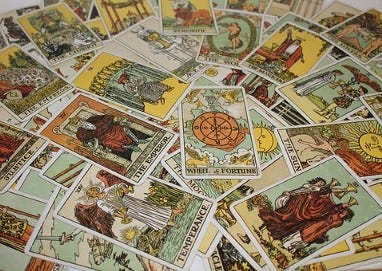
    Whether or not you believe in the Tarot as a tool for divination — what is colloquially called ‘fortune telling’ — the 22 cards of the major arcana are nevertheless a remarkable depiction of the soul’s spiritual journey into and through the material world, which I’m going to describe here. There is therefore a strong connection between the Tarot and ancient hero myths, which tell a similar story, especially that of Hercules. (I hope to write an article about that later.)

    This will up to a point be my own take on the cards, but I should say that my understanding is heavily influenced by a book called Living the Tarot: Applying Ancient Wisdom to the Challenges of Modern Living by Amber Jayanti¹. Also interesting is Jung and Tarot: An Archetypal Journey by Sallie Nichols². In what follows I’ll be referring to the Rider Waite deck, although lots of other interesting ones are available.

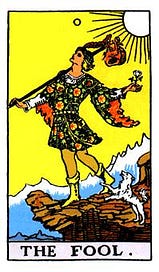
    The first card in the series is called The Fool. It shows a jester-like figure about to step, perhaps unknowingly since he is looking up skywards, over a cliff edge. This represents the soul prior to its incarnation and descent into the material world. Although it is the first card, it is numbered 0 because it represents the spiritual aspect of a human that is of the same nature as God; it therefore has connotations of infinity and nothingness, being without form. It is called The Fool because the soul is incarnating for the purpose of gaining knowledge and experience in the world; it is assumed at this stage, somewhat humorously therefore, to be ingenuous, inexperienced, thus ‘foolish’.

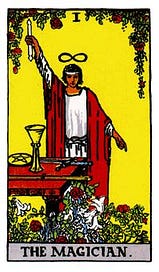
    The next card is called The Magician. This represents the incarnated soul still in the womb, or perhaps at the moment of birth. In either case the soul at this stage retains its divine wholeness — the figure stands before a table on which are placed symbols of the four elements of which all reality is composed, according to ancient belief, and above his head is the figure-of-eight symbol of infinity. These are the clues that he has not yet become a limited human being. The card therefore suggests that in theory absolutely anything is possible for this soul. He will, however, have to learn to limit himself and focus on the specific purpose of his incarnation.

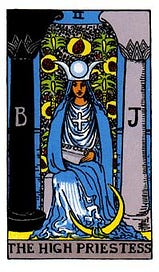
    The next card is called The High Priestess, representing the Feminine Mysteries, the irrational and interconnected psyche. For the soul’s journey this means the state of unconsciousness following birth, being immersed in the psyche with no awareness of oneself as a separate being. 

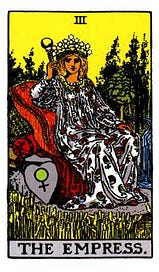
    Then follows The Empress which should be interpreted as the mother, the first being that the soul experiences as separate from itself. This card is about that relationship, the bonding stage with her caring and unconditional love.

    The next encounter is with the father (The Emperor card). He provides discipline and education, teaching the child the ways of the world, helping him or her grow in understanding.

    As the child grows older, he or she begins to think about the big questions: ‘Does God exist?’, ‘Why am I here?’, and so on. At this stage, however, there is not enough maturity to come up with one’s own answers, so one tends to accept the teachings of others. This is depicted on the The Hierophant (an ancient word for a High Priest), which shows two monk-like figures seeking guidance from this authority figure. (In some decks this card is called The Pope, the ultimate authority to whom one has to submit in the Roman Catholic tradition.)

    The next card is called The Lovers. It shows a young couple naked. We are obviously meant to think of Adam and Eve, because in the background we see a serpent entwining itself around a tree. I associate this card with the period of post-puberty adolescence, the hormone rush, the passionate, mad crushes, obsessions with pop stars, and so on. Fortunately, on the card is an angelic figure, probably representing the Higher Self, watching over affairs, making sure that the soul does not lose its way during this difficult, impulsive period.

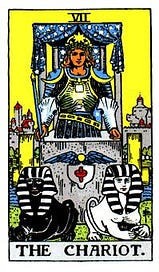
    A new section then begins, because the next card is The Chariot, which shows a young man leaving the city of his birth, having reached adulthood. He will be subjected to the world of the opposites, the complexities of the psyche, and will therefore be pulled in different directions, symbolised by the two sphinxes, one black, one white, which pull the chariot. He will have to hold firm to the reins to control these sphinxes, thus charting his course through life’s problems.

    The first adult challenge is depicted on the next card, Strength. This shows a female figure trying either to close or open a lion’s mouth. There is some debate about this, and the ambiguity is possibly deliberate; both are implied. The lion symbolises the wild side of human nature: biological drives, desires, passions, instincts. We obviously should not let these run riot, and act them all out. There is therefore a conflict in the personality, which Sigmund Freud would describe as the conflict between ego and id. As a dedicated materialist, he would be bound to see things in those terms. The Tarot, however, shows a divine feminine figure (Carl Jung would call this an aspect of the anima), controlling the biological drives (if closing the mouth), but not eradicating them, allowing them some form of expression (if opening the mouth). We have to form a right relationship with our instincts and passions; without them we would become merely robots.

    The next card is The Hermit, which I like to relate to The Hierophant. Earlier on, as a teenager, the soul relied upon external sources for spiritual guidance. Now this reclusive, introspective figure, having learned about life by passing through the Chariot and Strength phases, is ready to rely upon his own intuitions and judgements in order to formulate his philosophy of life. This is the beginning of wisdom.

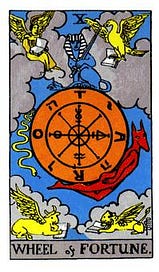
    Then follows the Wheel of Fortune, the symbolism of which is very complex. At this stage of the soul’s journey, we can interpret it simply by saying that it signifies that a new phase of life is about to begin.

    The next card Justice is the summary of everything that has happened so far. The soul has gone as far as it can go by relating purely to the material world. It has learned about life, has an integrated personality, is socially mature, and is therefore capable of making finely balanced decisions. The card shows a queen holding in her right hand a sword, which symbolises discrimination and a sharp mind, and in her left an evenly balanced pair of scales, symbolising the ability to judge wisely when difficult decisions are required.

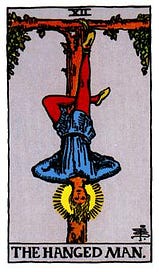
    We are now approximately halfway through this journey. Everything since The Magician has been about the soul’s relationship to the material world. In the second half there is a complete reversal; from now on everything will be about the soul’s relationship to spirit, thus the realms above. This is depicted in dramatic form on the next card The Hanged Man, perhaps the best known card of the Tarot deck. Human beings usually have their feet firmly on the ground; they are sustained, supported, even nourished by the earth. On this card, however, the feet are turned upwards, showing that from now on the soul will be sustained and nourished from above, by the heavens. Most people would feel uncomfortable if this were to happen to them, might even consider it a form of torture. The figure depicted, however, looks completely serene, and has a halo around his head, thus suggesting his willingness to engage with the spiritual realms.

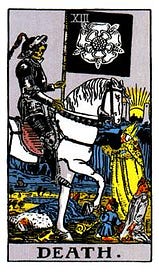
    Then comes Death, which has to be interpreted as psychological or spiritual death and rebirth; the grim reaper shown is, after all, riding on a horse towards a new sunrise. The card therefore represents a completely new personality, aligned with the world of spirit, the old one having been shattered.

    The next card Temperance confirms this, since it shows an angelic alchemist mixing, blending and reorganising the waters of the personality. The rising sun from the Death card reappears here.

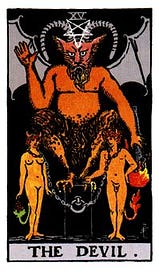
    Then comes The Devil, which represents everything that humans are chained to: habits, compulsions, addictions. All these have to be overcome, let go of. This card may perhaps also represent what Carl Jung called the shadow, the repressed darker aspects of our personality, which have to be dealt with.

    The next card is The Tower, which was perhaps inspired by the biblical story of the Tower of Babel, in which humans say: “Let us build ourselves a city, and a tower with its top in the heavens, and let us make a name for ourselves”. The Lord’s response is: “This is only the beginning of what they will do; nothing that they propose to do will now be impossible for them” (Genesis 11.4–6). The meaning is clear; humans have got ideas above their station, have become too big for their boots. Heaven reacts accordingly, and the Lord decides that the humans need to be taken down a peg or two. He therefore confuses their language, and scatters them across the Earth, so that they are forced to stop building the city and the tower.

    The Tower card therefore depicts a conflict between human will (that of the ego) and that of the divine (the Higher Self). The latter is demanding complete surrender from the ego, and the card shows the consequences of resisting this. The heavens will take their revenge; lightning destroys the tower that the hubristic humans have built. This may have been what Jesus was referring to when he said that the sin against the Holy Spirit will not be forgiven. This card also reminds me of the words attributed to Jesus in the Garden of Gethsemane prior to his arrest and execution: “Father, if it is possible, let this cup pass from me. But thy will not my will be done” (Matthew 26.39). Jesus here is learning the lesson of The Tower card.

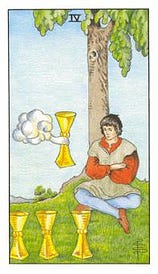
    The same conflict is also depicted, in less dramatic fashion, on another Tarot card, the Four of Cups, which shows a young man folding his arms, stubbornly refusing to accept what a ghostly (spiritual) hand is offering him.

    It would seem that the Higher Self wins this battle, because on the next card The Star normal service is resumed.

    Firstly, the card shows that the soul, following the encounter depicted on The Tower, has surrendered to the will of the Higher Self; from now on it is going to be guided by the stars, the will of heaven.

    Secondly, there is an obvious correspondence between this card and the earlier Temperance; both show a female figure mixing and rearranging waters following a dramatic transformation of consciousness. The star thus represents the emergence of one’s deepest sense of Self following this surrender, since a star is a well known symbol of a great personality. The Jungian writer Edward Edinger describes the image of the star as “a transpersonal centre of identity”, further saying: “The notion that one’s identity has an a priori existence is expressed in the ancient idea that each person has his own individual star, a kind of celestial counterpart, representing his cosmic dimension and destiny”³. We can therefore assume that the soul we are following has reached this stage of its journey; it is reconnecting with the purpose of its incarnation. (Also, as Edinger goes on to say, the poet Wordsworth uses the same image in these lines: “The soul that rises with us, our life’s star, hath had elsewhere its setting, and cometh from afar”⁴.)

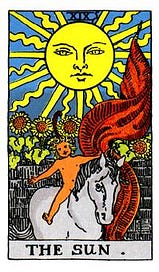
    The next two cards are The Moon and The Sun, representing the Divine Feminine and Masculine aspects of the soul’s spiritual personality.

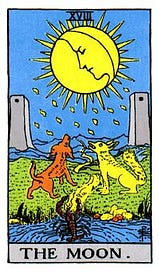
    The Moon is a strange card, since the image more closely resembles a sun with a kind of crescent moon superimposed upon it⁵, which may be a reference to the impending marriage of the male and female aspects of the personality. As we have seen, the cards of the major arcana so far depict the evolution of consciousness of an individual soul. The Moon card seems also to be a summary of the planet’s evolutionary journey, thus the whole story of the evolution of consciousness so far. It shows a long, long path disappearing into the distance, which has emerged from a pond, a symbol of the unconscious psyche. There are plants and grass, a vegetation level of existence. Out of the pond is crawling a crayfish, a pre-mammalian creature, thus a very primitive level of consciousness. Slightly further along the path, we see two mammals, a wild wolf alongside a dog, the domesticated creature into which it has evolved. Dogs are known as man’s best friend, thus close to humans, perhaps as close to being human as it is possible to be for an animal.

    The moon/sun is in the distance, however, as if it were the ultimate goal of this journey. Before that becomes possible, however, there is an initiatory threshold which has to be crossed, symbolised by two towers which the path passes between. (It’s worth noting that we saw something similar on the High Priestess card. She sits at the entrance of a temple, on both sides of which are the two pillars.) A pair of towers or pillars is a well known esoteric symbol. From an online article I’ve extracted these relevant phrases:

  • “Since the dawn of civilization, the entrance of sacred and mysterious places have been guarded by two pillars”.
  • “ Twin pillars are archetypal symbols representing an important gateway or passage towards the unknown”.
  • “They mark the passage towards the unknown and the otherworldly”.
  • leaving “the material world to reach a higher realm of enlightenment”.

    Since the pond, vegetation, crayfish, wolf and dog are placed before the threshold of the two towers, The Moon card suggests that the whole evolutionary process has been leading up to this point, but that this is a threshold which animal life cannot cross; it is reserved for humans. Our journeying soul now has to be initiated, in order to cross this threshold.

    The land beyond the two towers seems remarkably barren by comparison, uncultivated territory, perhaps suggesting that humans have only rarely been there. In the distance the path disappears into a mountainous area, climbing being an obvious symbol of spiritual advancement towards the heavens.

    On The Sun we see a joyous young boy, naked, riding a pony. His unashamed nakedness leads me to think that he has been freed from the embarrassment associated with nudity in the Garden of Eden story (Adam and Eve make more than one appearance in the Tarot deck). I’m also reminded of more lines from the Wordsworth poem just quoted: “Shades of the prison-house begin to close upon the growing Boy”. Some of the divinatory meanings for The Sun are: the awakening of the child within, recapturing lost spontaneity, the return to an authentic and open-hearted state of being, having the openness of a child with the wisdom of your adult years behind you. This sounds very much like the goal of Taoism. I suggest that the soul we have been following has now freed himself from Wordsworth’s prison-house, and recovered the “clouds of glory” with which he entered the world. This card also reminds me of the words attributed to Jesus: “unless you become as little children, you will never enter the Kingdom of Heaven”⁶.

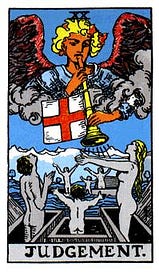
    The Judgement card seems, for reasons not clear to me, to be strongly influenced by Christian theology. The message is nevertheless clear. A trumpeting angel is calling upon all souls to wake up to their true nature. At the same time, the soul whose journey we have been following is being judged, to see whether it is ready to rediscover its original spiritual nature, the fact that it was made in the image of God. As the Hindus say: “Tat Twam Asi”, translated roughly as “you are the same as the universal essence”⁷.

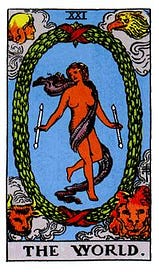
    The soul seems to pass the test, because the final card is The World, suggesting the successful completion of the spiritual journey, returning to one’s divine state, cosmic consciousness, the sacred marriage of masculine and feminine, self-realisation.

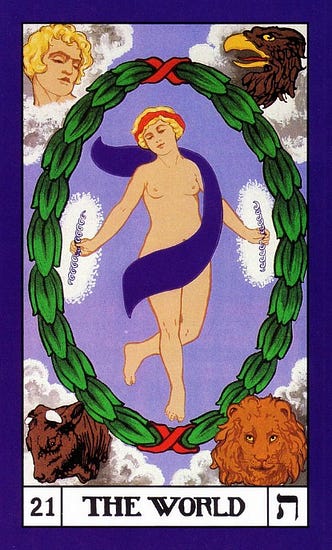
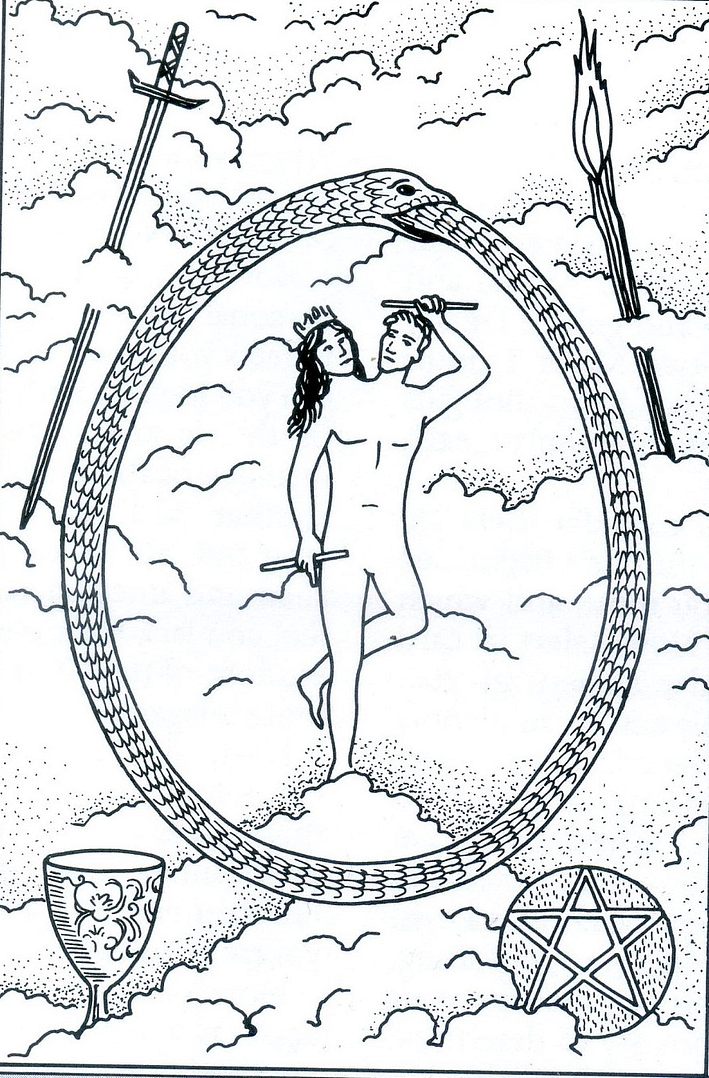
    In the Rider Waite deck (and also Builders of the Adytum, see below at the end of the article), we see an apparently female figure enclosed within a wreath, which is surrounded by the four figures of a man, an eagle, a bull, and a lion. On those three points I have always thought that a hermaphroditic figure, the ancient figure of the uroboros (a snake eating its own tail symbolising eternity), and a depiction of the four elements out of which the ancients believed everything in the universe was made, would be more appropriate. To my pleasant surprise, therefore, I’ve recently come across a deck which incorporates exactly those points. In Juliet Sharman-Burke’s Mythic Tarot the central figure⁸ is a body with two heads, one female, one male, enclosed within a uroboros, outside of which the four figures are replaced by symbols of the four elements, namely the four suits of the Tarot’s minor arcana — swords (air), wands (fire), cups (water), and pentacles (earth)⁸.

    The text from the accompanying workbook⁹ says: “The figure is of a hermaphrodite, symbolising the unity and perfection to be gained when all the lessons have been learned and are balanced. The final stage of the journey results in the unification of all opposites: masculine and feminine, dark and light, positive and negative. The four symbols in each corner stand for the four elements from which the world is supposedly composed, reflected in the four suits of the Minor Arcana, the Cup, the Wand, the Sword and the Pentacle. The four elements have fused to form a perfect fifth, symbolised by the central figure: man as a fully integrated being. The figure is protected by the golden snake devouring its own tail, the symbol of eternity”.

    This journey is presumably available to all humans, at least when they are ready for it. Isn’t it a great shame that the Tarot is not more widely known, and that it does not feature prominently in our education system?

=====================================================================================================

    I’ve written a song about this journey through the major arcana called The Way. You can find the lyrics here on my (musical) website, and hear me play it on Youtube, click here.

                                                                      from the Builders of the Adytum deck

============================================================================================

Footnotes:

1. Wordsworth, 2000. She is a member of an esoteric group called Builders of the Adytum, an offshoot of the Golden Dawn, founded by Paul Foster Case.

2. Samuel Weiser, Inc., 1980

3. Ego and Archetype, Shambhala, 1992, p159

4. Ode on Intimations of Immortality from Recollections of Early Childhood

5. The sky is of the same light blue colour as on The Sun card which follows, so no attempt is being made to suggest nighttime.

6. There are many variations in translation in the different editions, but the general idea can be found in Matthew 19:13–15, Mark 10:13–16, and Luke 18:15–17.

7. Chandogya Upanishad, repeated several times in chapter 6. One translation of the original text says: “This finest essence — the whole universe has it as its Self: That is the Real: That is the Self: That you are” (Hindu Scriptures, edited by Dominic Goodall, Phoenix, 1996, p140).

8. I’ve scanned a copy. Apologies for the large size.

9. Eddison Sadd, 2001

· Religion and Spirituality

Do Souls Exist?

24th February 2020

    This is a response to a recent article on Medium.com by Allan Milne Lees entitled ‘Can Souls Exist?’¹

    His question is slightly strange, since souls obviously can or might exist; the important question is whether or not they do exist. Lees concludes that they can’t exist, however, because he operates from the assumption of the truth of the philosophy of scientific materialism.

    His opening four paragraphs focus upon the brain, which he assumes to be the command centre of the person. His fourth paragraph (and its continuation) is the most relevant here: “And part of the job of the brain is to maintain a sense of self, so that when we wake each morning we don’t have to reconstruct a sense of who and what we are before we get on with the daily tasks of survival. It’s this last job that gives rise to our notion of individual identity… The constant factor in all of this is our sense of self… (In the past humans) easily accepted simple notions about what we were, based on this internal feeling of self-consistency. This sense of self is, however, illusory. We are actually a collection of hardwired impulses and behaviors… This feeling of being ‘us’ is, however, an illusion manufactured inside our brains”.

    These are all typical statements from the Bible of scientific materialism, which is a philosophical position that many consider to be an old paradigm which is gradually being replaced by more sophisticated ideas, even by scientists. See for example The Spiritual Brain: A Neuroscientist’s Case for the Existence of the Soul², and Out of Our Heads: Why You Are Not Your Brain, and Other Lessons from the Biology of Consciousness³. Lees’s definitive statements about the brain and our sense of self are merely assumptions for which there is no conclusive evidence. Other understandings of the brain are possible, for example, that it is an organ which limits consciousness, a theory known as the Transmission Model, following William James. Neuroscientists presumably assume that the self is an illusion, because they cannot see it when they do brain scans.

    Lees does go into a lot of interesting detail in his argument, but here I’ll focus on the central point. He argues that a soul cannot exist by asking the question, “How could a ‘soul’ interact with the body?” He says: “We now know enough about neuroscience to account for every aspect of our functioning”. I wish I could share his confidence. Another writer on Medium has recently stated: “You would be hard-pressed to find a neuroscientist who knows how the brain works”, and “mysteries and adventures abound in the neurosciences”⁴.

    We clearly do not know from neuroscience how to account for every aspect of our functioning, because we don’t know how the brain manages to create the ‘illusion’ of the self.

    Lees surely does not believe in the reality of out-of-body experiences, or the weird goings-on around a near-death experience, and must consider them illusions. Again, we do not know how the brain manages to create such elaborate ‘illusions’. If these phenomena are actually real, however, then they may well require a “magical disembodied entity” (his phrase), since neuroscientists cannot explain how the brain creates them.

    Nor can materialist neuroscience explain how the brain achieves ESP abilities: telepathy, remote viewing, clairvoyance. All it can do is deny their reality, despite compelling evidence. (See, for example, the writings of Dean Radin.)

    Lees then says: “Nor is there any mechanism by means of which such a disembodied entity could interact with the human body”. Really? What he means is that there is no mechanism that modern neuroscience is prepared to contemplate. There is indeed a possible mechanism, for a strong candidate would be the pineal gland, otherwise known as the third eye.

    It may be a bitter pill for Western science to swallow, but at some point it is going to have to realise that, despite its supreme self-confidence in its ability to discover truth, and its rejection of pre-Enlightenment thinking, it is very limited, because it deals only with what is manifest and visible. What is called new paradigm or cutting-edge science is only gradually beginning to catch up with the wisdom of ancient peoples, who often explored what is hidden and invisible, what we might call occult science.

    Let’s have a look at the pineal gland from such perspectives. Philosopher René Descartes is the Westerner best known for associating it with the soul. In his book Man the Grand Symbol of the Mysteries: Essays in Occult Anatomy ⁵, Manly P. Hall observes that “It was Descartes who saw the pineal gland as the abode of the soul or the sidereal spirit in man. He reasoned that although the anima was joined to every organ of the body, there must be one special part through which the divine portion exercised its functions more directly than through the rest. After concluding that neither the heart nor the brain could be as a whole that special locality, he decided through a process of elimination that it must be that little gland which, though bound to the brain, yet had an action or motion independent of it”.

    Biologist Rupert Sheldrake says: “Mechanistic science… expelled all souls from nature. The material world became literally inanimate, a soulless machine… No one could explain how minds related to the machinery of human bodies, but René Descartes speculated that they interacted in the pineal gland…”⁶

    Descartes may or may not have been correct, but his thinking at least allows the pineal gland to be a candidate for the connection between soul and body. What can be said, with a reasonable degree of certainty, is that the pineal gland, if not this connection, at least allows access to a different level of reality since it is widely believed to allow ESP abilities. Thus, in her book Where Science and Magic Meet⁷, parapsychologist Serena Roney-Dougal devotes a whole chapter to the pineal gland, which she calls ‘Third Eye and Psychic Chakra’. Here she quotes Swami Satyananda Saraswati: “Yogis, who are scientists of the subtle mind, have always spoken of telepathy as a ‘siddhi’, a psychic power for thought communication and clairaudience, etc. The medium of such siddhis is ajna chakra, and its physical terminus is the pineal gland, which is connected to the brain. It has been stated by great yogis… that the pineal gland is the receptor and sender of the subtle vibrations which carry thoughts and psychic phenomena throughout the cosmos”.

    Michael Talbot observes: “The pineal body is thought by many to be a vestigial sensory organ and is partly composed of light-sensitive tissue similar to that found in the retina of the eye. This, (Keith) Floyd asserts, seems ‘to lend support to the speculation that it might serve as the “grid” of patterned ambiguity on which perceptions are constructed and memories are reconstructed’. How appropriate, considering that the pea-sized organ has long been regarded in the East as the ‘third eye’ or mystical doorway to spiritual awareness”⁸.

    If that is the case, then it is reasonable to conclude that the pineal gland might well be the mechanism by which the disembodied entity of the soul interacts with the human body.

    Lees concludes: “So people will go on clinging to the idea of a ‘soul’ just as many children cling on to their belief in the Tooth Fairy long after their more astute peers have worked out that it’s really mommy and daddy who put the coin under their pillow while they’re asleep. It’s a harmless enough delusion for the most part and we shouldn’t begrudge people their comforts”. A more interesting question would be why so many people find comfort in the delusion of scientific materialism. 

======================================================================================================

Footnotes:

1. https://medium.com/the-philosophers-stone/can-souls-exist-5f76364bca0b

2. by Mario Beauregard and Denyse O’Leary, HarperOne, 2007

3. by Alva Noë, Hill and Wang, 2009
4. Russell Anderson, https://towardsdatascience.com/i-dont-believe-in-electrons-8f1b59adc1ec

5. Martino Publishing, 2009, p211

6. The Science Delusion, Coronet, 2012, p21

7. Element Books, 1991, my copy Green Magic, 2010. The quote is on p93.

8. Mysticism and the New Physics, Routledge & Kegan Paul, 1981, p56

· Religion and Spirituality

The Four Elements — the Source of All That Is — Update

21st February 2020

    I recently wrote an article discussing the view of ancient people that everything that exists is composed of four (equally important) elements — earth, air, fire, and water. In modern times this point of view is dismissed as nonsensical.  I argued, however, that when correctly understood it has something to be said for it.

    Since then I have been reading a book by the American esotericist Manly Hall called The Secret Teachings of All Ages1. Early on he summarises and compares the views of several ancient Greek philosophers. He says that:

  • “Water was conceived by Thales to be the primal principle or element, upon which the earth floated like a ship…”
  • “Anaximander, differing from his master Thales, declared measureless and indefinable infinity to be the principle from which all things were generated”.
  • “Anaximenes asserted air to be the first element of the universe; that souls and even the Deity itself were composed of it”.
  • “Archelaus declared the principle of all things to be twofold; mind (which was incorporeal) and air (which was corporeal), the rarefaction and condensation of the latter resulting in fire and water respectively”.
  • “Heraclitus… asserted fire to be the first element and also the state into which the world would ultimately be reabsorbed. The soul of the world he regarded as an exhalation from its human parts, and he declared the ebb and flow of the sea to be caused by the sun”. (all quotes p15–16)

    One could easily be forgiven for thinking that these ancient Greeks contradicted each other, were therefore hopelessly confused and, of course, that they believed ridiculous things. It struck me, however, that these points of view are not necessarily contradictory from a spiritual perspective; a case can be made that they are compatible. In order to do this, one has to assume that in these statements words like water, fire, air, and earth were not intended in the same sense as in the opening sentence above. Let’s look at them one by one.

    The statement by Thales can be compared to a verse in Genesis (1.9): “And God said, ‘Let the waters under the sky be gathered together into one place, and let the dry land appear’. And it was so”. The suggestion is that the material universe emerges out of a more fluid, less dense state, and therefore metaphorically floats upon it. This is the view of quantum physicists (who sometimes refer to the quantum sea, and it’s interesting, since we are talking about waters, that their term is quantum waves). It is also the view of esoteric and secret societies down the ages, according to Jonathan Black in The Secret History of the World².

    Despite what Manly Hall says, Anaximander’s viewpoint does not necessarily contradict that of Thales. His “measureless and indefinable infinity” clearly refers to the ultimate impersonal source of all things, beyond the four elements and therefore not one of them, and in the hierarchy of levels way above what Thales calls water — the immediate more fluid level above the material world. (In spiritual traditions words like astral, and etheric are used.)

    If souls and the Deity are considered to be composed of air, as Anaximenes says, then in this context the word is obviously intended to mean something incredibly rarified, some kind of primal cloud prior to individual, separate entities, rather than one of the four elemental principles out of which the universe is composed. This seems to be also the view of Archelaus, who says that fire and water are lower in the hierarchy than air, which must therefore be understood differently than as one of the four elements, and beyond them.

    Heraclitus’s statement shows that he is also of the view that fire and water are separate levels of reality, and does not use the terms as two of the four elements. It can also be compared to Genesis 1 (v3) where God’s first command is that there should be light, which can therefore be considered the basic building-block of the lower levels. (According to physicists Fred Alan Wolf and Bob Toben ” ‘Matter’ may be nothing but gravitationally trapped light [energy]”3.)

    We should note that light here should not be understood as the light that comes from the heavenly bodies, enabling us to see things — the conventional meaning. This was called lumen by early Christian writers, and was contrasted with lux, “the primary stuff God used to make the cosmos, close to a cosmic creative force, almost a manifestation of God himself”⁴.

    Both fire and light are bright and shining; perhaps the same meaning was intended by Heraclitus. Modern physicists consider matter to be “patterns of organic energy”5,  which can perhaps be considered fire-like. It is reasonable to assume that Heraclitus associates fire with the sun, and that by ‘sea’ he means the same as what Thales calls water. In his view the behaviour of the waters (the psyche, the astral level) is caused by the higher level, the sun (which can be considered a symbol for fire or energy).

    To conclude, if you think my arguments have not been especially convincing, it’s worth noting that at least some physicists agree, because in these statements physicists Wolf and Toben seem to express the non-contradictory position that I’m suggesting:

  • “The chair is not ‘solid’. It is a fantastic interplay of vibrating, spinning rings of light (the basic building block of everything) in the turbulent sea (waters) of space”.
  • “The incomprehensible unaware oneness beyond space-time (Anaximander’s measureless and indefinable infinity) becomes aware of itself, creating light. (God said ‘Let there be light’.) Light chases itself in gravitational collapse!”. (p46 and p47, my insertions.)

    It’s an interesting question, how did these ancient Greek philosophers have such amazing insight into the nature of reality?

========================================================================================================

Footnotes:

1. originally 1928, my copy Tarcher/Penguin, 2003

2. Quercus, 2008

3. Space-Time and Beyond, Bantam, 1983, p46

4. Science Stories, BBC Radio 4 August 22nd 2017, a programme about Bishop Robert Grosseteste

5. Gary Zukav, The Dancing Wu Li Masters, Fontana/Collins, 1980, p31

· Religion and Spirituality

  • Newer Posts
  • 1
  • …
  • 4
  • 5
  • 6
  • 7
  • 8
  • 9
  • Older Posts

Recent Posts

  • Quantum Physics and No Spirituality — Carlo Rovelli and Helgoland
  • Quantum Physics and Spirituality — Danah Zohar and a Quantum Worldview
  • Quantum Physics and Spirituality — Danah Zohar and a New Society, part 8
  • Quantum Physics and Spirituality — Danah Zohar and a New Society, part 7, Quantum Relationships
  • Quantum Physics and Spirituality — Danah Zohar and a New Society, part 6

Copyright © 2026 · Simply Pro Theme by Bloom Blog Shop.