Spirituality In Politics

  • Home
  • Intro
  • Articles Index
    • Introductory
      • 1. Metaphysics in a Spiritual Society
      • 2. The Spirit of Guidance
      • 3. Divination
      • 4. Raynor C. Johnson: The Imprisoned Splendour
    • Articles 2: Headline Policies for a Spiritual Society
      • Education
        • The Importance of Fairy Tales
        • The Importance of Fairy Tales, Part 2 – Fairy Tales and Feminists
        • Fairy Tales and Feminism – the Story of Psyche
        • Fairy Tales and Feminism — the Story of Psyche, Interpretation
        • Save Our Fairy Tales — Concluding Remarks
    • ARTICLES 3: MORE DETAILED IDEAS
      • Politics from a Taoist Perspective – Arguing for the Centre
      • Politics from the Centre — Is that the only way forward?
      • Changing the World – Spirituality or Socialism?
      • The Superorganism – a Challenge to Materialist Science
      • Is the Earth a Superorganism?
      • Humanity as Part of the Superorganism
    • Articles 4 The Role of the Citizen
      • The Role of the Citizen in a Spiritual Society
      • Reflections on Eastern and Western Spirituality
    • The Superorganism Question and the European Union
    • A Vision for a Spiritual United Kingdom Outside the European Union
    • Consciousness
      • Is the Self an Illusion – Series Introduction
        • Is the Self an Illusion? – Neuroscience, Gurdjieff and Buddhism
        • Is the Self an Illusion? – The Opposing Viewpoint
        • Is the Self an Illusion? — Yes and No
        • Is the Self an Illusion? — Summary and Conclusions
      • The Hidden, Deeper Self - Introduction
        • The Hidden, Deeper Self - Freudian Slips
        • The Hidden, Deeper Self - Dreams
        • The Hidden, Deeper Self – Synchronicity
        • The Hidden, Deeper Self - Automatic Writing
        • The Hidden, Deeper Self – Divination
    • Why Christianity Must Change or Die – Introduction
      • Christianity Must Change or Die — Gnosticism and Carl Jung
      • Significant Moments in Church History – Introduction
        • Number 1, The Council of Nicaea, 325AD
        • Number 2 – The Anathema Against Origen, 553 A.D.
          • Reincarnation and Christianity
    • Was Jesus Divine? – Introduction
      • Was Jesus Divine, the Son of God? – 1. The Adoptionist Problem
      • 2. The Jewish Messiah
      • 3. The Eschatological Prophet
      • 4. Shakespeare’s Heretical Play
      • 5. The Resurrection of Jesus – part 1
      • Was Jesus Divine, the Son of God? - Summary and Conclusions so far
      • 6. Was Jesus Married?
      • 7. Was Jesus Married? — part 2
      • 8. Was Jesus Married? — part 3
  • Blog Introduction
    • Blog Index
    • Religion and Spirituality
    • Politics
    • Science
    • Mythology
    • Miscellaneous
  • Contact

A Return to Animism? And Listening to Plants

16th March 2020

    The purpose of this article is partly to give some retrospective publicity to those participating in an event that I attended last Friday (March 13th, 2020). Before I move on to that, here is the relevant preamble.

    Spiritually oriented people believe that the fundamental nature of the universe is consciousness rather than matter, that everything in existence is a manifestation of a supreme (divine) consciousness. Since consciousness implies life, the logical conclusion is that, no matter how inorganic and lifeless some objects may seem, for example rocks, they must nevertheless have some form of consciousness, no matter how basic. Someone who argues this persuasively on Medium.com is White Feather (see his article, I Like Rocks: Have you ever imagined being one?). Also, the Transpersonal Psychologist Stanislav Grof has spent his life doing altered-states therapy, using LSD at the start of his career, then intensive breathing techniques when LSD was banned. He reports that people can identify with trees, and even stones, when in these altered states of consciousness.

    If everything in the universe is alive, this suggests a worldview called animism, which was a common, perhaps universal, belief of ancient peoples. It has unsurprisingly been rejected out of hand by modern science. Perhaps the ancients knew something we don’t, and it is time to return to animism.

    The first sign in modern times that things were changing was James Lovelock’s Gaia hypothesis, that planet Earth is a self-regulating ‘living’ superorganism. In the 1970s this shocked the scientific community, and attracted much criticism and derision from conventional scientists.

    More recently there has been a book called Towards an Animistic Science of the Earth by Stephan Harding, which is available as a free Ebook (click here). I am grateful to Jack Preston King on Medium.com for making me aware of this in an article entitled ‘God Killed the Great Mother. Science is Dancing on Her Grave. Let’s Bring Her Back to Life and Save the World’, and subtitled ‘What the World Needs Now — Scientific Animism’. He opens with a quote from Harding: “If we are to have any chance of surviving the looming catastrophe that science and technology have inadvertently helped to create we will need more wisdom, not more analytical capacity… We now urgently need to develop a new approach in science that integrates analysis with wisdom, fact with value, and nature with culture… by replacing our demonstrably unwise (and until recently, unconscious) assumption that the world is an inert machine with the arguably wiser and more accurate metaphor that the world is a vast animate (and hence ‘sentient’) being”.

    I have always been fascinated by Jeremy Narby’s book The Cosmic Serpent¹, especially the opening chapters. The basic claim is that the psychedelic substance ayahuasca allows communication with plants: “You can see images and learn things”, says Ruperto Gomez, someone he met during his research. Narby later says that people in the Amazonian forest “insisted that their extensive botanical knowledge came from plant-induced hallucinations” (p10).

    It is worth exploring that last point at some length. Narby says that “the botanical knowledge of indigenous Amazonians has long astonished scientists. The chemical composition of ayahuasca is a case in point. Amazonian shamans have been preparing ayahuasca for millennia. The brew is a necessary combination of two plants, which must be boiled together for hours. The first contains a hallucinogenic substance, dimethyltryptamine, which also seems to be secreted by the human brain; but this hallucinogen has no effect when swallowed, because a stomach enzyme called monoamine oxidase blocks it. The second plant, however, contains several substances that inactivate this precise stomach enzyme, allowing the hallucinogen to reach the brain. The sophistication of the recipe has prompted Richard Evans Schultes, the most renowned ethnobotanist of the twentieth century to comment: ‘One wonders how peoples in primitive societies, with no knowledge of chemistry or physiology, ever hit upon a solution to the activation of an alkaloid by a monoamine oxidase inhibitor. Pure experimentation? Perhaps not. The examples are too numerous and may become even more numerous with future research’.

    “So here are people without electron microscopes who choose, among some 80,000 Amazonian plant species, the leaves of a bush containing a hallucinogenic brain hormone, which they combine with a vine containing substances that inactivate an enzyme of the digestive tract, which would otherwise block the hallucinogenic effect. And they do this to modify their consciousness.

    “It is as if they knew about the molecular properties of plants and the art of combining them, and when one asks them how they know these things, they say their knowledge comes directly from hallucinogenic plants” (p10-11).
    What does that mean exactly? How does this knowledge come? Narby goes on to mention Luis Eduardo Luna, author of a study of the shamanism of mestizo ayahuasqueros, Vegetalismo: Shamanism among the mestizo population of the Peruvian Amazon , who “say that ayahuasca is a doctor, It possesses a strong spirit and it is considered an intelligent being with which it is possible to establish rapport, and from which it is possible to acquire knowledge and power…” (Narby, p18).

    Narby has long discussions with a local expert Carlos Perez Shuma who says: “When an ayahuasquero drinks his plant brew, the spirits present themselves to him and explain everything” (p19). This is intriguing. What does he mean by ‘spirits’? Are we talking about quasi-human disembodied spirits giving advice? Or is it rather the spirits of the plants themselves? The suggestion is that it is the latter for, according to Narby, Shuma goes on to mention “invisible beings called maninkari, who are found in animals, plants, mountains, streams, lakes, and certain crystals, and who are sources of knowledge”. He quotes Shuma: ‘The maninkari taught us how to spin and weave cotton, and how to make clothes” (p25).

    Western scientists must be getting very agitated at this point. What exactly are we talking about here? Fairies? Nymphs? Naiads? Dryads? Undines?

    Moving on now to the event I mentioned at the beginning, it took place at Treadwell’s bookshop, London. They stock books about esotericism, the occult, magic, paganism, and so on. They also host events, and I’m on their mailing list. A few weeks ago I received notification of an event called ‘Food Forest of Souls’, which was going to be a conversation between a certain Gordon White and Dr. Jack Hunter. I had never heard of them, but was intrigued by the advance publicity.

    Gordon White was described as “a practising chaos magician, and the host of Rune Soup, a popular podcast on magic, culture and the paranormal. He is the author of Star.Ships: A Prehistory of the Spirits, The Chaos Protocols: Magical Techniques for Navigating the New Economic Reality, and Pieces of Eight: Chaos Magic Essays and Enchantments”.

    Jack Hunter was described as: “Visiting Lecturer in the Department of Theology and Religious Studies at the University of Chester, a tutor on the MA in Cultural Astronomy and Astrology at the University of Wales Trinity Saint David, and an Access to Higher Education lecturer in the Humanities and Social Sciences at Newtown College. He is the editor of Damned Facts: Fortean Essays on Religion, Folklore and the Paranormal and Greening the Paranormal: Exploring the Ecology of Extraordinary Experience”.

    The publicity further said: “The return of animism as a worldview has strong advocates in Jack Hunter and Gordon White, and it is now on a shortlist of acceptable metaphysical models. Join these two as they undertake a ‘Rune Soup’ style conversation on the Treadwells sofa, to explore what ecology can learn from magic, what magic can learn from ecology and what they both can teach mainstream science. They will be taking in topics from UFOs to ayahuasca to plant-human relationships”.

    This all sounded really weird, and obviously relevant to the issues Narby’s book was raising, so I immediately signed up, hoping to gain more insight. Unfortunately, the day before the talk I received an email saying that Jack Hunter was no longer able to attend, and would be replaced by Jay Springett, “a theorist and strategist for hybrid environments. He’s a Solarpunk whose concerns lie in the area where humans intersect with technology and the environment. A founding member of the decentralised creative exchange Guild.is, he is also a fellow of the Royal Society of Arts and an associate of the Institute of Atemporal Studies. Jay is currently writing his first public book, Land as Platform”.

    I was offered the possibility of a refund and, from the biographies, I probably would have preferred Jack Hunter, but decided to go ahead anyway.

    I won’t go into details about the whole conversation, save to say that the two speakers were passionate ecologists — you can easily imagine their conversation from the publicity mentioned above. This was new territory for me, and I was introduced to words I’d never heard before: permaculture, steampunk, solarpunk.
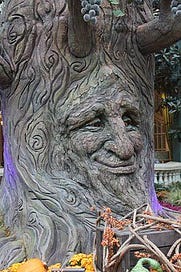
    The topic which I was hoping to learn about most was this question of human communication with plants, and the spirit world in general. I knew from the books of Peter Wohlleben that trees and plants seem to communicate with each other. It was new to me to hear, even if we don’t understand how, that insects and plants also communicate with each other; at least, this is something Gordon White firmly believes. He pointed out that humans are apparently unique, in that we are the only species which uses language to communicate. All other creatures seem to use non-verbal, we assume, methods. He said that he communicates with plants in order to assist him in his ecological endeavours.

    The words ‘magic’ and ‘spirit world’ cropped up frequently. I began to wonder exactly what was meant by this. I was having fantasies of latter-day John Dee figures, invoking spirits through magical spells. I asked a question along those lines at the end of the session, and Gordon replied that this was a rather old-fashioned way of looking at it, and that it was more a question of communing with spirits. I engaged him in further conversation during the drinks which followed. I asked him again about the nature of his communication with plants. He told me that it was indeed non-verbal, more in the nature of imagery, and intuitions, although very real.

    I had a second question. This is the background to it. I’m very interested in the question of superorganisms, for example, how a termite colony seems to act as one, even though it may consist of thousands of individual termites. I was once fortunate to ask the ‘heretical’ biologist Rupert Sheldrake his opinion about this in a conversation following a talk he gave. His response was that he believed it was “a group mind”.

    As I had never previously had the opportunity to speak directly to anyone who claimed to communicate with plants, I was keen to ask Gordon whether he thought he was communicating with individual plants, which would suggest that they had some awareness of their identity, or whether there was some hidden supervising intelligence, a group mind which was coordinating things behind the scenes. I was thinking along these lines: an individual liver cell probably doesn’t know that it is part of a liver, yet performs its function perfectly within that organ; a liver probably doesn’t know that it is part of a human being, yet performs its function perfectly nevertheless. The brain seems to be the organising command centre of a human, but does the brain know what it is doing? Where exactly does the organising intelligence lie?

    By analogy, if we accept James Lovelock’s Gaia hypothesis, that the Earth is a self-regulating ‘living’ superorganism, and that all things that exist on it, for example plants, have some function within the superorganism, then it is reasonable to ask whether each individual plant has some awareness of its function, or whether it performs its function unconsciously, controlled by something like a global brain. I asked Gordon this question in an abbreviated form, and he replied the former, that he believed that he was actually communicating with individual plants. That is extremely interesting. Is each individual termite or ant aware of its role in the overall functioning of the nest, therefore? I have no answers to any of these questions, yet still find the subject matter fascinating.

    To conclude, at this event I heard for the first time about Dr. Monica Gagliano and her book Thus Spoke the Plant: a Remarkable Journey of Groundbreaking Scientific Discoveries and Personal Encounters with Plants. This is the Amazon description: “Dr. Monica Gagliano is a pioneer in the cutting-edge science of plant intelligence, cognition, and communication. This book is the enchanting account of Monica’s journey. It’s comprised of events of absolute bravery to pursue what, in her heart, she believed was her true path”. I’ll definitely be adding this to my reading list.

    By a strange coincidence, just as I was about to upload this, I noticed that Jeremy Narby, discussed above and the original inspiration for this article, has said of her book: “Those who wish to see how a shamanic approach can help advance the scientific understanding of plants need to read this wonderful book. Monica Gagliano opens up new frontiers and her methods deserve broad attention”².

    Let’s all do everything we can to bring back animism to the world’s attention.

===========================================================================================================

Footnotes:

  1. Phoenix, 1999
  2. found on her website

· Science, Uncategorised

Materialist Science — Facts or Opinions?

9th March 2020

    This article is a response to a recent one on Medium.com by Ryan Reudell entitled ‘Does Consciousness Continue After Death?’ (I’ll quote it extensively, but if you would like to read it first, click here.) His answer to this question was a firm NO, and he claimed that ‘science’ or ‘scientists’ supported his viewpoint. It seemed clear to me, however, that what he really meant by these terms was the philosophy of materialism and those who advocate it. It is a frequent ruse used by dedicated materialists to claim that what is merely their worldview is ‘science’.

    I responded: “These are not facts, or science, merely your firmly held opinions. Stating opinions with conviction does not make them any more true. The things you say are facts are debatable and controversial, therefore not facts”.

    He responded: “Graham, I respect your disagreement and I honor your right to think differently, but if what I’ve said are merely firmly held opinions, then make your own response based on facts and science. Because I’m sharing the “opinions” — and by opinions, I mean the thoroughly researched observations and experiments of highly educated, experienced scientists — of those who know more about this than either of us. Right now your response to my article is merely a firmly held opinion. Give me something factual to work with so we can have an honest debate”.

    So here we go.

=================================================================================================

    The debate between the philosophy of materialist science and alternative understandings is a theme that I frequently address in my articles; hopefully my followers will be interested in yet another episode in this saga. Some of the material here will be restating things from earlier articles, so feel free to jump ahead, if you think you are familiar with it.

    I’ll begin by noting things that Reudell considers to be facts, thus science, but which I think are merely opinions.

    Firstly he says: “We know everything you and I are made of. We already have the language to describe the most basic parts of the universe — all the elementary particles and the forces moving them around, including the ones inside our bodies”.

    I’m impressed, but surprised, by his confidence. He therefore believes that this statement amounts to ‘science’. Why then does a recent issue of New Scientist magazine¹ have blazed across its front cover: ‘Why the Laws of the Universe Explain Everything… Except You?’ Someone clearly thinks that Reudell’s belief is not science. The accompanying article² was entitled: ‘Your Decision-Making Ability is a Superpower Physics Can’t Explain’, and the subtitle was: ‘In a universe that unthinkingly follows the rules, human agency is an anomaly. Can physics ever make sense of our power to change the physical world at will?’ The article clearly suggested that physics was struggling to do this, and then quoted Matt Leifer from Chapman University in California: “If I’m saying that something doesn’t boil down to the laws of physics, then I’m basically positing something supernatural, that’s outside natural laws”. Very interesting indeed! Perhaps, contrary to what Reudell says, we do not know everything you and I are made of.

    My second criticism in response to this first statement is that Reudell seems to be suggesting that elementary particles are things, material objects. Physicists will tell you, however, that what appears to us as matter is an illusion, and is in reality patterns of energy. They will also tell you that particles emerge into and out of existence at incredibly fast speeds. Where are they coming from, and where are they going to? No one really knows, but speculations are made about hidden non-material levels of reality. Physicists also speak of massless particles. How can matter be made out of ingredients with no mass?

    Continuing on that theme, another recent issue of New Scientist magazine³ asked on its front cover: ‘What is Reality?: the More We Look at it, the Less Real it Seems’. The title of the accompanying article⁴ added “Why we still don’t understand the world’s true nature”.

    That’s strange; I thought that Reudell said we did. His opening statement above, about elementary particles and forces, suggests that he has complete faith in what is known as the Standard Model. Here is what this article has to say on that subject: “By roughly the middle of the 20th century, physicists thought they had at least identified the fundamentals of the game: particles and quantum fields. The particles made up the matter and energy around us, and the quantum fields were responsible for forces, like electromagnetism, which governed how they interact. The rules of the game were set by quantum theory. This standard model has broadly stood the test of time. The discovery of its final missing piece, the Higgs boson, was confirmation that it is at least on the right track. And it arguably fulfils at least one philosophical definition of reality: what exists and what does it do? According to philosopher of science Tim Maudlin of New York University, if you have answered both these questions, then you have essentially cracked the problem of reality”.

    So far so good for Reudell. However, the article continues: “But the standard model is nowhere near a complete answer. It leaves out many things that physicists are pretty sure are real even if they have yet to be characterised, including dark matter and dark energy. And it can’t account for the force that substantially defines our experience of reality, gravity. Despite high hopes that the Large Hadron Collider would follow the discovery of the Higgs with at least some hints about a more complete theory, none has yet been forthcoming”.

    This missing “more complete theory”, as I would have thought every scientist knows, is that there is as yet no theory of everything which can accommodate both quantum theory and general relativity, even though both of them on the whole are considered to be ‘true’. This is a problem on a grand scale, exercising the minds of the world’s greatest cosmologists and physicists, not some minor inconvenient detail that needs to be worked out. The Standard Model is not the be-all and end-all of our understanding of reality. 

    From his statement we can also deduce that Reudell seems committed to an approach known as Reductionism, that if we can only get down to the basic building blocks of matter (elementary particles) then we will understand how the universe, including human beings, works. In response I can say that as early as 1968 there was a symposium at Alpach of scientists (and other intellectuals) which rejected this approach. The participants were mainly scientists, and sixteen are listed. Some of the better known names (in scientific circles) were: Jean Piaget (Professor of Experimental Psychology, University of Geneva), W. H. Thorpe (Director, Sub-Department of Animal Behaviour, Department of Zoology, University of Cambridge), Viktor E. Frankl (Professor of Psychiatry and Neurology, University of Vienna), Paul A. Weiss (Emeritus Member and Professor, Rockefeller University), and Ludwig von Bertalanffy (Faculty Professor, State University of New York at Buffalo). Others included the Director of the Centre for Cognitive Studies at Harvard, the Professor and Head of an Institute of Neurobiology and Histology, a Professor of Psychiatry, a Professor of Developmental Psychology, a Professor of Psychology, and a Professor at a Genetics Department. The proceedings of the symposium were recorded in Beyond Reductionism: New Perspectives in the Life Sciences⁵. Some very impressive qualifications there!

    You could argue, therefore, that Reudell’s worldview is already more than fifty years out of date. (Remember that the article mentioned above said that the Standard Model was formulated “by roughly the middle of the 20th century”.) Since 1968 many more scientists have concluded that Reductionism cannot explain the universe, that is to say that the parts cannot explain the whole, as explained by Marilyn Ferguson in her classic book about the emerging new paradigm, The Aquarian Conspiracy: “Science has always tried to understand nature by breaking things into their parts. Now it is overwhelmingly clear that wholes cannot be understood by analysis”⁶ (her italics). Scientists have therefore turned to other understandings based on the concepts of systems theory, holism, complexity theory, dissipative structures, a holographic universe, downward causation, synergy, and self-organisation. A well known advocate of this approach would be Fritjof Capra — see for example The Web of Life: a New Synthesis of Mind and Matter⁷.

    Reudell continues: “Scientists are strongly convinced they will never discover new particles that will matter in you and me — no new particles that will change the way we think or behave or how we’re conscious… We have a complete view of 100% of what makes you… you. In the physical sense”.

    From this we conclude that he thinks that consciousness is the result of interactions of particles. Also that we humans are nothing but these interactions. I submit that these are merely opinions for which there is no scientific evidence or, more accurately, that they are preconceptions based on the assumption of the truth of the philosophy of (atheistic) materialist science. I am happy to concede, up to a point, that we have a complete view of what makes us human in a physical sense. It would then have to be demonstrated that that is indeed all we are. Science has never done this, although the unnamed scientists, whom Reudell approves of, may claim that this is the case.

    Here is the second point that Reudell calls science, but which I think is merely an opinion: “There is no particle in your mind — no atom, electron, proton, or neutron — that will pass on so much of a nanogram of your personality, thoughts, feelings, values, or anything related to your identity to another life. No particle survives death. The hardware of your brain dies and the software of consciousness dies with it. Everything that is you in You dies… When the brain dies, consciousness dies”.

    My first reaction to reading this passage was, why does he need to keep repeating himself? This is what led me to say in my response “stating opinions with conviction does not make them any more true”.

    Once again we are confronted with the unproved assumption that personality, thoughts etc. are manifestations of elementary particles. Putting that to one side, however, it is more interesting to consider the following: “We know what makes you You is in your brain because there are fully functioning, conscious humans with no arms or legs yet when someone suffers brain damage, their personality can irreparably change”.

    I accept that the relationship between consciousness and the brain is exceedingly complicated, and I don’t dispute the truth of this statement. However, in one of the issues of New Scientist mentioned above, there was another article entitled ‘Teen born without half her brain has above average reading skills’⁸. It opened by repeating the title, then said: “The 18-year-old also has an average-to-high IQ and plans to go to university. Brain scans reveal she has more of the type of brain tissue involved in reading than typical. Tests of her brain activity indicate that the right side of her brain has taken on some of the functions of the left, suggesting that the organ has adapted to compensate for the missing tissue”.

    The title of the Leader accompanying the article⁹ was ‘A woman with half a brain offers more proof of the organ’s superpowers’, and the subtitle was ‘From a teenager excelling with half a brain to the organ’s visual areas being co-opted in people who are blind, our brain’s ability to adapt continues to amaze’.

    The leader went on to say: “This week, we cover the case of a teenager born without a left hemisphere. Given that this is the half of the brain specialised for language, you might have expected her speaking and reading skills to suffer. Not so. In fact, she has above-average reading skills”.

    I think it is reasonable to say that being born without half a brain constitutes what Reudell calls “brain damage”. In this case, however, far from the personality changing irreparably (for the worse), the brain actually adapts and compensates for the damage. I would like to hear the explanation as to how the unintelligent motions of elementary particles have achieved this extraordinary feat.

    My next response to his second point is that, if what Reudell says is true, then there would be no possibility of reincarnation. Why then do some children have memories of past lives, the details of which, so far as is possible, have been authenticated by scientists? I have previously written a longer article about this, which can be consulted if anyone is interested. This is not necessary, however, because what follows are extensive quotations from that article, in order to extract the main points.

    The best known researcher in this field is Ian Stevenson, who began work in the 1960s, then published Twenty Cases Suggestive of Reincarnation¹⁰. He describes “an almost conventional pattern. The case usually starts when a small child of two to four years of age begins talking to his parents or siblings of a life he led in another time and place. The child usually feels a considerable pull back toward the events of that life and he frequently importunes his parents to let him return to the community where he claims that he formerly lived. If the child makes enough particular statements about the previous life, the parents (usually reluctantly) begin inquiries about their accuracy. Often, indeed usually, such attempts at verification do not occur until several years after the child has begun to speak of the previous life. If some verification results, members of the two families visit each other and ask the child whether he recognises places, objects, and people of his supposed previous existence. On such occasions the case usually attracts much attention in the communities involved and accounts reach the newspapers” (p16).

    Stevenson further says: “The child claims (or his behaviour suggests) a continuity of his personality with that of another person who has died…in a few cases the identification with the previous personality becomes so strong that the child rejects the name given him by his present parents and tries to force them to use the previous name. But in most cases, the subject experiences the previous self as continuous with his present personality, not as substituting for it” (p359).

    Stevenson openly admits that his cases are not definite proof of reincarnation, as in his title merely suggestive. He nevertheless states that some of the cases furnish “considerable evidence” for reincarnation, and that “about thirty others are as rich in detail and as well authenticated as the ten best cases of the present group” (p2). He is aware of nearly six hundred cases, of which he and his colleagues have investigated about a third.

    In a later book Where Reincarnation and Biology Intersect¹¹, Stevenson makes an even more extraordinary claim, that birthmarks or birth defects on a person correspond to wounds or death blows from a previous incarnation. He says that such marks “provide an objective type of evidence well above that which depends on the fallible memories of informants. We have photographs (and occasionally sketches) which show the birthmarks and birth defects. And for many of the cases, we have a medical document, usually a postmortem report, that gives us a written confirmation of the correspondence between the birthmark (or birth defect) and the wound on the deceased person whose life the child, when it can speak, will usually claim to remember… The birthmarks and birth defects in these cases do not lend themselves easily to explanations other than reincarnation” (p2).

    He says that he is “well aware of the seriousness — as well as the importance — of such a claim” that “a deceased personality — having survived death — may influence the form of a later-born baby”, but “can only say that I have been led to it by the evidence of the cases” (p2). He believes that this is “a better explanation than any other now available about why some persons have birth defects when most persons do not and for why some persons who have a birth defect have theirs in a particular location instead of elsewhere”. He agrees that there are other causes for such marks, yet thinks that these “account for less than half of all birth defects” (p3).

    We can easily understand why Stevenson is “aware of the seriousness” of this claim, since it deals a fatal blow to the philosophy of materialism which Reudell is advocating, and his specific claims; how on earth could a ‘memory’ of a wound from a previous life be represented on a later body according to the rules of orthodox science?

    Erlendur Haraldsson carried on Stevenson’s work, and reports on his results in I Saw a Light and Came Here: Children’s Experiences of Reincarnation¹². In it there is a foreword by Jim Tucker, who says of Stevenson, that once he began looking for such cases, he found hundreds more”. “He quickly saw that details the children gave could often be verified to match ones belonging to the life and death of one particular deceased person”. A review in the Journal of the American Medical Association said that “in regard to reincarnation he has painstakingly and unemotionally collected a detailed series of cases… in which the evidence is difficult to explain on any other grounds”. Tucker says of Haraldsson that he shows “the same dogged attention to detail that Stevenson did” (all quotes Pxi). I hope this description qualifies him to be a scientist worth listening to.

    Let us remind ourselves of Reudell’s ‘scientific’ claim: “There is no particle in your mind — no atom, electron, proton, or neutron — that will pass on so much of a nanogram of your personality, thoughts, feelings, values, or anything related to your identity to another life. No particle survives death”. Would he accept any of the above as evidence that he is wrong? I doubt it, even though these were methodical and extensive studies by reputable scientists. The least we can say, however, is that the issue remains unresolved, and to say that science has proved that nothing of any person’s identity survives death is clearly not a fact, merely an opinion, and, given the above accounts, perhaps an unlikely one at that.  I, of course, do not believe that it is the interactions of elementary particles that are responsible for the effects that Stevenson and Haraldsson describe.

==========================================================================================================

    Reudell and I seem to be arguing about what is called old paradigm and new paradigm science. Readers familiar with Thomas Kuhn’s work will appreciate those terms. I obviously assume Reudell’s article to be part of the old paradigm which is gradually disappearing into history. He will hopefully respond to this article with his defence of this old paradigm.

    I’ll now offer some further examples of scientists who disagree with Reudell’s claims. Two books with striking titles which obviously contradict his worldview are:

  • The Spiritual Brain: a Neuroscientist’s Case for the Existence of the Soul¹³
  • Out of Our Heads: Why You Are Not Your Brain and Other Lessons from the Biology of Consciousness¹⁴

    Another prominent scientist with similar views is the late Sir John Eccles, Nobel Prize winner in Physiology or Medicine. (Is that educated and experienced enough for Reudell? To see an impressive list of his credentials and honours, click here.) He co-wrote with Karl Popper The Self and Its Brain¹⁵, which is self-explanatory. Another book of his is The Human Mystery which contains the Gifford Lectures of 1977–1978¹⁶. In its preface he makes an important statement relevant to the current discussion: “I believe that it is vitally important to emphasize the great mysteries that confront us when, as scientists, we try to understand the natural world including ourselves. There has been a regrettable tendency of many scientists to claim that science is so powerful and all pervasive that in the not too distant future it will provide an explanation in principle of all phenomena in the world of nature including man, even of human consciousness in all its manifestations. When that is accomplished scientific materialism will then be in the position of being an unchallengeable dogma accounting for all experience. In our recent book Popper has labelled this claim as promissory materialism, which is extravagant and unfulfillable. Yet, on account of the high regard for science, it has great persuasive power with the intelligent laity because it is advocated unthinkingly by the great mass of scientists who have not critically evaluated the dangers of this false and arrogant claim” (pVII). I offer the suggestion that the unnamed “highly educated, experienced scientists” whom Reudell admires so much are scientists of this type.

    There is a series of conferences called Mystics and Scientists. (Its 43rd conference will take place this April.) I have a book which is a collection of contributions from the 1980s and 90s¹⁷. Scientists willing to appear at these conferences, thus rejecting materialism and speaking from an alternative, new paradigm, viewpoint, were:

  • Fritjof Capra: The New Physics and the Scientific Reality of our Time
  • David Bohm: Cosmos, Matter, Life and Consciousness
  • Paul Davies: The Cosmic Blueprint: Self-Organizing Principles of Matter and Energy
  • Kurt Dressler: The Experience of Unity
  • Glen Schaefer: A Holistic Philosophy of Nature
  • James Lovelock: The Environment Now and the Gaian Perspective
  • Brian Goodwin: Complexity, Creativity and Society
  • Lyall Watson: The Biology of Being: A Natural History of Consciousness
  • Rupert Sheldrake: Evolutionary Habits of Mind, Behaviour and Form
  • Charles Tart: Transpersonal Dimensions in Psychology
  • Sir John Eccles: The Mystery of the Human Psyche

    I suggest that none of these scientists would agree with the statements that Reudell calls science. At the very least they would consider them limited or highly debatable.

I’ll turn now to two books under the general editorship of Edward F. Kelly:

  • Irreducible Mind: Toward a Psychology for the 21st Century¹⁸
  • Beyond Physicalism: Toward Reconciliation of Science and Spirituality¹⁹

    In the preface to the first of these Kelly says: “We also identify a variety of specific empirical phenomena, and a variety of critical aspects of human mental life, that appear to resist or defy understanding in terms of the currently prevailing physicalist conceptual framework” (Pxxix), which is obviously the framework that Reudell subscribes to. Some of the phenomena discussed are: ESP and parapsychology, hypnosis and Mesmerism, genius, savant syndrome and prodigious memory, memory and consciousness surviving bodily death, reincarnation (and birthmarks and birth defects in relation to this), memory as not being a brain function, secondary centres of consciousness, a deeper self beyond the ego, mystical and conversion experiences, near-death and out-of-body experiences, dreams, hallucinations, apparitions and visions, trance, placebo and nocebo effects, ecstasy, voodoo death, possession, faith healing, automatic writing, mediumship, psychosomatic phenomena, artistic creativity, and invisible environments interrelated with the one we know directly.

    I assume that Reudell and his ‘scientists’ would dismiss all or most of these as illusions, brain malfunctions, or nonsense believed only by credulous, gullible people. They are nevertheless discussed seriously and in great depth by Kelly’s team.

    The remainder of Reudell’s article consists of statements typical of modern materialist scientists. They are the brave, heroic figures who have faced up to the truth of the tragic human condition, and who struggle to make the rest of us lesser mortals face unpleasant truths, instead of seeking comfort in religion and fantasies of the afterlife. The only logical solution is to adopt a philosophy of Humanism (a term which he does not use, but which seems to me to apply to what he is saying). I have criticised advocates of Humanism in earlier articles²⁰.

    Reudell’s article is a typical statement from the Bible of (atheistic) scientific materialism. Like all fundamentalists, he is convinced of the truth of his worldview. Are what he considers to be scientific facts really facts, or are they just opinions? I leave the reader to judge. The very least we can say is that, if there are such differing understandings among scientists, then any particular worldview remains a hypothesis, thus an opinion rather than established science.

    He may choose to appeal to “thoroughly researched observations and experiments of highly educated, experienced scientists”. These authorities are so far unnamed, and I hope he reveals them, in order to take the debate further. I would be surprised if they were any more educated or experienced than those I’ve mentioned in this article. If he chooses only to read and be aware of scientists who agree with him, and ignore all those who don’t, then it is hardly surprising that he arrives at the conclusions he wants to arrive at.

    To conclude, I’ll repeat one of his statements: “No particle survives death. The hardware of your brain dies and the software of consciousness dies with it”. He is so confident of this that he puts the opening sentence in bold print. This is one of the more bizarre things that he says, implying that elementary particles are material objects, that our bodies are composed of them, that one collection of particles is exclusive to us and dies with us, in effect that they are our elementary particles. I hope that he would consider Richard Feynman to be a “highly educated, experienced scientist”, one of “those who know more about this than either of us”. He is, after all, a Nobel laureate in physics. Feynman has been quoted: “Today’s brains are yesterday’s mashed potatoes”, in which case they can presumably be tomorrow’s mashed potatoes as well. Does Reudell really understand quantum physics and the nature of elementary particles?

==============================================================================================================

Footnotes:

1. issue 3269, February 15th 2020

2. By Richard Webb, click here.

3. issue 3267, February 1st 2020

4. click here.

5. Edited by Arthur Koestler and J. R. Smythies, Hutchinson of London, 1969

6. Granada Publishing, 1982, p168

7. Flamingo, 1997

8. by Jessica Hamzelou, issue 3269, February 15th 2020, click here.

9. click here.

10. University Press of Virginia, 2nd edition 1974

11. Praeger, 1997

12. White Crow Books, 2016

13. by Mario Beauregard and Denyse O’Leary, HarperOne, 2007

14. by neuroscientist and cognitive scientist Alva Noë, Hill and Wang, 2009

15. Routledge & Kegan Paul, 1983

16. Routledge & Kegan Paul, 1984

17. The Spirit of Science, edited by David Lorimer, Floris Books, 1998

18. Rowman & Littlefield, 2010

19. Rowman & Littlefield, 2015

20. click here, here, and here.

· Science, Uncategorised

The Reality of ESP — Uri Geller?

9th March 2020

    This article is partly a response, but really an addendum, to a recent article on Medium.com by Joshua Hehe entitled ‘Extrasensory Perception: On the History and Validity of Psychic Phenomena’ (click here). In it he claimed that the psi ability of remote viewing is real, and praised the talents of Pat Price in that field. (He could perhaps also have mentioned Joe McMoneagle.) He did, however, say that Uri Geller was a charlatan.

    This reminded me of some TV documentaries that I’ve seen, one of which seemed to offer at least some convincing evidence that Geller is genuinely psychic. Before I describe that, however, I’ll just say in passing that, in another documentary¹, the famous and fanatical psychic debunker James (the Amazing) Randi did appear on live TV to expose some trickery by Geller, and claimed that the episode I’m about to describe was also cheating. I’ll leave the reader to judge. 

    According to the documentary The Secret Life of Uri Geller², a CIA officer Kit Green (who was interviewed on camera), said that he had received a telephone call on a classified line from the intelligence agency of a very powerful ally (assumed to be Israel). He was told that Geller was doing things for them which they could not understand. “Things appeared to have an electromagnetic aspect. He was capable of altering highly sophisticated electronics, including imaging electronics at will. And they didn’t know how he was doing it”.

    So Geller was brought to the USA in 1972 to be interviewed at the Stanford Research Institute by Hal Puthoff and Russell Targ, who had involvement with the CIA because of their work as laser physicists. They were experimenting with lasers as listening devices from distant places. They had also been working with Pat Price as a remote viewer.

    Uri Geller claimed to them that he had remote viewing ability. So they telephoned Kit Green, who was sceptical, but nevertheless spoke to Geller. He said that he would put something on his desk, and see if Geller could get it remotely. He chose a book, which was a collection of medical illustrations of the nervous system. He opened it up to a page, which showed a cross-section of the human brain.

    Geller scribbled a drawing of a pan of scrambled eggs (which looked reasonably similar to a human brain), but said at the same time that the word ‘architecture’ was coming in strong. Green was astonished because he had written “architecture of a viral infection” next to the diagram. (He still had the book and showed the page on camera.) There had been no cues over the telephone, and Puthoff said that it was a genuine result. It could not be published at the time, classified because of direct CIA involvement.

    As a result of this experience Kit Green authorised sufficient funds to enlarge a CIA programme to include remote viewing. Puthoff says that over the years maybe 20 million dollars was spent on the project, and “we ended up having several dozen remote viewers”. The SRI “came up with an almost unanimous verdict that Geller was legitimate”.

    So, were the CIA so easily fooled by an allegedly fraudulent Uri Geller? And if this result was achieved by trickery, can anyone explain how it was done?

===========================================================================================================

Footnotes:

1. Exposed: Magicians, Psychics and Frauds, BBC4

2. BBC2, July 21st 2013

· Science

What’s the Point of the Word ‘Evolved’?

28th January 2020

    This is a question posed by biochemist Michael Behe, well known critic of Darwinian evolutionary theory, in his recent book Darwin Devolves¹. He invites readers to consider a sentence from an article in Scientific American, “Humans have evolved a sense of self that is unparalleled in its complexity”, then contrast it with “Humans have a sense of self that is unparalleled in its complexity”. He then asks: “what information has been lost by deleting the word ‘evolved’? There have been no studies demonstrating how evolutionary processes could produce a mind with a sense of self… In fact, the word ‘evolved’ in the sentence carries no information. It’s just a science-y, content-free salute to the notion that everything about living beings… simply must have come about by the ordinary evolutionary processes that biologists study” (p23).

    He offers further examples:

  • “Birds like the silky flycatcher… that are mistletoe specialists have evolved a ‘waggle dance’ ”. He again asks what information would be lost if the word ‘evolved’ were omitted: “The word does no real work. It’s pretend knowledge”.
  • “Every cell has evolved mechanisms that identify and eliminate misfolded and unassembled proteins” (from an article in a very technical journal). Behe comments: “But in fact we have no actual knowledge of how such sophisticated mechanisms could have come about by evolutionary means. We barely know what changes in modern cellular systems would help or hinder their work. Now, reread the quote, this time leaving out the word ‘evolved’. What knowledge has been lost? None at all”.

    Behe describes this use of the word ‘evolved’ as a “territorial imperative to plant Darwin’s flag everywhere”, and a “habit of reflexively affirming current evolutionary theory”.

                                                                                            Michael Behe

    I was reminded of the above passage as I was reading an article in the current edition of New Scientist, where the author said: “It may seem improbable that life could survive among ice crystals, given its dependence on liquid water, but microbes have evolved ingenious ways of eking out a living in snow”². I’m sure that Behe would say that the word ‘evolved’ in this sentence adds no extra knowledge, and is therefore superfluous. Again, we do not know how such sophisticated mechanisms could have come about by evolutionary means.

    The issue is far more important than being merely a careless use of words. As Behe says, the continual use of the word ‘evolved’ subconsciously reinforces the supposed truth of neo-Darwinian evolutionary theory, which says that natural selection acts unintelligently and without purpose upon random genetic mutations. If microbes do indeed have ingenious ways of eking out a living in snow, is it not more reasonable to assume that some intelligence lies behind the process? That is, after all, what ‘ingenious’ means.

    The article went on to say that, to the researchers’ surprise, “In the snow they discovered a rich hidden ecosystem of algae, fungi and “bacteria”. One of them, Shawn Brown, is quoted: “I was just blown away by the biodiversity”.

    The article further said that “snow microbes play a role in cycling nutrients and carbon. They may be tiny but, given that snow covers a third of land on Earth, they could have an overlooked impact on the planet’s health and climate”. This lends credence to the idea that the Earth is a self-regulating, living superorganism, in accordance with James Lovelock’s Gaia hypothesis, an idea that neo-Darwinian theory considers heretical.

=====================================================================================================

Footnotes:

1. HarperOne, 2019

2. “Deep and crisp and living: How snow sustains amazing hidden life” by Claire Ainsworth, issue 3261, December 21st 2019. https://www.newscientist.com/article/mg24432611-100-deep-and-crisp-and-living-how-snow-sustains-amazing-hidden-life/

· Evolution, Science

Did the Universe Really Begin with a Big Bang? One More Development

28th January 2020

        This is a follow up to the previous article, so consider reading that first if you are not already familiar with it (click here). I received a response from Bill Wesley¹, which referred to a “serious theory by a PHD physicist who worked for NASA”. (Included was a link to https://www.jamespaulwesley.org/.)

    The response included these points especially relevant to my argument:

  • “an infinite eternal steady state universe is presented”.
  • “The red shift is considered as caused by the transfer of energy away from the electromagnetic field and into strengthening the energy of the gravitational field such that dark energy is not needed since the red shift is not then a Doppler shift and dark matter is not needed since extended gravity can hold on to galaxies better”.

    Here are some observations on those key points:

  • an eternal universe is the understanding of spiritual traditions down the ages, what has been called the Ancient Wisdom.
  • ‘Steady State’ was the theory of the astronomer Sir Fred Hoyle. It was he who coined the term Big Bang, intending it to be pejorative, although it has stuck. It is now considered to be discredited, especially following the discovery of the Cosmic Microwave Background Radiation, which Stephen Hawking described as the final death-knell for the Steady State theory in favour of the Big Bang. However, as I pointed out in the last article, there was a better explanation for the CMBR which is now ignored. I repeat the comment here: “In 1933, the German physicist Erich Regener had predicted the existence of a microwave background produced from the warming of interstellar dust particles by high-energy cosmic rays, thus not a product of a Big Bang. His prediction for its temperature was far more accurate than that of Big Bang theorists Alpher and Herman. Regener was therefore the first to predict the existence of the CMBR, but also the one who predicted it with the greatest accuracy, but for reasons unconnected with a Big Bang”.
  • Advocates of the Big Bang myth persist in saying that Edwin Hubble’s discovery of the red shift demonstrated that the universe is expanding. As I have pointed out in earlier articles, this was not what Hubble himself believed. He said in 1935 that some mechanism other than expansion might be responsible for producing the cosmological redshifts². He later wrote a paper that came out decidedly in favour of an alternative theory called the tired-light model. His data agreed with a stationary Euclidean universe in which the redshifts were due to some unknown effect, which caused photons to lose energy as they travelled through space³. He said in his paper that the data were incompatible, and that “the expanding models are a forced interpretation of the observational results”⁴. In the theory above the red shift is also not a Doppler shift, and there is therefore no need to conclude an expanding universe from it.
  • the alternative theory in Wesley’s response does away with the need for dark matter and energy, which physicists have not yet detected despite extensive efforts, even though many of them have an absolute faith in their existence. This is perhaps because they are so addicted to the Big Bang model.

=====================================================================================================================

Footnotes:

1. https://medium.com/@billwesley/this-is-a-serious-theory-by-a-phd-physicist-who-worked-for-nasa-that-features-relativity-playing-e3e389514b64

2. E. Hubble and R. C. Tolman, ‘Two methods of investigating the nature of the nebular red-shift”, Astrophysical Journal 82 (1935): 302–37

3. ‘Effects of red shifts on the distribution of nebulae’, Astrophysical Journal 84 (1936): 517

4. ibid. p554

· Science

Did the Universe Really Begin with a Big Bang? Further Developments

3rd January 2020

    I have discussed this question in earlier articles¹. As a non-scientist I obviously have to be cautious, and not make definitive claims, given the almost total unanimity in favour of the Big Bang model among cosmologists and physicists². On Medium.com (where I first published this article) there is even one writer with the pseudonym Starts With A Bang; the author Ethan Siegel has written an article beginning: “There are a few fundamental facts about the Universe … One of them is the Big Bang…”³.

    What encourages me to resist this trend is that scientists do sometimes get things completely wrong. For example, many biologists believe that Darwinian evolutionary theory is a complete explanation for life on Earth. It is slightly easier to argue against the Big Bang, because the arguments, on the whole, are scientific, whereas Darwinism is motivated by atheism, hostility to the alternative religious explanations, and that debate arouses strong passions. With the Big Bang theory, however, we have merely to deal with the materialist, physicalist assumptions that the basic laws of the universe, as understood by physicists, are all that need to be taken into account in the calculations. However, as the esotericist Manly P. Hall once pointed out: “The wise men of all ages have claimed that Nature works through intelligent forces and not through mechanical laws”⁴. (This may be the explanation for cosmologists’ inability to detect dark matter and energy.)

    One thing that can be said is that, even if the Big Bang is the correct explanation for the origin of the universe, that conclusion was reached via some very poor science. The most obvious point is that the Cosmic Microwave Background Radiation (CMBR) was hastily claimed to be evidence for the Big Bang, when there was an alternative, better explanation for it (described in footnote 5. For more details, see the articles in footnote 1).

    What is the alternative to the Big Bang model? Spiritual traditions speak of the emergence of the material universe as the culmination of a process of gradual densification of spirit from higher levels of reality. This is hinted at in the first chapter of Genesis , which mentions different levels of waters, obviously referring to fluid, less dense levels of reality. And then “God said, ‘Let the waters under the sky be gathered together into one place, and let the dry land appear’ ”(v9). ‘Dry land’ is a fairly obvious allegorical reference to the material universe which, according to the text, emerges from a less dense, fluid level, under the influence of a Divine Mind.

    This idea of progressive densification of spirit, and the emergence of matter from higher levels, is also the understanding of esoteric secret societies (as described, for example, in The Secret History of the World, by Jonathan Black⁶).

    The same idea has been expressed in scientific language by various quantum physicists, perhaps most explicitly by David Bohm, whose concept of implicate and explicate orders seems to refer to the lower waters and the physical universe respectively⁷. The physicists Werner Heisenberg, Sir James Jeans, and Sir Arthur Eddington have made interesting statements on this theme, suggesting that the material universe, as we perceive it, is an illusion, rather a manifestation of consciousness⁸. Even more eye-catching, however, was a statement by Max Planck: “There is no matter as such! All matter originates and exists only by virtue of a force which brings the particles of an atom to vibration and holds this most minute solar system of the atom together… We must assume behind this force the existence of a conscious and intelligent Mind. This Mind is the matrix of all matter”⁹. Thus, according to Planck and the other three physicists, matter emerges from a mental level, and is therefore a densification of consciousness. This modern scientific understanding seems surprisingly close to that of Genesis 1.

      With all this as background, it was interesting to note a recent surge of articles in New Scientist magazine casting doubts upon Big Bang theory. The first was entitled ‘What if there was no big bang and we live in an ever-cycling universe?’, and the subtitle was ‘There is no good evidence that our universe even had a beginning…’ (my italics)¹⁰. The article went on to say: “The answer, thrillingly, may be that there never was a big bang, but instead a universe with no beginning or end, repeatedly bouncing from an epoch of contraction to expansion, and back again”. This statement is interestingly in accordance with the Hindu understanding of the universe as the breathing out and breathing back in of the creator god Brahma: “In Hindu metaphor this process is expressed as the great breath of Brahma which creates and destroys worlds in an incessant cyclical rhythm. God breathes out and the universe proceeds from the appearance of laya, or neutral centre, or else from the primordial meeting point of forces: the field of aggregation. With the intake of breath the universe is called back to the source and ceases to exist, but on the act of breathing out again manifestation begins anew”¹¹.

    Then in November a front cover dramatically announced: ‘Dark Matter. We still haven’t found it. Our theories are falling apart. Is it time to rethink the universe?’ The title of the relevant article by astrophysicist Dan Hooper was ‘Why dark matter’s no-show could mean a big bang rethink’, with the subtitle ‘We can’t find any trace of cosmic dark matter — perhaps because our models of the early universe are missing a crucial piece’¹². The article went on to say: “Our failure to detect the particles that make up dark matter suggests that the beginning of the universe may have been very different from what we imagined”.

    There followed an article by Chanda Prescod-Weinstein entitled ‘Studying the universe’s origins hint that its beginning has no end’, with the subtitle ‘The cosmos is stranger than we ever imagined and new bubbles of space-time may pop up and grow continuously with no beginning or end’¹³. The article opens: “There may not have been a beginning to the thing we understand as ‘the universe’ ”. (Some spiritual traditions say that the universe is indeed eternal.)

    Also interesting was a later article by Daniel Cossins entitled ‘Big bang retold: The weird twists in the story of the universe’s birth’, with the subtitle ‘It certainly wasn’t big, and probably didn’t bang — and the surprises in the conventional story of the universe’s origins don’t end there’¹⁴. This was not an attempt to cast doubt upon Big Bang theory per se, rather to try to understand better what it actually means.

    The first of these articles described the conventional story which led to the theory of the Big Bang: “In the 1920s, the Russian physicist Alexander Friedmann and the Belgian priest and astronomer George Lemaître independently proposed that the universe was expanding. Extrapolating backwards in time, Lemaître reasoned that it ought to have started off as a small ‘primeval atom’. When Edwin Hubble provided compelling empirical evidence in favour of cosmic expansion based on his observation of the motions of distant galaxies, the case was settled. The expansion theory implied that the cold, vast universe we see today had once been a tiny, hot patch of space. Keep going further back, assuming the same laws apply, and the hot patch shrinks to a pinpoint containing an ultra-high concentration of energy”.

    If this account is correct, it is hard to avoid the conclusion that it should in theory be possible to identify a point away from which all galaxies are expanding. It would be hard to find a cosmologist who says that, however. The fourth article opens: “Whatever you do, don’t ask where it happened”. Soon afterwards, Cossins says: “Everywhere in today’s universe was where the big bang was”, and then quotes Dan Hooper (author of the second article): “It’s not something that happened somewhere, but something that happened everywhere, including the space you happen to be occupying now”. This would seem to be closer to the idea that the material universe emerged everywhere simultaneously from a higher level.

    Have we really reached the point where Big Bang theory is no longer credible? If so, many physicists and cosmologists would have egg on their face, given their dogmatic insistence on the truth of this model. They may be reluctant to acknowledge their error. However, fingers in the dyke cannot hold out forever.

===================================================================================================================

    I first published the above on Medium.com. Soon afterwards I received a supportive response from Bill Wesley, referring me to the work of his father: 

    “This is a serious theory by a PHD physicist who worked for NASA that features relativity playing out in absolute space time, an infinite eternal steady state universe is presented.
    The red shift is considered as caused by the transfer of energy away from the electromagnetic field and into strengthening the energy of the gravitational field such that dark energy is not needed since the red shift is not then a Doppler shift and dark matter is not needed since extended gravity can hold on to galaxies better.
    Space is not then inflating in this model, no special particles are required, gravity inhibits the reach of electromagnetism while electromagnetism extends the reach of gravity, dark energy and matter are then excused from duty,
    Relativity plays out inside absolute space time instead of outside absolute space time, Newton is not overthrown but is extended.
https://www.jamespaulwesley.org/” 

    This response led me to write a further article there, the text of which is as follows:

    I recently wrote an article casting doubts upon Big Bang theory. I received a response from Bill Wesley15, which referred to a “serious theory by a PHD physicist who worked for NASA”. 

    The response included these points especially relevant to my argument:

  • “an infinite eternal steady state universe is presented”.
  • “The red shift is considered as caused by the transfer of energy away from the electromagnetic field and into strengthening the energy of the gravitational field such that dark energy is not needed since the red shift is not then a Doppler shift and dark matter is not needed since extended gravity can hold on to galaxies better”.

    Here are some observations on those key points:

  • an eternal universe is the understanding of spiritual traditions down the ages, what has been called the Ancient Wisdom.
  • ‘Steady State’ was the theory of the astronomer Sir Fred Hoyle. It was he who coined the term Big Bang, intending it to be pejorative, although it has stuck. It is now considered to be discredited, especially following the discovery of the Cosmic Microwave Background Radiation, which Stephen Hawking described as the final death-knell for the Steady State theory in favour of the Big Bang. However, as I pointed out in the last article, there was a better explanation for the CMBR which is now ignored. I repeat the comment here: “In 1933, the German physicist Erich Regener had predicted the existence of a microwave background produced from the warming of interstellar dust particles by high-energy cosmic rays, thus not a product of a Big Bang. His prediction for its temperature was far more accurate than that of Big Bang theorists Alpher and Herman. Regener was therefore the first to predict the existence of the CMBR, but also the one who predicted it with the greatest accuracy, but for reasons unconnected with a Big Bang”.
  • Advocates of the Big Bang myth persist in saying that Edwin Hubble’s discovery of the red shift demonstrated that the universe is expanding. As I have pointed out in earlier articles, this was not what Hubble himself believed. He said in 1935 that some mechanism other than expansion might be responsible for producing the cosmological redshifts16. He later wrote a paper that came out decidedly in favour of an alternative theory called the tired-light model. His data agreed with a stationary Euclidean universe in which the redshifts were due to some unknown effect, which caused photons to lose energy as they travelled through space17. He said in his paper that the data were incompatible, and that “the expanding models are a forced interpretation of the observational results”18. In the theory above the red shift is also not a Doppler shift, and there is therefore no need to conclude an expanding universe from it.
  • the alternative theory in Wesley’s response does away with the need for dark matter and energy, which physicists have not yet detected despite extensive efforts, even though many of them have an absolute faith in their existence. This is perhaps because they are so addicted to the Big Bang model.

    I then received a further response from Bill Wesley, giving further information. If interested, please click here.

===================================================================================================================

Footnotes:

1. A discussion of the Big Bang was the centrepiece of a talk I gave in June 2019 (the Big Bang material starts about half way through). For the full text of the talk, click here. I then extracted the content relevant to the Big Bang in a series of articles, which can be found on this website (see under Science on the Blog Index page – the first four posts in the Big Bang section lead up to this one).

2. Two significant dissenting physicists are Eric J. Lerner, who wrote Big Bang Never Happened (Simon & Schuster, 1992), and Paul LaViolette, who wrote Beyond the Big Bang (Park Street Press, 1995, republished as Genesis of the Cosmos). He uses as inspiration ancient Egyptian religion, astrology, and the Tarot, which is very brave for a modern scientist, and ok with me, but obviously means that he won’t be taken seriously by orthodoxy.

3. https://medium.com/starts-with-a-bang/if-the-universe-is-13-8-billion-years-old-how-can-we-see-46-billion-light-years-away-db45212a1cd3

4. Unseen Forces, Philosophical Research Society Press, 1936, p3, available in the Kessinger Legacy Reprints series

5. In 1933, the German physicist Erich Regener had predicted the existence of a microwave background produced from the warming of interstellar dust particles by high-energy cosmic rays, thus not a product of a Big Bang. His prediction for its temperature was far more accurate than that of Big Bang theorists Alpher and Herman. Regener was therefore the first to predict the existence of the CMBR, but also the one who predicted it with the greatest accuracy, but for reasons unconnected with a Big Bang.

6. Quercus, 2010

7. see Wholeness and the Implicate Order, Routledge 1995, first published 1980

8. Werner Heisenberg: “Modern physics has definitely decided for Plato. The smallest units of matter are not physical objects… They are forms, structures, or — in Plato’s sense — Ideas” (in Quantum Questions, Ken Wilber, Shambala, 1984, p51).

Sir James Jeans: “The universe is looking less like a great machine, and more like a great thought” (The Mysterious Universe, CUP, 1947, p137, first published 1930).

Sir Arthur Eddington: “Matter and all else that is in the physical world have been reduced to a shadowy symbolism”. “That environment of space and time and matter, of light and colour and concrete things, which seems so vividly real to us is probed deeply by every device of physical science and at bottom we reach symbols. Its substance has melted into shadow” (Science and the Unseen World, Quaker Books, 2007, p21, p23).

9. lecture given in Florence, quoted by John Davidson in The Secret of the Creative Vacuum.

10. By Anna Ijjas, magazine issue 3243, published 17 August 2019, https://www.newscientist.com/article/mg24332430-800-what-if-there-was-no-big-bang-and-we-live-in-an-ever-cycling-universe/

11. https://mindbreathmeditation.blogspot.com/2012/07/the-breath-of-brahma.html

12. Magazine issue 3256, published 16 November 2019, https://www.newscientist.com/article/mg24432560-600-why-dark-matters-no-show-could-mean-a-big-bang-rethink/

13. Magazine issue 3258, published 30 November 2019, https://www.newscientist.com/article/mg24432584-900-studying-the-universes-origins-hint-that-its-beginning-has-no-end/

14. Magazine issue 3260, published 14 December 2019, https://www.newscientist.com/article/mg24432601-200-big-bang-retold-the-weird-twists-in-the-story-of-the-universes-birth/

15. https://medium.com/@billwesley/this-is-a-serious-theory-by-a-phd-physicist-who-worked-for-nasa-that-features-relativity-playing-e3e389514b64

16. E. Hubble and R. C. Tolman, ‘Two methods of investigating the nature of the nebular red-shift”, Astrophysical Journal 82 (1935): 302–37

17. ‘Effects of red shifts on the distribution of nebulae’, Astrophysical Journal 84 (1936): 517

18. ibid. p554

· Science

Did the Universe Begin with a Big Bang? — part 4, a Spiritual Alternative

24th June 2019

    This article follows on from part 1, part 2, and part 3. These were all extracted from a longer article on the theme of the reunification of science and religion, and then edited, for those readers who are only interested in this specific topic. I am now going to continue with further reflections not from that original article.

    I’ve reached the point where, even though Big Bang Theory might be true — many eminent cosmologists believe it — I think I have shown that it is based on some very poor scientific thinking. The most obvious example of this is the claim that Edwin Hubble’s discovery of the redshift demonstrated that the universe is expanding when Hubble himself rejected this claim (as mentioned in part 2). Can bad arguments lead to a correct theory? Perhaps, but probably unlikely.

    It’s now time to consider alternative ideas. According to various spiritual traditions there are several levels of reality in the universe; seven is the usual number given. The names given are not always the same, but the overall scheme is easily recognisable. Some of the levels in relation to humans have been called soul, causal, mental, astral, physical, and so on. (I’ve discussed this in two articles¹. What follows is based on material from them.)

    The source of these seven levels is an ultimate ground of being, and they are said to emanate from it. It is described as a void, emptiness, or nothingness which in another manifestation, paradoxically, is also a fullness, the totality of all that is, an ultimate oneness, which is creative. It then begins to manifest itself as these various levels, each one increasingly more dense, until it eventually becomes the material world, the lowest emanation, which emerges from the level immediately above it, usually called the astral.

    It seems likely that such a process of unfoldment would be gradual rather than sudden, and would therefore render unnecessary any idea of a sudden explosion. It’s interesting to note, however, that Big Bang Theory is a kind of caricature or parody of spiritual thinking on this issue. Various early creation myths use the word ‘void’. This is surely a good word to describe the universe at the time of the singularity before the Big Bang. It is equally a good word to describe the moment when the divine creative principle is withdrawn completely within itself before the process of manifestation begins. Big Bang Theory also describes an ongoing process of manifestation from an initial nothingness, so seems to be on the right track, but lacks a spiritual perspective.

    The text of Genesis 1 is very confusing, but nevertheless has pointers to the above understanding of a multi-levelled universe, and describes up to a point that process of creation, provided we do not take the words literally. For example, verses 6–8 say: “And God said, ‘Let there be a dome in the midst of the waters, and let it separate the waters from the waters.’ So God made the dome and separated the waters that were under the dome from the waters that were above the dome. And it was so. God called the dome Sky. And there was evening and there was morning, the second day”.

    It is hard to believe that the word ‘waters’ in this context means what we normally understand by it, so how should we interpret it? The dividing dome between the higher and lower waters is called Sky, which we can perhaps interpret symbolically as heaven; at the very least it is some kind of threshold, a distinct separation between the higher planes and the lower. There are waters above it, thus the higher realms of spirit, and waters under it, the lower levels of psyche (including what is known as the astral). This is said to have occurred on the second day, thus early in the process of manifestation.

    Then at Genesis 1.9: “God said, ‘Let the waters under the sky be gathered together into one place, and let the dry land appear’ ”. If we take the ‘dry land’ to mean the material, physical level of the universe, then we have a clear reference here to the emergence of the material out of a less dense, non-material, astral level. The text suggests that the appearance of the dry land is a consequence of some process happening in the lower waters. This is essentially what the modern revolution in quantum physics discovered, that matter, as we perceive it, is an illusion generated from another level of reality, and is actually non-material. This was an idea originally expressed by:

  • Werner Heisenberg, “The smallest units of matter are not physical objects in the ordinary sense of the word: they are forms, structures, or — in Plato’s sense — Ideas”.
  • Sir James Jeans, “The universe is looking less like a great machine, and more like a great thought”.
  • Sir Arthur Eddington, “Matter and all else that is in the physical world have been reduced to a shadowy symbolism”. The material world “which seems so vividly real to us is probed deeply by every device of physical science and at bottom we reach symbols. Its substance has melted into shadow”.

and more recently by David Bohm in Wholeness and the Implicate Order², and Unfolding Meaning³, which is a very interesting title from a spiritual perspective. I take his concepts of Implicate and Explicate Orders in the first-named book to refer to the lower waters and the physical universe respectively. (It is interesting that one of the Greek pre-Socratic philosophers Thales seems to have understood this. He suggested that the earth rests on water.)

    Max Planck added an explicitly spiritual dimension to this way of thinking: “There is no matter as such! All matter originates and exists only by virtue of a force which brings the particles of an atom to vibration and holds this most minute solar system of the atom together… We must assume behind this force the existence of a conscious and intelligent Mind. This Mind is the matrix of all matter”.

    I accept that there are other parts of Genesis 1 which do not easily fit with this interpretation. I can only speculate on the reasons for this: have there been editorial changes, meanings lost in translation, or am I reading too much into the text? I suspect, however, that when the original Hebrew version was written, it was, for whatever reason, more profound than the version that has been handed down to us. At the very least, the above interpretation fits more closely with what other spiritual traditions have to say.

==============================================================================================

Footnotes:

1. Here are links to the two articles: article 1 and article 2

2. 1980, reissued by Routledge, 1995

3. a weekend of dialogue with David Bohm, edited by Donald Factor, Foundation House Publications, 1985

· Science

Did the Universe Begin with a Big Bang? — Part 3

24th June 2019

    I assume that readers are familiar with part 1, and part 2.

    So, is Big Bang theory a terrible error of modern science? There remains, of course, the enormous weight of contrary opinion; such a claim would obviously be dismissed by orthodox cosmologists. Who am I to challenge them? Is everything I’ve said in part 2 an erroneous, fringe viewpoint, easily disproved by the experts?

    Wishing to find further material to support my argument, I therefore had a look at a book called Let There Be Light, Modern Cosmology and Kabbalah: a New Conversation Between Science and Religion¹. As you can imagine from the title, I was hoping for agreement with the general thrust of what I was saying in part 1. (For the relevant passages, see footnote 2.)

    However, the author Howard Smith, a senior astrophysicist, and lecturer on cosmology and Kabbalah, turned out to be a dedicated believer in orthodox Big Bang theory. For example, he says: “The basic theory and its derivatives have enabled scientists to explain with remarkable accuracy the intricate birth and early evolution of the universe and to understand its salient attributes, such as the rapid expansion that we see. Many subtle predictions have been verified, and meanwhile, as increasingly ethereal features of the observed universe are being uncovered, the model continues to provide either credible explanations or a solid framework for variant ideas. So far, the essential picture remains robust”. Smith has persuaded himself that the Big Bang is in accord with the ideas expressed in the Zohar (a medieval Kabbalistic text of Jewish mysticism).

    Christians also have enthusiastically accepted the Big Bang model, since creation ex nihilo seems to be in accord with the Genesis account. An example would be a book called Developing a Christian Worldview of Science and Evolution by Charles Colson and Nancy Pearcey³.

    From my perspective, the problem with both books is that they accept the orthodox story of the Big Bang, and are completely ignorant of what I have chosen to call the true history (in part 2). Thus we read the conventional ideas about redshift and CMBR. My suggestion, therefore, is that anyone who claims the truth of the theory, should be asked to explain in detail:

  • why the tired-light theory is wrong
  • why Hubble himself rejected the idea of the expanding universe
  • and why the Big Bang explanation for CMBR was accepted, rather than the alternative which made much more accurate predictions of its temperature.

    By coincidence, I then listened to the tape of a talk given by the late John Gordon, former President of Blavatsky Lodge (the HQ of the Theosophical Society in London, where the talk was given), on a completely different subject⁴. I was pleasantly surprised, therefore, when I came across the following section:

    “The modern paradigm theory, put about by orthodox science, is that of Big Bang. Well, as I suggested to an astronomer from Glasgow University a little while ago, much to his dismay, the general theory about Big Bang theory, is as full of holes as a kitchen colander. (The audience laughs.) You laugh, he didn’t. He went ballistic at the very suggestion, on the grounds that I was not a scientist or an astrophysicist, therefore I knew nothing about the background to it. (This is what happens when you challenge the ‘experts’.) But when I asked him about certain of the phenomena associated with it, and the idea that the redshift and the blueshift, which is the basis of Big Bang theory, that redshift and blueshift occur purely also in relation to the movement of planets, relative to our own planet within the solar system, he wasn’t quite so keen on pushing the boat out. Nor the idea that the background microwave radiation, which has also been used to justify Big Bang theory, that this itself is not altogether surprising, bearing in mind that we have a huge number of celestial bodies moving through space. It’s rather like water moving through the ground. It creates an electrical field…

    “So, at the moment, Big Bang theory, science’s Big Bang theory, is a paradigm theory. It’s the best one they can think of, but they have to keep plugging the holes”. (‘Plugging the holes’ has been a familiar theme in parts 1 and 2.)

    He then referred to certain BBC Horizon programmes, in which “some of the foremost astrophysicists in the world have expressed puzzlement, dismay, disquiet over the fact that the whole of astrophysical theory at the moment looks highly suspect”. This was in March 2010. Things must have changed at the BBC since then, because the Horizon programmes I have been watching more recently have reverted to advocacy of the Big Bang theory without any signs whatsoever of puzzlement, dismay, or disquiet.

    Interestingly, in the same talk, John Gordon, obviously not sharing Howard Smith’s understanding, goes on to discuss the Zohar in support of his Theosophical, non-Big Bang viewpoint.

    This series will continue with further reflections on the Big Bang.

==============================================================================================

Footnotes:

1. New World Library, 2006

2. It seems that there are two possible solutions to the dark matter and dark energy problems. (The second solution is that) the cause of the dark matter and energy problems might have an esoteric or occult explanation. Esotericist Douglas Baker says: “The dark matter and energy now being probed by modern science are the mental matter and energies known to ancient sages”. This is also the line that Cox adopts, saying that the existence of dark matter conforms with the Ancient Wisdom. He wonders: “Is it possible that this represents the discovery (or rediscovery) of the galactic field of tamas known to the ancients thousands of years ago?”, and says that the dark-matter halo of modern science “corresponds directly to the dark neck of Shiva, which extends above his galactic torso”.

    So, even though Big Bang theory has presented very serious, perhaps insoluble, problems, it is still accepted uncritically by the majority of those involved. As (Robert) Cox puts it: “Although this theory is enormously popular it amounts to little more than a modern creation myth. …its starting premise is flawed logically. The dictates of pure reason tell us that something cannot be created from nothing. (The universe) must have been made from something, though modern science is mute as to what that mysterious something might have been. If we assume the Big Bang as a starting premise, the subsequent explanation of creation can be expressed logically, though it is rooted in an unexplained miracle”. Science accepts this last point, calling it a singularity, invoking uses of the word ‘infinite’ usually reserved for God. Cox’s last sentence is especially important, suggesting that the whole structure of Big Bang cosmology is a series of logical deductions based on the a priori assumption that Big Bang theory is correct. What if this assumption is wrong?

3. Tyndale House Publishers, 1999

4. ‘Atlantis and the Global Warming Cycle’, March 21st 2010

· Science

Did the Universe Begin with a Big Bang? — part 2 Possibly (Probably?) Not

13th June 2019

    This article follows on from part 1, and I strongly advise anyone not familiar with the conventional history of Big Bang theory to read that before continuing here.

    I’m now going to outline what I believe to be the actual history of the Big Bang theory, the true story. (Obviously as a non-scientist I am relying upon sources — see the bibliography.) Before I do that, it would be interesting to know if any reader knows what I’m going to say. Pause for a moment, and consider whether you know of any other credible alternative to the Big Bang theory, apart from Steady-state.

    There are two features of the conventional history especially worthy of comment. I’ll begin with the Cosmic Microwave Background Radiation (from here on referred to as CMBR).

    As noted in part 1, Alpher and Herman predicted the existence of the CMBR in 1948. In 1933, however, the German physicist Erich Regener had predicted the existence of a microwave background produced from the warming of interstellar dust particles by high-energy cosmic rays, thus not a product of a Big Bang¹.

    Now, if CMBR is predicted by Big Bang theory, and also by a non-Big Bang theory, then surely its discovery says nothing whatsoever about the truth or otherwise of the Big Bang. This becomes even more interesting when you consider that Alpher and Herman predicted in 1948 a microwave temperature of about 5 degrees Kelvin, which they revised upward to 28 degrees Kelvin in the three years that followed. This turned out to be ten times too high. Regener, however, had predicted a temperature of 2.8 degrees Kelvin, this estimate erring from the actual value by less than 3 percent.

    So Regener was not only the first to predict the existence of the CMBR, but also the one who predicted it with the greatest accuracy. According to the scientific method, therefore, this alternative theory should have been considered superior to the Big Bang. So why did Big Bang theorists win? Apparently, they were better organized, and lost no time in claiming the newly discovered CMBR for their own cause. It is even claimed that Gamow was somewhat economical with the truth about his earlier predictions at that time.

    Some pretty shoddy science followed. The CMBR was claimed to be proof of the correctness of Big Bang theory. “But as more data on the CMBR were gathered, little evidence appeared of any connection between the alleged big bang fireball and this microwave radiation. The uniform manner in which the CMBR is distributed across the sky implied that the fireball should have been extremely uniform and that matter should also be uniformly distributed in space. Instead, the universe is seen to be very clumpy. Matter is gathered in the form of gas clouds and galaxies, which in turn are gathered into clusters, and so on. Just to account for the existence of galaxies, the big bang theory required that the CMBR intensity vary from one part of the sky to another by at least one part in a thousand. To account for the vast structures discovered in the mid-1980s, the supercluster complexes and immense periodic structures stretching across the universe, even greater nonuniformities would have been needed.

    “But such nonuniformities were not found. In 1992, the most accurate observations of the microwave field were made with the COBE satellite (that’s the Cosmic Background Explorer). These indicate that when the Earth’s motion relative to the CMBR is taken account of, there are intensity variations of less than one part in 100,000, a hundred times smaller than the big bang theory’s most modest prediction. When the COBE scientists first announced the discovery of ‘ripples’ in 1992, they proudly asserted that they had finally proven the existence of the Big Bang. The news media blindly echoed their claims, and even theologians were purporting the ripples to be evidence of the biblical act of creation. Yet if anything, the COBE measurements had definitively disproven the big bang theory by showing that the CMBR was far too smooth to account for the universe’s clumpiness”².

    In the following year an article appeared in New Scientist³ with the heading, Challenge for the big bang: Results from the COBE probe ruled out key elements in the conventional explanation of how the Universe began. Is it time for an alternative theory? The article did indeed suggest an alternative called quasi-steady state cosmology (echoes of Fred Hoyle there).

    So, evidence which disproves, or at least challenges, a theory is claimed to be proof of it. How can this be allowed to happen? How can ‘scientists’ not notice that they are doing this? Why are they so desperate to preserve Big Bang theory?

    I’ll turn now to the redshift phenomenon, which is not itself in dispute although, as Robert Cox says: “Hubble’s explanation of the cosmological red shift is not the only possible explanation; it is simply the most popular. There are a number of complementary explanations that do not require any form of galactic recession.” This sounds like several competing theories. Actually, however, he says that they all come under the general heading of tired-light theories. How many of you thought of that earlier, when I asked for alternative theories? And if not then, now that I’ve mentioned it, how many of you have heard of it?

    This was proposed by the German physicist Walther Nernst in 1921⁴. He pointed out that in a universe of unlimited age, whether it be stationary or freely expanding, the temperature of interstellar space should be continually increasing, owing to its accumulation of stellar radiant energy. Noting that the temperature of space has instead remained quite low, he proposed that light photons must lose energy to the ether as they travel through space. He published a further paper on the same theme in 1938, citing Regener’s CMBR prediction⁵.

    Also in 1929, only seven months after Hubble had published his redshift results, Fritz Zwicky proposed a quite different interpretation of his findings, suggesting that galaxies and space were cosmologically static and that the redshift was instead due to light photons gradually losing their energy during their long journey through space, thus supporting Nernst’s tired-light hypothesis⁶.

    Nernst’s prediction came before Friedmann, Lemaïtre, and Hubble’s discovery of the cosmological redshift-distance relation. Furthermore, and this is really important, in 1935, somewhat alarmed by the velocities involved, Edwin Hubble himself suggested that some mechanism other than expansion might be responsible for producing the cosmological redshifts⁷. And a year later, armed with a much better set of data, Hubble wrote a follow-up paper that came out decidedly in favour of the tired-light model. His data agreed with a stationary Euclidean universe in which the redshifts were due to some unknown effect, which caused photons to lose energy as they travelled through space⁸. He was therefore agreeing with Nernst, Zwicky, and Regener.

    So, the man whose discovery led to the theory of the expansion of the universe, and therefore to the Big Bang, contrary to what you are led to believe by TV documentaries and popular science books, himself did not believe in the idea, saying in his paper that the data were incompatible, and that “the expanding models are a forced interpretation of the observational results”⁹.

    In 1938 Nernst praised Hubble’s conclusions, noting that his own hypothesis had anticipated the redshift discovery as early as 1921. He said: “It is highly significant that Hubble, one of the discoverers of redshifts, should consider the model of the expanding universe to be unreliable”¹⁰.

    This alternative history that I have presented has been merely a summary. I could also have mentioned Charles Guillaume, Sir Arthur Eddington, Andrew McKellar, Gerhard Herzberg, Erwin Finlay-Freundlich, and Max Born. They are significant figures in this story, whether or not you have heard of them.

    Despite all the above, Simon Singh, writing a book almost 500 pages long, called Big Bang: The Most Important Scientific Discovery of All Time and Why You Need to Know About It¹¹, finds no room at all to mention Regener, Nernst, nor the relevant work of any of those just mentioned, claiming incorrectly that Zwicky was the inventor “of the flawed theory of tired light”. He attempts briefly to justify this claim, but unconvincingly in my opinion. He says merely that it did not fit in with the then known laws of physics. Laws and theories, of course, sometimes need to be revised in the light of new discoveries.

    He further says that:

  • Hubble “demonstrated that the universe was expanding” even though, as quoted above, he rejected the idea.
  • that the COBE results proved the Big Bang model once and for all.

    BBC4 Horizon documentaries continue to churn out the orthodox story (as described in part 1). In two different programmes within the space of two months¹², Jim Al-Khalili went over the same material, failing to mention any of the above, and claiming that the main opposition to Big Bang theory was the Steady-State theory. There was no mention of the tired-light theory, even if only to dismiss it, and explain why it is wrong. I don’t wish to claim conspiracy, even if I sometimes suspect it, but such ignorance, and failure to do proper research is inexcusable.

    In passing, let’s note that tired-light theory goes along with a static universe, which is consistent with Einstein’s 1917 theory including the cosmological constant, and with a theory of dynamic equilibrium advanced by Andre Assis and Marcos Neves¹³. It is also at least in name related to Hoyle’s Steady-State theory.

    So to summarise, once it had been decided that the discovery of the CMBR had proved the Big Bang, even though it had been predicted more accurately by non-Big Bang theory, the Big Bang became a fact. Thereafter, every time that observations, actual data, contradicted the predictions, the rules of the scientific method were ignored, and something fanciful was invented to fix the theory. I have focused on inflation, dark matter, and dark energy.

    Interestingly, in 2005 New Scientist reported on a conference of Big Bang dissenters in Portugal¹⁴ described as “doubters thinking the unthinkable”, asking “the question no one is supposed to ask”. One attendee, Riccardo Scarpa was quoted: “Every time the basic big bang model has failed to predict what we see, the solution has been to bolt on something new — inflation, dark matter and dark energy”. The data contradicting the theory at the time of writing were argued to be: the temperature of the universe, the expansion of the cosmos, and even the presence of galaxies. All these were said to have cosmologists “scrambling for fixes”.

    The article further said: “For Scarpa and his fellow dissidents, the tinkering has reached an unacceptable level. All for the sake of saving the notion that the universe flickered into being as a hot, dense state”. Eric Lerner, author of Big Bang Never Happened, attended and is also quoted: “Big bang predictions are consistently wrong and are being fixed after the event”.

    The author of the article, Marcus Chown, offered the orthodox CMBR story, then asked: “So if there was no big bang, where did the CMBR come from?” As if there were no alternative explanation! He draws a comparison between Lerner’s ideas and Hoyle’s Steady-state theory, but seems to have no knowledge of Regener and Nernst. And he is a physics graduate, professional science writer, and cosmology consultant for New Scientist.

    One more detail from the article. Following significant data obtained by the Spitzer telescope “some of the stars in distant galaxies appear older than the universe itself”. This is not the only time this has happened. Down the years there have been occasional articles in New Scientist describing stars which are calculated to be as old, if not older than the universe, at least according to the date of the origin of the universe according to the predictions of Big Bang theory.

    So, should we take Big Bang theory seriously or not? Further reflections will follow in part 3.


Bibliography:

  • Paul LaViolette, Beyond the Big Bang: Ancient Myth and the Science of Continuous Creation, Park Street Press, 1995, p275f. This was later reissued with the title Genesis of the Cosmos, Bear & Company, 2004.
  • A paper by Andre Koch Torres Assis & Marcos Cesar Danhoni Neves http://www.dfi.uem.br/~macedane/history_of_2.7k.html   Regrettably, this paper is no longer available online.
  • http://thunderbolts.info/tpod/2006/arch06/060823bigbangscience.htm

The precise details are not always in complete agreement, but the general thrust is the same.

=======================================================================================================

Footnotes:

1. ‘Der Energiestrom der Ultrastrahlung’, Zeitschrift für Physik 80, 1933, pp666–69

2. LaViolette, p277

3. Jayant Narlikar, issue 1878, June 19th 1993

4. The Structure of the Universe in Light of Our Research, Berlin: Springer, 1921, p 40, translated by R. Monti in SeaGreen 4, 196: 32–36

5. “Additional test of the assumption of a stationary state in the universe”,                                                          Zeitschrift für Physik 106: 633–61

6. “On the red shift of spectral lines through interstellar space”, Proceedings of the National Academy of Sciences 15 (1929): 773–79

7. E. Hubble and R. C. Tolman, “Two methods of investigating the nature of the nebular red-shift”, Astrophysical Journal 82 (1935): 302–37

8. “Effects of red shifts on the distribution of mebulae”, Astrophysical Journal 84 (1936): 517

9. ibid. p554

10. as footnote 5, pp. 639–40

11. Fourth Estate 2004, Harper Perennial 2005

12. January 17th 2016, Lost Horizons: the Big Bang, and The Beginning and the End of the Universe, programme 1, March 22nd 2016

13. see bibliography

14. issue 2506, July 2nd 2005

· Science, Uncategorised

Did the Universe Begin with a Big Bang? — part 1 What the ‘Experts’ Say

13th June 2019

    A discussion of the Big Bang theory was the centrepiece of a talk which I gave recently on the subject of science and religion¹. I have extracted the content, added some extra material, and edited it to become the first three parts in this series, for readers interested in just this topic. The series will then continue with further reflections.

    I’m sure that many readers with an interest in science will be familiar with much of the material here. It is important, however, to establish in detail the conventional story of the Big Bang, before moving on in Part 2 to what I believe to be the true story. That will cast doubt on whether the universe did indeed begin with a Big Bang.

==================================================================================================

    For the vast majority of cosmologists the Big Bang has become an accepted fact. In this new series of articles I want to suggest that this theory, even though it might be true, is based on some very poor science and, like the theory of Darwinian evolution, has become tantamount to a religious dogma, a faith no more scientific than the beliefs of religious people that scientists sometimes rush to condemn.

    The term Big Bang was coined by the astronomer Fred Hoyle, and it has been adopted even though he intended it to be pejorative. His alternative was called the Steady State theory, which proposed that the universe was both expanding and eternal.

    In a 1987 article in New Scientist² Marcus Chown asked: “How do we know there was a big bang?” He could have said, but didn’t, why do we think there was a Big Bang? His justification included the phrases “armed with a growing mass of evidence” and “so confident of the scenario”. I’m going to investigate whether such confidence is justified. What follows is an outline of why cosmologists think there was a Big Bang, the orthodox story, repeated on BBC4 Horizon documentaries, and in various science books for popular consumption.

    I transcribed the next paragraph from a BBC4 documentary. Before publication this article was checked by a friend of mine who is a University of Cambridge Physics Professor. He marked this paragraph “not good”. If he’s right, that just goes to show how unreliable the BBC can be.

    The idea of an expanding universe could have been predicted by Einstein from his General Theory of Relativity, although he held back from doing so, preferring for non-scientific reasons, a static universe. He introduced into his equations the Cosmological Constant, which he later described as the biggest mistake of his career.

    In similar vein, here are two quotes from a New Scientist article³:

  • “The big bang was born from our best theory of gravity, general relativity”.
  • “According to general relativity it (space-time) must once have been an infinitely tiny, infinitely dense point known as a singularity”.

    This is the text of my friend’s correction: “In its original form (1915), Einstein’s General Relativity equations implied an infinite universe. There were difficulties with this, and to make it finite, he found that an addition of an extra term (in 1917) (‘the cosmological term’) could make the universe finite. He then considered a slowly changing case (a quasi-static approximation), which then put a direct link between the value of the cosmological constant and the total mass of the universe. This was a mathematically tractable problem. De Sitter soon considered another approximate solution to Einstein’s equation with the cosmological term, but such that was very far from equilibrium, which then also becomes a mathematically tractable problem. He obtained a finite rapidly expanding universe”.

    The significant difference between the two versions is that the programme and the article suggest that the theory of General Relativity predicts an expanding universe, therefore associating the idea with Einstein, while the alternative says that the real issue for him was whether or not the universe is infinite. It was De Sitter, not Einstein, whose calculations suggested an expanding universe. I am not competent to decide which of the two accounts is closer to the truth.

(Returning now to, I believe, a reliable account.)

    Then, in the early 1920s, the Russian mathematician Alexander Friedmann published solutions to Einstein’s equations, making no attempt to force a static-universe solution. This work later became the foundation for Big Bang theory, although it was the Belgian cosmologist and Catholic priest Georges Lemaître who in 1927 independently first proposed the idea of a universe born at a single instant in the past, and expanding outwards.

    About this time the astronomer Edwin Hubble was analysing the light from distant galaxies, and discovered that it was shifted to the red end of the spectrum. Astronomers interpreted this as a Doppler effect, familiar to anyone who has noticed how the pitch of a police siren changes as it passes by. The siren becomes deeper because the wavelength of the sound is stretched out. Similarly with light, the wavelength of light from a galaxy which is moving away from us would be stretched out to the longest, or reddest, wavelength.

    It was therefore believed that Hubble had discovered that most galaxies are receding from the Milky Way, in other words that the universe is expanding. There seemed to be only one conclusion: the Universe must have been smaller in the past. There must have been a moment when the Universe started expanding: the moment of its birth. By imagining the expansion running backwards, astronomers deduce that the Universe came into existence several billion years ago — the figures given ranging between 13.5 and 15 billion years.

    According to the scientific method, a hypothesis or theory is required to make predictions which can be tested; if the predictions prove correct, this lends support to the theory, although not definite proof of it.

    In 1948 Big Bang advocates Robert Herman and Ralph Alpher, a student of George Gamow, who also made a significant contribution, predicted the existence of the cosmic microwave background radiation (which I’ll call CMBR from here on), believed to be the afterglow of the Big Bang. In 1965, Arno Penzias and Robert Wilson detected an odd signal with a radio horn they were using for satellite communications. The signal did not come from the Earth nor the Sun. It seemed to come from all over the sky. This appeared to be the evidence required, and scientists rushed to the conclusion that they had discovered the CMBR. Hoyle’s steady-state theory was rejected, Stephen Hawking no less saying that the discovery of the CMBR was the “final nail in the coffin for the steady-state theory”.

    So far, so good. Later on, however, it was decided that the observable universe did not fit with the predictions of Big Bang theory. The universe had to start off extremely uniform, with only tiny variations in the distribution of matter and energy, and had to be geometrically flat. These starting conditions seemed unlikely. It was therefore hypothesised that there must have been a very early spectacular growth spurt which would have spread out energy until it was evenly dispersed and straightened out any curves and warps in space. This spurt was named inflation.

    One could argue that this was just an elaborate fantasy designed to preserve Big Bang theory. After all, what could possibly have caused this inflation? Since the need to preserve the theory was considered so important, soon after inflation was hypothesised, it was concluded that it had indeed occurred.

    So everything seemed to be fine again, at least for the time being. I’ll just mention that recently there has been a complication, in that Paul Steinhardt, one of the original contributors to inflation theory, had second thoughts, and wrote a paper in 2011 which expressed doubts about it⁴.

    Later on, however, it was again decided that the observable universe did not fit with the predictions of Big Bang theory. Cosmologists were attempting to correlate the estimated mass of the galaxy with the known laws of gravity. Their results were inconsistent to the extent that their estimate of the galactic mass was off by as much as 90 percent. It was decided that the missing mass could be accounted for by postulating the existence of non-luminous, therefore invisible, dark matter. To date no one has detected it, or observed it for certain, but this does not prevent New Scientist articles from announcing frequently: “we know that the vast majority of the mass of the galaxy is hidden”.

    So, once again, Big Bang Theory was back on track, assuming that dark matter actually exists. Something akin to Groundhog Day happened, however, when it was noted that galaxies were accelerating away from each other, whereas, if the initial cause of the expansion was the Big Bang, it was assumed that the expansion should be slowing down. Dark energy was therefore hypothesised, to account for the discrepancy.

    Have cosmologists forgotten that, according to the scientific method, when data conflict with the predictions of a theory, you are meant to re-examine the theory? It seems, however, that the Big Bang has become so accepted that this is no longer deemed necessary. I have actually heard Harvard Professor of Physics Lisa Randall being interviewed on the radio, discussing dark matter, and saying “we have to defend the theory”. Why?

    So, even though Big Bang theory has presented very serious, so far insoluble, problems, it is still accepted uncritically by the majority of cosmologists. Are they right? I believe there is a strong possibility that they are wrong. So, in the next article I’ll turn to an alternative account, what I believe to be the true history. This will challenge the Big Bang theory in its entirety. The following paragraphs give a flavour of some of the objections.

     The spiritually oriented writer Robert Cox describes the problem: “Although this theory is enormously popular it amounts to little more than a modern creation myth… Its starting premise is flawed logically. The dictates of pure reason tell us that something cannot be created from nothing. (The universe) must have been made from something, though modern science is mute as to what that mysterious something might have been. If we assume the Big Bang as a starting premise, the subsequent explanation of creation can be expressed logically, though it is rooted in an unexplained miracle”⁵.

    Science accepts this last point, calling it a singularity, invoking uses of the word ‘infinite’ usually reserved for God (infinitely small, infinitely dense). Cox’s last sentence is especially important, suggesting that the whole structure of Big Bang cosmology is a series of logical deductions based on the a priori assumption that Big Bang theory is correct. What if this assumption is wrong?

    The philosopher Peter Wilberg gives more detail, and is even more scathing in his criticism: “The claim, now accepted as dogma, that the universe, including time and space themselves, began with a ‘Big Bang’, implies that there could be something ‘before’ time or ‘outside’ space. Such a simple logical and philosophical observation as this wholly subverts the assumption that ‘Big Bang’ theory is simply a verifiable scientific hypothesis confirmed by physical measurements and ‘observations’. Instead it is quite evidently a metaphysical theory full of logical and philosophical contradictions and paradoxes. It is effectively just a new religious creation ‘story’ or myth”⁶ .

    Or as Jon Cartwright puts it from a scientific viewpoint: “Recounting the beginning of time is about finding not just the right words, but the right physics — and ever since the big bang entered the popular lexicon, that physics has been murky”³. Indeed it has!


Footnotes:

1. For links to two versions click here.

2. issue 1583, October 22nd 1987

3. ‘Why the Big Bang was not the Beginning’, Jon Cartwright, issue 3169, March 17th 2018

4. ‘The Inflation Debate’, Scientific American, April 2011, Vol. 304 Issue 4, pp 36–43

5. Creating the Soul Body: The Sacred Science of Immortality, Inner Traditions, 2008, p90

6. The Science Delusion, New Gnosis Publications, 2008, pp 69–70

· Science

  • Newer Posts
  • 1
  • 2
  • 3
  • 4
  • 5
  • 6
  • …
  • 9
  • Older Posts

Recent Posts

  • Quantum Physics and No Spirituality — Carlo Rovelli and Helgoland
  • Quantum Physics and Spirituality — Danah Zohar and a Quantum Worldview
  • Quantum Physics and Spirituality — Danah Zohar and a New Society, part 8
  • Quantum Physics and Spirituality — Danah Zohar and a New Society, part 7, Quantum Relationships
  • Quantum Physics and Spirituality — Danah Zohar and a New Society, part 6

Copyright © 2026 · Simply Pro Theme by Bloom Blog Shop.