Spirituality In Politics

  • Home
  • Intro
  • Articles Index
    • Introductory
      • 1. Metaphysics in a Spiritual Society
      • 2. The Spirit of Guidance
      • 3. Divination
      • 4. Raynor C. Johnson: The Imprisoned Splendour
    • Articles 2: Headline Policies for a Spiritual Society
      • Education
        • The Importance of Fairy Tales
        • The Importance of Fairy Tales, Part 2 – Fairy Tales and Feminists
        • Fairy Tales and Feminism – the Story of Psyche
        • Fairy Tales and Feminism — the Story of Psyche, Interpretation
        • Save Our Fairy Tales — Concluding Remarks
    • ARTICLES 3: MORE DETAILED IDEAS
      • Politics from a Taoist Perspective – Arguing for the Centre
      • Politics from the Centre — Is that the only way forward?
      • Changing the World – Spirituality or Socialism?
      • The Superorganism – a Challenge to Materialist Science
      • Is the Earth a Superorganism?
      • Humanity as Part of the Superorganism
    • Articles 4 The Role of the Citizen
      • The Role of the Citizen in a Spiritual Society
      • Reflections on Eastern and Western Spirituality
    • The Superorganism Question and the European Union
    • A Vision for a Spiritual United Kingdom Outside the European Union
    • Consciousness
      • Is the Self an Illusion – Series Introduction
        • Is the Self an Illusion? – Neuroscience, Gurdjieff and Buddhism
        • Is the Self an Illusion? – The Opposing Viewpoint
        • Is the Self an Illusion? — Yes and No
        • Is the Self an Illusion? — Summary and Conclusions
      • The Hidden, Deeper Self - Introduction
        • The Hidden, Deeper Self - Freudian Slips
        • The Hidden, Deeper Self - Dreams
        • The Hidden, Deeper Self – Synchronicity
        • The Hidden, Deeper Self - Automatic Writing
        • The Hidden, Deeper Self – Divination
    • Why Christianity Must Change or Die – Introduction
      • Christianity Must Change or Die — Gnosticism and Carl Jung
      • Significant Moments in Church History – Introduction
        • Number 1, The Council of Nicaea, 325AD
        • Number 2 – The Anathema Against Origen, 553 A.D.
          • Reincarnation and Christianity
    • Was Jesus Divine? – Introduction
      • Was Jesus Divine, the Son of God? – 1. The Adoptionist Problem
      • 2. The Jewish Messiah
      • 3. The Eschatological Prophet
      • 4. Shakespeare’s Heretical Play
      • 5. The Resurrection of Jesus – part 1
      • Was Jesus Divine, the Son of God? - Summary and Conclusions so far
      • 6. Was Jesus Married?
      • 7. Was Jesus Married? — part 2
      • 8. Was Jesus Married? — part 3
  • Blog Introduction
    • Blog Index
    • Religion and Spirituality
    • Politics
    • Science
    • Mythology
    • Miscellaneous
  • Contact

Time for a New Paradigm — Quantum Physics, part 2

9th January 2019

    This article is part of a series, and follows on directly from part 1, where I discussed the primary conclusion of quantum physics, that matter as we perceive it is an illusion, actually patterns of organic energy, emerging from who knows where. The second conclusion, related to the first, is that the common perception of separation — that I am different from you, who are different from that car, which is different from that mountain, which is different from that mountain on the moon — is also in some sense an illusion, at least at the material level.

    This is how Gary Zukav explains the idea: “The idea that objects exist apart from events is part of the epistemological net with which we snare our particular form of experience. This idea is dear to us because we have accepted it, without question, as the basis of our reality. It profoundly influences how we see ourselves. It is the root of our inescapable sense of separateness from others and environment” (1).

    How should we be seeing things, in order to avoid this illusion, to understand the reality? To help us on our way, I’ll repeat one of the quotes from part 1: “The search for the ultimate stuff of the universe ends with the discovery that there isn’t any. If there is any ultimate stuff of the universe, it is pure energy, but subatomic particles are not ‘made of’ energy, they are energy… What we have been calling matter constantly is being created, annihilated, and created again” (2). We therefore have to conclude that, although we are completely oblivious to the process of change, our physical continuity is merely apparent. As Danah Zohar says: “The inanimate matter that we conscious beings are made of keeps changing — in the case of human beings, it changes totally every seven years (her italics)… Our living bodies are in constant, dynamic interchange with other bodies and with the inanimate world around us” (3).

    Richard Feynman expresses the same idea more humourously: “So what is this mind? What are these atoms with consciousness? Last week’s potatoes! That is what now can remember what was going on in my mind a year ago — a mind which has long ago been replaced. That is what it means when one discovers how long it takes for the atoms of the brain to be replaced by other atoms, to note that the thing which I call my individuality is only a pattern or dance. The atoms come into my brain, dance a dance, then go out; always new atoms but always doing the same dance, remembering what the dance was yesterday” (4). (Feynman is assuming that memories are stored in the brain, thus adopting a materialist perspective. This is not necessarily true.)

    It is an interesting question, for another time, how our experience of a continuing self, our identity, can be maintained, apparently without difficulty or interruption, through such a process.

    I’ll discuss the implications of this second illusion, and part 1, in a later article.


Footnotes:

(1) The Dancing Wu Li Masters, Fontana, 1980, p267

(2) ibid., p212

(3) The Quantum Self, Flamingo, 1991, p40

(4) ‘The Value of Science’, in Project Physics Reader 1, Authorized Interim Version (1968–9), p3. Quoted by Fred Alan Wolf, Taking the Quantum Leap, Harper and Row, 1989, p228.
· Uncategorised

The Decline of Humanism

29th November 2018

    My starting point is a chapter in Critique of Intelligent Design by Fisher/ Clark/York (1). The (I assume publisher’s) blurb on the back of the book says that it “offers empowering tools to understand and defend critical and scientific reasoning in both the natural and social sciences and society as a whole”. Two quotes from supportive academics, chosen from a total of seven, are as follows:

  • the authors “never lose sight of the real issue which is the struggle between materialism and supernaturalism as an explanation for the world of phenomena” (Richard Lewontin, Harvard Professor).
  • “A scholarly and compelling book showing intelligent design to be an anti-Enlightenment project — and one full of illusion, superstition, and hidden reactionary agendas. Anyone interested in science and reason rather than fairy tales about a Celestial Designer should get hold of a copy” (Peter Dickens, University of Cambridge, UK).

    I hope, in the light of the above, that I do not have to spell out that this book is not about science, rather a philosophical battle between materialism and spirituality (supernatural explanations). Despite the enthusiasm of these seven academics, this book is pretty awful, and anything but scholarly. I will offer a more detailed critique in later articles.

    The chapter I have in mind is about the Renaissance and is called Enlightenment Materialism and Natural Theology. It begins: “During the Renaissance numerous long lost works of antiquity were recovered as humanists sought out the missing classics. … Poggio Bracciolini located a copy of Lucretius’s De rerum natura. … A revival of interest in Epicureanism followed, giving new impetus to materialist thought”. This historical detail may be true, although I have never heard it before, but their claim that the Renaissance was a revival of early materialist thought is the complete opposite of the truth. The Renaissance was known rather for the revival and celebration of works by authors whose views they oppose and are seeking to condemn.

    This was a period called Renaissance Humanism by later scholars, which was actually a revival of spiritual ideas: Platonism, Neoplatonism, and Hermeticism, for example. Let’s take a look at some significant figures; I believe that the following three are the most important.

Petrarch

    Perhaps the best known name now is Petrarch (1304–1374), who sought out ancient manuscripts, and attempted to reconcile them with Christian texts.

    Less well known names nowadays, but highly significant at the time, and more important for the purposes of this article, were:

Marsilio Ficino

    Marsilio Ficino, (1433–1499), who was especially interested in Plato and Neoplatonism — that’s about as spiritual as it’s possible to be. He translated and commented on many texts, like Plutarch seeking to assimilate such ideas into Christian theology. His own writing included Platonic Theology, which was a philosophical study of the soul, Book on the Christian Religion, and tracts on astrology. He was actually ordained a priest and became a church official of Florence Cathedral. So much for a “new impetus to materialist thought”!

Giovanni Pico della Mirandola

    Giovanni Pico della Mirandola (1463–1494), whose most famous work is Oration on the Dignity of Man, part of his attempt at a synthesis of all religious schools of thought — pagan, Christian, Islamic and Jewish — thus an early Perennial Philosophy. Does this sound like someone who was seeking to give new impetus to materialist thought? In case anyone thinks I am misrepresenting the three materialist authors, this text has been described as “the manifesto of humanism”, and “the most succinct expression of the mind of the Renaissance”, the primary meaning of which was “the rebirth of man in the likeness of God” (2).

    So what are we to make of our three authors’ statement? Are they merely ignorant, or are they deliberately lying? Whatever the answer, they lack intellectual credibility, despite the praise heaped on them by the seven academics; if writers have to resort to such a deception, why should anyone accord them any respect? This is what happens, I believe, when fanatics are not interested in the truth, only in converting others to their own ideas.

    What actually triggered “a new impetus to materialist thought” was not Renaissance Humanism, rather the so-called ‘Enlightenment’ (or, as I would prefer to call it, the New Dark Ages), with its exaggerated emphasis on science and reason, and its rejection of religion and spirituality in favour of a materialist philosophy, all of which our three authors are obviously promoting.

    Alongside this development, and presumably a consequence of it, was a change in the meaning of the word Humanism. When the Enlightenment took over, we ended up with a Humanism devoid of any spirituality, and appropriated by  Darwinism.

    There is more that I could say, but the most obvious evidence for this is that arch-Darwinian atheist Richard Dawkins is the Honorary Vice-President of Humanists UK. Here is his estimation of what it means to be human: “We are machines built by DNA whose purpose is to make more copies of the same DNA. … This is exactly what we are for. We are machines for propagating DNA, and the propagation of DNA is a self-sustaining process. It is every living object’s sole reason for living” (3). In similar vein, he has also written that an elephant is a roundabout way of making elephant DNA. By extension therefore, a human being is a roundabout way of making human DNA. If we are merely machines for propagating human DNA, a further step would be to say that the genius of Beethoven’s 9th symphony, Bach’s B minor mass, Titian’s paintings is a meaningless, accidental by-product of human DNA propagating itself. I hope I don’t need to explain why I think this is madness.

Conclusion

    This is my personal take on what has happened:

    Originally Humanism was a celebration of humanity as spiritual beings created, as Genesis put it, in the image of God. Although Shakespeare came later, the attitude of Renaissance Humanism is summed up by these words of Hamlet: “What a piece of work is a man! How noble in reason! how infinite in faculties! in form and moving how express and admirable! in action, how like an angel! in apprehension, how like a god! the beauty of the world! the paragon of animals!” (Act II, scene 2).

    Humanism now means something like, in the absence of God humans taking centre stage, elevating humans to the status of gods, without having to take into account any higher powers. This will obviously sound reasonable to many, but to me reveals a naïve, over-optimistic view of human nature, failing to take into account the dark side. Let me make it clear that what I am about to say has nothing to do with the stated goals of modern Humanism. However, we have evidence of what happens when atheistic humans elevate themselves to the status of gods in the appalling totalitarian regimes of Stalin and Mao Tse Tung. Also, although Darwin would not have wanted it, his ideas were an inspiration for Hitler, and the Eugenics movement.

    Therefore, when modern Humanism tries to remove God and replace him/her by humans, this is potentially hubris of an ugly and dangerous kind. Let’s seek a new Renaissance of ancient wisdom in the spirit of the original Humanism.

ADDENDUM

    Since writing the above, and the follow-up post, I have been reading Reincarnation: The Phoenix Fire Mystery (4). This is a wonderful book, ostensibly a compilation of quotes and related material from believers in reincarnation down the ages, which ends up as a magnificent 500-page encyclopedia and history of spiritual thinking from Hinduism to modern times.

    My main point will follow. However, in order to further reinforce what I said above, I’ll make a brief reference to their chapter on the Renaissance, which actually begins with a section called The Italian Renaissance and the Neoplatonic Revival. As I did, they singled out Marsilio Ficino and Pico della Mirandola as highly significant figures. They also mention someone I had not heard of before, George Gemistus, known as Pletho, who was “in effect a founding father of the Italian Renaissance… chiefly memorable for having been the first person who introduced Plato to the Western world” (p243). He was “a venerable Byzantine Platonic philosopher” who gave Cosmo de Medici (the patron of the Renaissance) “the idea of founding a Platonic academy”. This is what led to Cosmo choosing Ficino “for a thorough education in Greek language and philosophy”. How can all this be described as “a new impetus to materialist thought”? (5)

    The chapter opens by referring to the Hulsean Lectures of the scholar W. R. Inge (6), who describes the Italian Renaissance thus: “It was like an awakening from a deep sleep… At the Renaissance the dropped threads are taken up again… New worlds are opened to the seeker after truth, Galileo’s new worlds above, the new worlds of the explorers beyond the seas, and the new world of the philosophers within”.

    The authors say that “the new world within had its source in the rebirth of the philosophy of Plato and the Neoplatonists. Inge states that the Platonic tradition had never really been extinct: ‘or we may say more truly that the fire which, in the words of Eunapius, “still burns on the altars of Plotinus”, has a perennial power of rekindling itself when the conditions are favourable’ ”.

    Above I called for “a new Renaissance of ancient wisdom in the spirit of the original Humanism”. In the follow-up I said that, in the light of the depressing scenario outlined by Bertrand Russell, Stephen Weinberg, Jacques Monod, Albert Camus, Richard Dawkins, E. O. Wilson (and others), modern science has become “a hopeless cul-de-sac from which we need to escape”.

    Surely the conditions are now favourable for a rekindling of the wisdom of the ancients.

===========================================================================================

Footnotes:

(1) For details, and the context, see my Introduction.

(2) from the introduction of http://www.andallthat.co.uk/uploads/2/3/8/9/2389220/pico_-_oration_on_the_dignity_of_man.pdf

(3) https://www.azquotes.com/quote/573352. I assume this originally came from The Selfish Gene.

(4) Joseph Head & S. L. Cranston, Crown Publishers, 1977

(5) as (1), p65

(6) published as The Platonic Tradition in English Religious Thought, Longmans, Green and Co., 1926. The following quotes are on pages 21, 22, and 28.


· Science, Uncategorised

The Truth of Mythology — the Problem of Literalism

11th June 2018

    My subject-matter in this post is the problem of interpreting religious or mythological texts literally, expressed alternatively as the total inability of some people to think symbolically. The most obvious example of this is a tendency within Christian Fundamentalism to treat everything in the Old Testament, specifically Genesis, as literally true. This led Bishop James Ussher, based upon numerical calculations of ages of figures in the Bible, to state that the world was created in October 4004 BC, something which some young-earth Creationists still believe. I’ll return to the subject of Genesis in later articles but, in the meantime, here is one simple example of the problem.

    Richard Milton is an interesting figure, having challenged the scientific establishment in two books The Facts of Life: Shattering the Myth of Darwinism (1), and Forbidden Science (2). The first one attracted a deluge of vitriolic abuse from Richard Dawkins, which led me to suspect that Milton was on the right lines. He is clearly an alternative thinker, being against reductionism in science, in favour of research into ‘weird’ areas, e.g. the paranormal. It was something of a disappointment, therefore, when I read the following passage: “To the scientists of the Babylonian civilisation, it seemed reasonable to believe that the Earth was flat and was held up by elephants standing on a giant sea turtle — even though their astronomy was highly developed and they had observed the curvature of the Earth’s shadow moving across the Moon during eclipses. They held this view because they could not imagine a plausible alternative theory” (3).
    It is obvious that the Babylonians did not believe and could not have believed this literally. As Milton himself explains, their understanding of astronomy and science had reached a point which made them far too sophisticated. The problem, rather, is that Milton completely fails to understand the nature of symbolism and allegory, falling into the trap of literalism. This Babylonian myth, while not offering a complete description of reality, is nevertheless brilliantly accurate in every detail; it is actually, but not literally, true.

    The myth describes various levels of a hierarchical universe. It describes the Earth as flat. I assume that even in ancient times, no matter where you lived, you would be aware of the existence of mountains, so would not think of the Earth as flat. The earth here is a symbol of the material world, the lowest level of reality.
    This earth is “held up by elephants”, for which I read supported or sustained by elephants. Quantum physicists now say that the material world emerges from another level of reality, perhaps the most clearly stated example of which is David Bohm’s idea of explicate and implicate orders. In ancient mythologies, this was a level of gods and goddesses, and in spiritual traditions there is talk of archetypes, Monads, Plato’s realm of Ideas, and so on. That is the level referred to in the myth by the elephants.
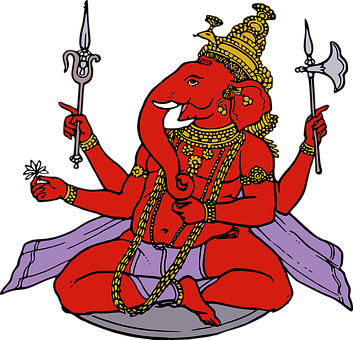
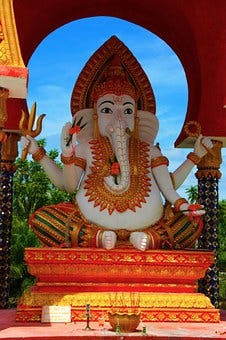
    As is often the case with symbolism, it is not immediately obvious why the chosen image should perform this function, and that is the case with the elephants here. There seems little doubt, however, that elephants do represent the creative level of the gods. This is most obvious in Hinduism. I hope these pictures need no further commentary or explanation.

    Further information on this topic is provided by the Jungian writer Marie-Louise von Franz. She discusses the meaning of the elephant symbol in her book Puer Aeternus (4). Here are a few relevant phrases:

  • “a great deal of mythological fantasy was spun around the elephant”.
  • “the elephant is said to represent invincible fortitude and to be an image of Christ”.
  • “they represent purification, chastity, and pious worship of God”.
  • “the hero archetype got projected”.
  • “the elephant is the archetype of the medicine man or wise man, who also has courage but, in addition, wisdom and secret knowledge”.
  • “so in their hierarchy, the elephant represents the individuated personality” (p14–15). 

    Even though the meaning of the content is obviously different in these examples, they all suggest a higher level of consciousness associated with the elephant, emerging from the “mythological fantasy” that she refers to.

    The myth further says that the elephants are “standing on a giant sea-turtle”. The gods and goddesses could only be generated by, thus supported by the ultimate source, namely God, however you understand that term. Why is the turtle an appropriate symbol of the Divine? This one is a lot easier than the elephant. In all spiritual traditions there is an ultimate Ground of Being, conceived of as a self-contained emptiness or nothingness, complete in itself. Yet in another aspect, this emptiness is also the One, the creative source behind all that is. There are thus two aspects of the Divine, the first we might call introverted, and the second extroverted. What a perfect symbol for this is the turtle, which is equally capable of and comfortable with withdrawing its head inside its shell, or leaving it outside looking out into the world! (5)

    As an afterthought, Sting once released an album called The Dream of the Blue Turtles. In the language of symbolism, the colour blue, especially light shades like sapphire and turquoise, represent spirituality — I don’t know why, but I know that it’s true. If Sting had a dream including blue turtles, I would interpret it as meaning that his spiritual path involved finding the right balance between introversion and extroversion, living in two worlds.

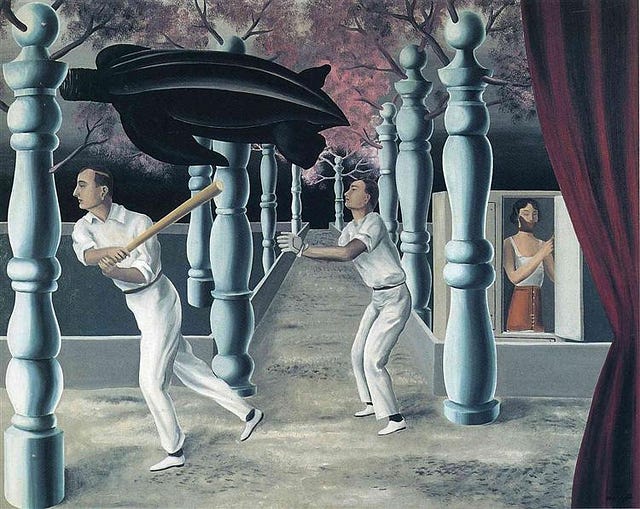
    Also interesting is this painting by the spiritually oriented painter Magritte.

    As you can see, a turtle is depicted floating above a scene taking place in the material (albeit surreal) world. Strangely, the male figures seem static; there is no sense of motion, even though they are engaged in an active sporting event. The painting is called The Secret Player! Magritte seems to think that there is a secret player hovering above this sporting scene, which is perhaps the source or support for the material world. In spiritual language we would call that God, or some similar term. He has chosen a turtle to convey that idea!

 

Footnotes:

(1) Fourth Estate Ltd., 1992

(2) Fourth Estate Ltd., 1994

(3) as (2), p210

(4) Sigo Press, 1981

(5) The myth specifies that it is a sea turtle, thus living in the waters. In the language of symbolism, waters represent the fluid level of the psyche — what Jung would call the Collective Unconscious — contrasted with the solidity of matter. This is where the Divine would reside, although strictly speaking we should assume that the waters are another level of reality, generated by this Creative Principle — spiritual traditions would usually place the waters, i.e. the psyche, between the elephants and the earth. Genesis 6:6, however says: “Let there be a firmament in the midst of the waters, and let it divide the waters from the waters”, thus saying that there are two levels to the waters, which are therefore more complicated than we normally understand.

· Religion and Spirituality, Uncategorised

A Further Reason to Leave the European Union – the 2014 Bill

6th April 2018

    Many people, including me, in Britain were somewhat surprised when it was announced in the media on October 17th 2014 that we had been presented with an apparently sudden and unanticipated bill for £1.7 billion from the European Commission, with the request that it be paid by December 1st.
    What was the reason for this bill? Apparently there was an agreement that economies which perform better should make extra contributions to the EU budget. It had been calculated that the British economy had been performing better than expected over the previous four years.
    Prime Minister David Cameron, presumably in an attempt to impress the electorate, responded: “It has never been the case that a €2 billion bill has suddenly been presented like this. It’s an appalling way to behave. I’m not paying that bill. It’s not going to happen”. Commission President José Manuel Barroso, however, said that the demand should “not have come as a surprise” to the UK, as it was made under a system agreed by all the member states and based on data provided by them”.
    Yet very few people knew about this agreement, which explained the surprise which the announcement caused. I follow politics and the media reasonably carefully, and I had never heard of it. This suggests that our politicians deliberately keep quiet arrangements they enter into, on the assumption that the electorate would find them unacceptable. And they would be right. This agreement is outrageous. What is the incentive for a nation to work hard and have a strong economy if the end result is that we have to give away the fruits of our success to other countries who don’t, and in future obviously won’t, feel the need to work so hard. It was somewhat ironic that the same calculation gave refunds to Germany and France, the two most prominent and most wealthy members of the EU, to the tune of €780m and €1.16bn.
    What was the outcome of all this? You may be wondering, if you don’t already know, what happened, David Cameron having said that he was definitely not going to pay the bill. It was reported in the Daily Mail the following September that Britain had quietly paid the £1.7billion European Union surcharge in two instalments on July 1st and September 1st in full, even though Chancellor George Osborne had claimed, a fortnight after the bill was revealed, to have halved it at negotiations in Brussels. A cross-party House of Commons Treasury Committee report subsequently decided that Mr Osborne’s claim was “not supported by the facts”. So another lie.


Bibliography:
https://www.theguardian.com/politics/2014/oct/24/david-cameron-refuses-pay-eu-bill-december-deadline
http://www.bbc.co.uk/news/uk-politics-29754168
http://www.dailymail.co.uk/news/article-3237073/Cameron-Osborne-quietly-pay-1-7BILLION-bill-Brussels-dismisses-totally-unacceptable.html

· Uncategorised

  • Newer Posts
  • 1
  • 2

Recent Posts

  • Quantum Physics and No Spirituality — Carlo Rovelli and Helgoland
  • Quantum Physics and Spirituality — Danah Zohar and a Quantum Worldview
  • Quantum Physics and Spirituality — Danah Zohar and a New Society, part 8
  • Quantum Physics and Spirituality — Danah Zohar and a New Society, part 7, Quantum Relationships
  • Quantum Physics and Spirituality — Danah Zohar and a New Society, part 6

Copyright © 2026 · Simply Pro Theme by Bloom Blog Shop.