Spirituality In Politics

  • Home
  • Intro
  • Articles Index
    • Introductory
      • 1. Metaphysics in a Spiritual Society
      • 2. The Spirit of Guidance
      • 3. Divination
      • 4. Raynor C. Johnson: The Imprisoned Splendour
    • Articles 2: Headline Policies for a Spiritual Society
      • Education
        • The Importance of Fairy Tales
        • The Importance of Fairy Tales, Part 2 – Fairy Tales and Feminists
        • Fairy Tales and Feminism – the Story of Psyche
        • Fairy Tales and Feminism — the Story of Psyche, Interpretation
        • Save Our Fairy Tales — Concluding Remarks
    • ARTICLES 3: MORE DETAILED IDEAS
      • Politics from a Taoist Perspective – Arguing for the Centre
      • Politics from the Centre — Is that the only way forward?
      • Changing the World – Spirituality or Socialism?
      • The Superorganism – a Challenge to Materialist Science
      • Is the Earth a Superorganism?
      • Humanity as Part of the Superorganism
    • Articles 4 The Role of the Citizen
      • The Role of the Citizen in a Spiritual Society
      • Reflections on Eastern and Western Spirituality
    • The Superorganism Question and the European Union
    • A Vision for a Spiritual United Kingdom Outside the European Union
    • Consciousness
      • Is the Self an Illusion – Series Introduction
        • Is the Self an Illusion? – Neuroscience, Gurdjieff and Buddhism
        • Is the Self an Illusion? – The Opposing Viewpoint
        • Is the Self an Illusion? — Yes and No
        • Is the Self an Illusion? — Summary and Conclusions
      • The Hidden, Deeper Self - Introduction
        • The Hidden, Deeper Self - Freudian Slips
        • The Hidden, Deeper Self - Dreams
        • The Hidden, Deeper Self – Synchronicity
        • The Hidden, Deeper Self - Automatic Writing
        • The Hidden, Deeper Self – Divination
    • Why Christianity Must Change or Die – Introduction
      • Christianity Must Change or Die — Gnosticism and Carl Jung
      • Significant Moments in Church History – Introduction
        • Number 1, The Council of Nicaea, 325AD
        • Number 2 – The Anathema Against Origen, 553 A.D.
          • Reincarnation and Christianity
    • Was Jesus Divine? – Introduction
      • Was Jesus Divine, the Son of God? – 1. The Adoptionist Problem
      • 2. The Jewish Messiah
      • 3. The Eschatological Prophet
      • 4. Shakespeare’s Heretical Play
      • 5. The Resurrection of Jesus – part 1
      • Was Jesus Divine, the Son of God? - Summary and Conclusions so far
      • 6. Was Jesus Married?
      • 7. Was Jesus Married? — part 2
      • 8. Was Jesus Married? — part 3
  • Blog Introduction
    • Blog Index
    • Religion and Spirituality
    • Politics
    • Science
    • Mythology
    • Miscellaneous
  • Contact

Time for a New Paradigm — Two Interesting Scientists

14th March 2019

    The new paradigm I’m referring to is an ongoing theme of mine — the reunification of science and religion.

    I have been reading a book called Cosmos, Bios, Theos¹. In it 60 prominent scientists were asked their view on the fundamental questions:

  • what was the origin of the universe?
  • how did life begin?
  • where do humans come from?
  • do you believe in God?

    There is much that I could quote, but here I’ll just refer to two interesting responses. Professor Christian B. Anfinsen, Professor of Chemistry and joint winner of the 1972 Nobel Prize for Chemistry, says that he believes in the Big Bang, that the origin of life was “an inevitable consequence of the evolution of the universe, physically speaking”, that homo sapiens “developed from lower forms by… processes of mutation and selection”. A spiritually minded person might well have objections to much of this, these responses suggesting that he is an orthodox scientist with the expected modern beliefs. When asked about the existence of God, however, he replies: “I think only an idiot can be an atheist”. (Richard Dawkins, Daniel Dennett etc., take note.) “We must admit that there exists an incomprehensible power or force with limitless foresight and knowledge that started the whole universe going in the first place. Such a process may have occurred many times earlier, and, indeed, must have, and will very likely occur again in the future”.

    This sounds more like the Ancient Wisdom teaching found in Hinduism — the Divine Mind, and a process of evolution and involution — a truly spiritual response.

    Anfinsen goes on to quote Einstein: “That deeply emotional conviction of the presence of a superior reasoning power, which is revealed in the incomprehensible Universe, forms my idea of God”². I have heard Richard Dawkins claim on a radio programme that Einstein was an atheist. Don’t let anyone tell you that and let them get away with it.
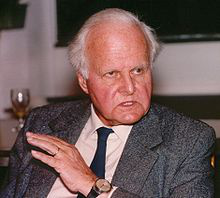
    Many modern (materialist) scientists say that science and religion are incompatible and irreconcilable. Professor Carl Friedrich von Weizsäcker, an eminent physicist, says: “I think the relationship between religion and science should be friendship. In the last resort their messages might turn out to be identical, but this would mean both of them would have to mature. At present I feel that just in friendship they should ask each other critical questions. Religion might ask science whether scientists understand the immense danger into which they bring the world, mankind, and the living world on our earth, if they do not take their responsibility for the future as their first duty. On the other hand, science should ask religion, in all friendship, whether it is not resting on concepts which are outmoded by five hundred years or more. Both of them ought to mature and they would be far closer to each other than they realize today”.

    I agree with his final conclusion, but am not quite so sure about the route by which he arrived there. He thinks the main thing that science can learn from religion is related to questions of morality and ethics; he does not seem to think that science has anything scientific to learn from the ancient religions (in contrast to Fritjof Capra, who found parallels to quantum physics in Hinduism, Taoism, and Buddhism).

    He does not say precisely which concepts he thinks are outmoded. He is “quite satisfied (scientifically) with the origin of life as described by modern theories of molecular biology”. However, he goes on to bring quantum physics into the picture: “The question then is, what are molecules? Quantum theory, I think, would be fully in agreement with the idea of what I call a spiritualistic monism, that is, that there is not something which is not living and beside which there is life which ought to be explained, but that the basic essence of the universe is to live”³.

    He therefore seems to be saying that the universe is a living organism, which is what ancient spiritual traditions were saying a lot longer than 500 years ago. He obviously doesn’t think that this is an outmoded religious concept, although materialist scientists might disagree.
Footnotes:

1. Edited by Henry Margenau and Roy Abraham Marghese, Open Court, 1992

2. pp138–40

3. pp128–129

· Science

The Misuse of the Word ‘Science’

8th March 2019

    In 1946 George Orwell wrote an interesting essay Politics and the English Language¹, in which he explained how many words are used “in a consciously dishonest way. That is, the person who uses them has his own private definition, but allows his hearer to think he means something quite different”. He was writing about politics, and was focusing at that point on the word ‘democracy’. When I read that sentence, however, I immediately thought of how the word ‘science’ is sometimes misused in this way. It was interesting therefore that a few lines later Orwell included as an example ‘science’ in a list of otherwise political words although, unfortunately, he did not go on to explain how he thought it was being misused. I’ll therefore come up with an example of my own. (The event I’m going to discuss is no longer topical, but the underlying theme — how people can use words to make themselves sound good when the truth is less pleasant — is still very relevant.)

    In April 2017 there was a worldwide March for Science. The main event took place in Washington DC, but there were 600 other events in towns and cities around the world. Included in the mission statement was this quote: “Scientists work to build a better understanding of the world around us. Science is a process, not a product — a tool of discovery that allows us to constantly expand and revise our knowledge of the universe. In doing so, science serves the interests of all humans, not just those in power”². If that is the case, it is reasonable to ask why on earth we would need such a march. Since no one could possibly be against such a science, what was the march’s real purpose? What was lying behind this rather bland slogan?

    It wasn’t easy to find out. New Scientist magazine, which was openly in favour of the march, noting that “some critics were being irritated by the lack of a coherent answer from organisers”, in an editorial asked “What does the March for Science really stand for?³” In the following issue they noted that there was a “perceived lack of a clear message”. If the organisers themselves were not clear about the purpose of the march, and could not give a coherent answer to a reasonable question, suspicions arise about their real motives.

    In the absence of any clear direction from the organisers, the protesters were free to demonstrate for or against anything that took their fancy. Some variously said that they were marching to: stop funding cuts; promote gender equality; raise awareness of climate change; safeguard scientists from attacks; protect science education; oppose anti-science rhetoric; defend the theory of evolution. When expressed in those terms, this on the whole sounds reasonable. Lurking beneath the surface of these soundbites, however, was there a suggestion of an alternative agenda? If you are for science, what exactly is it that you are against? After all, a march for science could be seen merely as a celebration. Indeed there were funk, soul and jazz musicians performing between the speakers. Why was the word ‘protest’ used then, suggesting that they thought the march was actually against something?

    Here are a few random observations.

    An indication of the confusion amongst all those involved was that the organisers claimed that the March was “not political”. It’s not clear what they meant by this since there were public speeches, and the protesters certainly didn’t get the message; if you are marching with banners and placards, it’s hard to see how you can call what you are doing non-political, one placard reading: “Scientists, Speaking Truth to Power”. Also, the march seemed to be a thinly disguised attack:

  • on Trump in the USA. The march was conceived at the Women’s March on Washington, which took place a day after, and in protest against, Donald Trump’s inauguration on January 21st. Originally the protest was going to be called the Scientists’ March on Washington, an obvious reference to the Trump protest.
  • on the Brexit vote in Britain. The British protest defended the status of ‘experts’. This was an obvious reference to the politician Michael Gove’s comment during the referendum campaign, that “people in this country have had enough of experts”. The British organisers were therefore overtly criticising the vote to leave the European Union.

    There is a suspicion that the march was, up to a point, against religion. One placard read “Science — A Candle in the Dark”. I wonder what “the Dark” was a metaphor for. The master of ceremonies was the soul musician Questlove. He said: “It’s been frustrating to watch as certain forces in our society try to squelch science, or their refusal to believe in it or propose alternative realities and facts”. Who was he talking about there? If not religious people, it would have to be those challenging climate change research. In either case, whatever you may think about those alternative claims, is he advocating the suppression of legitimate debate, the intelligent free thinking that the organisers said the March was seeking to promote? It is not possible to squelch science, if it is the search for truth. It is possible, though, to criticise some things that certain scientists say.

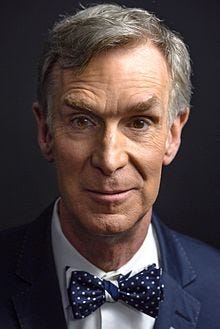
    Was the march really about free thinking, science in the pursuit of truth, or was it about the maintenance of orthodoxy? An honorary co-chair and front man for the Washington march was Bill Nye. Stephen Meyer noted that he was the perfect choice:

  • “March organisers have paid lip service to critical thinking and ‘diverse perspectives’ in science. However, Nye is a good example of someone who promotes science as a close-minded ideology, not an open search for truth. He attacks those who disagree with him on climate change or evolution as science ‘deniers’. He wouldn’t even rule out criminal prosecution as a tool”.
  • “Cajoling the public into giving their minds over to the ‘experts’ is Mr. Nye’s specialty”.

     Meyer concludes: “The March is about demanding that science, and the public, conform to expectations and embrace only orthodox ideas on evolution, climate change, and more”⁴.

    Gareth Sturdy, a teacher in London, made similar observations: “The self-selecting weekend warriors in London last Saturday didn’t speak for scientists, and they certainly didn’t speak for science. This wasn’t a celebration of science, but of scientism: the attempt to adopt science as an all-embracing ideology and push it beyond its purview. The pretence towards a fictitious global consensus and the fear of dissenting opinions had more in common with the medieval church than the Enlightenment. The whole basis of science is continual questioning and argument. Alternative views are the lifeblood of the scientific disciplines… Contrary to what the marchers believe, the most serious threat to scientific thinking today is themselves: people who seek to exploit science to defend themselves from ideas that frighten them”⁵.

    David Klinghoffer commented: “Being ‘pro-science’ has become a bizarre cultural phenomenon in which liberals (and other members of the cultural elite) engage in public displays of self-reckoned intelligence as a kind of performance art, while demonstrating zero evidence to justify it”⁶.

    Here are some of the other messages on the placards:

  • “Science Pursuing the Truth”. That is somewhat debatable; many ‘scientists’ seem determined to promote unhesitatingly a materialist, atheist, worldview.
  • “Saving the World”. I wonder whether the carrier of this placard remembered that scientists were responsible for creating nuclear weapons.
  • “Science is the Answer”. To what exactly?

    Obviously, there is a limit to what one can say on a placard, but surely the protesters could have come up with something better than these meaningless soundbites. The organisers’ mission statement, among other things, said this: “We support science education that teaches children and adults to think critically, ask questions, and evaluate truth based on the weight of evidence”⁷. It would seem that there is a great need for this, especially among the organisers and protesters themselves.

    “In today’s world, blind and unthinking deference to ‘The Science’ has become as much a part of Western culture as unquestioned deference to ‘The Church’ used to be”⁸. It’s a shame that those involved in the March for Science could not see this.

====================================================================================================

Footnotes:

1. http://www.orwell.ru/library/essays/politics/english/e_polit

2. https://www.marchforscience.com/mission-and-vision/

3. issue 3122, April 22nd 2017. It is interesting, but perhaps not surprising given the magazine’s title, to note that New Scientist was not at all bothered by this, and positively celebrated the lack of a coherent message, saying: “To draw numbers worthy of public attention, the events will have to attract a broad coalition of supporters with disparate views on the proper role of science”, and “diversity of concerns and voices is a strength, not a weakness, when it comes to mass protest. Decide for yourself what science stands for, stand up for it — and stand together”.

4. https://www.evolutionnews.org/2017/04/stephen-meyer-bill-nye-is-perfect-talking-head-for-a-march-against-science/

5. http://www.spiked-online.com/newsite/article/five-reasons-the-march-for-science-was-a-dumb-idea/19729

6. https://www.evolutionnews.org/2017/04/science-as-cargo-cult-more-thoughts-on-the-march-for-science/

7. https://www.marchforscience.com/mission-and-vision/

8. The Science Delusion, Peter Wilberg, New Gnosis Publications, 2008, back cover

· Science

In Defence of Magical Thinking

8th March 2019

    That is the title of a book by Medium writer Jack Preston King, which is an anthology of some of his articles. His subtitle is Essays in Defiance of Conformity to Reason. There is one article with the same title as the book, which has the subtitle What if Magical Thinking is the Key to Spiritual Development? I’ve been reading the book recently, and here I am writing in support of his ideas, hopefully adding relevant material.

    None of what follows is intended as a rejection of reason, which is a very useful tool when used correctly. I wish merely to point out that it is limited, and that its value is overestimated by its advocates, since it cannot alone lead to a complete understanding of how the universe works.

    Some people think otherwise. For example, Richard Dawkins has established a Foundation for Reason and Science, and Steven Pinker has written a book entitled Enlightenment Now: The Case for Reason, Science, Humanism, and Progress. They think that reason and logic are the only tools which science can use to unlock the universe’s secrets. There would be a problem, however, if there were levels of reality, and phenomena, which are actually irrational, which I suggest is the case. For example, Carl Jung describes the psyche as irrational. Richard Dawkins, conveniently for him, does not believe that the psyche, in Jung’s sense, exists.


    Lothar Schäfer, who at the time of the following quotes was a Professor of Physical Science, discusses the issue in some depth. He says: “Compatibility with reason is (an) essential aspect of the procedures that we use to establish facts… They will not be accepted if they make no sense. There are laws of thinking correctly, which are summarised in logic, the science of valid reasoning. If it does not conform to logic, it cannot be accepted as a verification of fact”. This suggests that reason and logic should reign supreme. However, he then adds the following reservations:

  • “As it turns out, all propositions about reality and all techniques of establishing facts take a lot for granted, and the means of observation and reason that we employ in deriving facts are not as clearly and distinctly factual as the feeling of certainty that they evoke.
  • “For example, as to the desired rationality of established facts, the concept presupposes that the logic of the universe must in some ways conform to the logic of the human mind. Why that should be so is by no means self-evident”¹.

    He says later that common sense “typically tells us what cannot occur. It is a sense of what is absurd; it tells us what will not happen, rather than what will happen… The problem with this view is that reality is counterintuitive. Common sense is in accord with some of reality but not with all of it”. He offers Einstein’s relativity and the phenomena of the quantum world as two such examples of reality contrary to common sense, therefore counterintuitive²... (Appropriate synonyms for ‘counterintuitive’, I suggest, would be irrational and illogical.)

    Here are some quotes, explaining why he says this, beginning with Einstein, who once said: “science cannot solve the ultimate mystery of nature”. If that is correct, then reason must be an inadequate tool. Reflecting upon this inability, he also said: “All these fifty years of conscious brooding have brought me no nearer to the answer to the question ‘What are light quanta?’ Nowadays every Tom, Dick and Harry thinks he knows it, but he is mistaken”³. Even the reasoning powers of the genius Einstein could not solve this mystery!

    Turning now to quantum physics, there are several relevant quotes which indicate exactly how irrational the new experimental results appeared:

  • “Exploration of the atomic and subatomic world brought them in contact with a strange and unexpected reality. In their struggle to grasp this new reality, scientists became painfully aware that their basic concepts, their language, and their whole way of thinking wereinadequate to describe atomic phenomena. Their problems were not merely intellectual but amounted to an intense emotional and even existential crisis” (Fritjof Capra).
  • “I remember discussions with Bohr which went through many hours till very late at night and ended almost in despair; and when at the end of the discussion I went alone for a walk in the neighbouring park, I repeated to myself again and again the question: Can nature possibly be so absurd as it seemed to us in these atomic experiments?” (Werner Heisenberg)
  • “I think it is safe to say that no one understands quantum mechanics” (Richard Feynman).

    In similar vein, parapsychologist Dean Radin says:

  • “It took years to reconcile what I was seeing in those experiments at Bell Labs with what my formal education had led me to expect. I hadn’t realised just how deeply I had accepted the assumptions of conventional science until I came face-to-face with experimental results that ‘shouldn’t be’. At times I became a bit frightened when I started to think about the implications”.
  • “One day, as I was complaining to a friend about the results of the experiments, I said, ‘I just can’t imagine how this can be!’ My friend calmly replied, ‘Well, it sounds like you’re limiting yourself’ ”.
  • “The difficulties in reconciling ‘magic’ with science were caused entirely by my prior beliefs. The moment I imagined that some aspects of science would simply expand to accommodate psi, and that most established scientific principles would remain the same as before, suddenly there was nothing left to reconcile”.
  • “Many very interesting facets of the world are just left out of science altogether… The scientific worldview is far from complete”⁴.

    It would seem that these are the problems you encounter if you restrict yourself to trying to understand the universe purely through reason. Interestingly, like Jack Preston King, Radin calls the new discoveries ‘magic’.

    There is a further problem. Who gets to decide what is rational, logical, common sense, counterintuitive? The answer given by a dedicated materialist who does not believe in the paranormal, the supernatural, the magical, for example Richard Dawkins or James Randi⁵, will be very different from the one given by Jack Preston King or me. Some of the things that such people consider impossible are:

  • ESP — telepathy, clairvoyance, remote viewing, precognition, psychometry, psychokinesis
  • spiritual healing, homeopathy, dowsing, astrology, alchemy
  • out-of-body experiences
  • divination: Tarot readings, I Ching consultations, runes
  • belief in synchronistic events
  • ghosts, fairies, demons

    This list may not be exhaustive, but that is enough to make the point. Let’s suppose, merely hypothesise for a moment, that all of these are actually real, not the fantasies of some misguided individuals still living in the past, rather the skills of those who have freed themselves from the limitations of the rational, ‘scientific’ mindset. If science is meant to be a search for an understanding of the true nature of the universe, wouldn’t we be missing out on an awful lot if we rejected all these as mumbo-jumbo⁶? Wouldn’t we be holding science back in its quest?

    I’ll repeat some material from a recent article of mine about the scientist Brian O’Leary. He says that he was once “a typical ‘left-brained’ academic — rationalistic, reductionistic, deterministic, materialistic (who felt he) had the universe and its laws mastered”. Then, as a result of an ESP experience, “my hard-earned scientific belief system was irreversibly shaken”. What he had previously considered ‘poppycock’ “turned out to be true”.

    His revised worldview is: “In confronting ‘unexplainable’ phenomena, what I learned was that we — scientists and lay people alike — had isolated ourselves in an invisible box of our own making… We had painted ourselves into a conceptual corner that kept us from asking the most basic questions about ourselves and the universe. As a result we had become prisoners of our own limiting beliefs. Science itself had become a religion, with mechanistic materialism as the Supreme Dogma”⁷.

    Or, as the poet William Wordsworth put it:

“…trailing clouds of glory do we come, from God, who is our home: Heaven lies about us in our infancy! Shades of the prison-house begin to close upon the growing Boy”⁸.

    Perhaps materialists consider the items on my list irrational and impossible precisely because they are so trapped in the prison of their own minds. (Remember the advice of Dean Radin’s friend above.) They say “extraordinary claims require extraordinary evidence”, even when abundant evidence exists.

    Spiritual traditions have always considered intuition and imagination to be faculties higher than reason. They also believe that all humans potentially have ‘magical’ powers, which can be acquired as part of a spiritual training. For example, the third founding principle of the Theosophical Society is “to investigate unexplained laws of nature and the powers latent in humanity”. (Let us not forget that the genius Isaac Newton was a dedicated alchemist who, there is reason to believe, succeeded.)

    It is not surprising, given their beliefs, that people like Richard Dawkins, Steven Pinker, James Randi, the late Christopher Hitchens⁹, and many others I could mention, have not discovered these latent powers.

    In conclusion, let me just remind you of the subtitle of Jack’s article¹⁰: What if Magical Thinking is the Key to Spiritual Development? Here is a quote from it: “And if, in fact, God, angels, the Blessed Virgin, pagan deities, and even spooky things like extraterrestrials, ultraterrestrials, demons, ghosts, fairies, etc. are real camouflaged components of our environment, capable of meaningfully impacting our world and our lives, shouldn’t we all want to be aware of that?”

Footnotes:

1. In Search of Divine Reality: Science as a Source of Inspiration, University of Arkansas Press, 1997, p17

2. ibid. p132

3. in a letter to M. Besso

4. The Conscious Universe, 1997, new edition HarperCollins, 2009, pp338–9

5. the magician and paranormal ‘debunker’ who wrote Flim-Flam: Psychics, ESP, Unicorns and other Delusions, Prometheus Books, 1982

6. Francis Wheen, for example, has written How Mumbo-Jumbo Conquered the World

7. The Second Coming of Science: An Intimate Report on the New Science, North Atlantic Books, 1992, Foreword Pix.

8. Intimations of Immortality from Recollections of Early Childhood, Stanza 5

9. who said: “The cause of my life has been to oppose superstition. It’s a battle you can’t hope to win — it’s a battle that’s going to go on forever. It’s part of the human condition”. Quoted on Medium by Erman Misirlisoy PhD: https://medium.com/@ermanmisirlisoy/your-brains-battle-between-science-and-superstition-8ff37742682f

10. https://medium.com/@beyondtherobot/in-defense-of-magical-thinking-c24f9cb95e

· Science

Quantum Physics and the Ancient Greeks

8th March 2019

    In previous articles on the theme of quantum physics, I have made frequent reference to the enthusiasm of its pioneers for Plato, and his allegory of the cave with its shadows on a wall. Sir James Jeans, for example, used it as the epigram for his book The Mysterious Universe. The clearest statement came from Werner Heisenberg: “Modern physics has definitely decided for Plato. The smallest units of matter are not physical objects… They are forms, structures, or — in Plato’s sense — Ideas”.

    If modern physics has decided for Plato, what has it decided against? On the evidence of that quote, it would be the philosophy of materialism, which is still so influential in science today despite the quantum revolution. Another possibility could have been Aristotle, who was once Plato’s student, but later went his own way and developed his own philosophy. However, it would seem that on the issues brought up by quantum physics, Aristotle held similar views to Plato. Heisenberg, in addition to the quote above, also refers to Aristotle: “The probability wave means a tendency for something. It is a quantitative version of the old concept of ‘potentia’ in Aristotelian philosophy. It introduces something standing in the middle between the idea of an event and the actual event, a strange kind of physical reality just in the middle between possibility and reality”.

    I came across that quote in a book by Lothar Schäfer¹, who then continues:

  • “Aristotle believed that matter without form is not quite real. He believed that stuff in itself, unformed and indefinite, is not part of reality, but it has the potential, potentia, to come into reality by being formed. Form brings matter into reality” (all his italics).
  • “Potentia is a concept in Aristotle’s metaphysics that describes a state of being which, at the ground of reality, is intermediate between ‘not being’ and ‘really being’. In order for forms to become reality, matter has the meaning of possibility.
  • “Aristotle’s term for reality is energeia, the root of our ‘energy’. His term for possibility is dynamis. It is an interesting coincidence that, in order for virtual particles to be real, they need energy, and that, furthermore, the values of dynamical variables of quantum particles are not quite real until they are observed”.
  • “In Heisenberg’s view the electrons and atoms share these aspects of potentia: when not observed, they are not real in the ordinary sense, but suspended in a world of possibilities, of non-material, wave-like patterns of probabilities. Particles in a superposition of states contain all kinds of wave forms; that is, they have no definite form. When measurements give particles a definite form, they project them into reality. In Aristotle’s words: Forms bring matter into reality. In the terms of quantum physics: Measurements give form (reality) to indefinite superpositions of states” (his italics).

    We are left to wonder how Plato and Aristotle came to such conclusions (similar ideas can also be found in Hinduism) without the benefit, we assume, of 20th century technology. (It is an ongoing theme of mine that there was once an Ancient Wisdom, which to some extent has been lost). Schäfer says: “It is not quite clear how Aristotle arrived at the view that forms help matter to become real, or how he was able to defend it. Sometimes it seems that inspired ideas need no defence and it is immaterial how they were derived”.

    While we’re on the subject of Aristotle, it is interesting to note that, even though he broke away from Plato, he nevertheless held many views consistent with a modern spiritual perspective, in opposition to materialism.

  • “In contrast to Plato’s transcendentalism, Aristotle thought that ideas, or forms, are not transcendental but exist in the things, that true reality is immanent, not transcendent”. Arguing against the concept of Platonic Ideas, “the forms are present in the things. Animals, trees, have a soul ‘psyche’. Nature is animated, the universe an organism”.
  • “According to Aristotle, a tree has a soul that guides its growth; soul gives unformed matter its form; the form is the goal and purpose of the evolution of a tree, as all natural phenomena, even physical ones, occur for a purpose²”

    From my perspective, divinity is both transcendent and immanent. And Aristotle is an animist, and believes in teleology; no wonder he has been rejected by the modern ‘Enlightenment’. It would seem that, as well as seeking a reunification of science and religion, we would also benefit from a reunification of Platonism and Aristotelianism.

====================================================================================================

Footnotes:

1. In Search of Divine Reality: Science as a Source of Inspiration, University of Arkansas Press, 1997. The following quotes are from pages 46 and 47.

2. Schäfer, p126

· Science

Time for a New Paradigm — or The End of Science?

8th March 2019

    It is often claimed that towards the end of the 19th century, there was a feeling in the physics community that all the great problems had been solved, that there were some issues which needed clearing up, but on the whole physics as a scientific search had come to an end. A speech by Albert Michelson in 1894 is quoted: “While it is never safe to say that the future of Physical Science has no marvels even more astonishing than those of the past, it seems probable that most of the grand underlying principles have been firmly established and that further advances are to be sought chiefly in the rigorous application of these principles to all the phenomena which come under our notice”¹.

    This seems to be something of an over-simplification, and the situation was not quite so clear cut. Some eminent physicists were already expressing doubts about the ability of classical mechanics to resolve the problems, for example James Clerk Maxwell in 1859, and Lord Kelvin in 1900. For the purposes of this article, however, this is not crucial. The important point is that classical mechanics had indeed gone as far as it could go, and what was needed to resolve the remaining problems unleashed a scientific revolution, a new paradigm. It is not necessary to go into the scientific details but, in a nutshell, one problem was the nature of light. The Michelson-Morley experiment had suggested that light could not be considered a wave in a mechanical medium. Also, when the filament of a light bulb was heated with electricity, it glowed, and the colour of the light changed as the filament got hotter, but the physics to explain this was a mystery. Other relevant topics are the equipartition theorem, black body radiation, the ultraviolet catastrophe, and the photoelectric effect, should anyone wish to research them.

    Einstein, in 1905, had to think the unthinkable and come up with a new theory. His solution was that light consisted of bullet-like particles (quanta); they were tiny lumps of energy. At the time the idea seemed crazy, it was considered heretical and revolutionary, but it solved all the problems with light at a stroke. It provided a wonderful explanation of the photoelectric effect, and also solved the mystery of the light bulb.

    However, the problem then became deeper. The mystery of the nature of light became a battle about the nature of reality. In the 1920s, came the quantum revolution, which completely overturned the classical system. Even the scientific genius Einstein was vehemently opposed to it. Within 30 years of Michelson’s speech, physics had been turned on its head.

    What should we learn from all this? One suggestion is that on those occasions when scientists seem to have discovered just about all there is to know, this is an indication that an enormous revolution is about to take place. Despite that, the science writer John Horgan thinks that we may indeed have reached the end of science, and is so confident that he has even written a book (first published 1996) with that as the title². He wonders: “Was it possible that science could come to an end? Could scientists, in effect, learn everything there is to know? Could they banish mystery from the universe?” He thinks: “By far the greatest barrier to future progress in pure science is its past success” (p16).

    He does not seem to be aware that not all physicists were content with classical mechanics, and goes along with the idea that they were reasonably satisfied that physics had come to an end — he has a section entitled ‘That’s What They Thought 100 Years Ago’. From the point of view of his argument that science now is coming to an end, this is quite clever. Even though he thinks that the last time physicists thought they understood just about everything, but were soon afterwards shown to be completely mistaken, he still makes the claim that scientists in modern times have understood just about everything.

    What are his grounds for saying this? He talks about an “impressive, if not terribly detailed, narrative of how we came to be”. (It’s interesting that he is not bothered by the lack of detail; science, as I understand it, is meant to give complete, detailed explanations.) This narrative, impressive in his mind, turns out to be the Big Bang, DNA, natural selection, Darwinian evolution. He continues: “My guess is that this narrative that scientists have woven from their knowledge, this modern myth of creation, will be as viable 100 or even 1,000 years from now as it is today. Why? Because it is true… There will be no great revelations in the future comparable to those bestowed upon us by Darwin or Einstein or Watson and Crick” (p16).

    This is similar to something the biologist Ursula Goodenough wrote: “The Big Bang, the formation of stars and planets, the advent of human consciousness and the resultant evolution of cultures — this is the story, the one story, that has the potential to unite us, because it happens to be true”³.

    Are such statements clues to what the next revolution will be? Are the Big Bang, Darwinian evolutionary theory, the advent of consciousness precisely the ideas which need to be challenged and overturned? That is what spiritual traditions have suggested, along with some significant new-paradigm thinkers. Let’s have a look at those ideas one at a time.

    According to the old paradigm, matter is the fundamental reality, life evolved from non-life, and consciousness mysteriously evolved from brain activity. According to the new paradigm, consciousness is primary, and matter is a manifestation of consciousness. This a view which has become more familiar in modern times with the advent of quantum physics. There was therefore no advent of consciousness in the sense that Goodenough intends.

    Regarding evolutionary theory, there is no problem with DNA and the science of genetics. The problem begins when Darwinian theory is used to support a materialist or atheistic philosophy. Richard Dawkins says that Darwin made it possible to become an intellectually fulfilled atheist. This is what needs to be challenged by a new paradigm.

    Regarding the Big Bang, if it is a false idea, which is what spiritual traditions suggest, then this will be the most difficult of the three challenges to win, since there is almost complete unanimity among scientists that it really happened. I’ve been invited to give a talk later in June, the core of which will be a challenge to Big Bang theory, so I don’t want to publish my material just yet, but I will do so nearer the time. At this point I’ll just say that whether or not there was a Big Bang, the theory is based on some poor science.

    At some point in the future, these three key ideas will hopefully have become historical curiosities. If and when that happens, then the new paradigm of a spiritual science will truly have arrived. Horgan says, however, that there are scientists “who are seeking to misread and therefore to transcend quantum mechanics or the big bang theory or Darwinian evolution”. These points of view are at best interesting, but do “not converge on the truth. (They) cannot achieve empirically verifiable surprises that force scientists to make substantial revisions in their basic description of reality” (p7). ‘Misread’ and ‘transcend’ are interesting words to choose; are they a materialist’s substitutions for ‘challenge’ and ‘argue against’? What is wrong with wanting to ‘transcend’, i.e. go beyond, previous knowledge? Perhaps he’s right, but we’ll just have to wait and see.

====================================================================================================

    “Unconvinced, in each generation (the rationalist) believes himself to be in possession of the last and final word; and he simply cannot see that his sons and successors will have a different ‘last’ and even more ‘final’ word, which in turn will be surpassed or disproved by their sons and successors. That is one of the most absurd aspects of the behaviour of Western science: for centuries on end it has patted itself on the back every twenty or thirty years for having reached the pinnacle of scientific inquiry and in this arrogant pose has passed its findings on to its students and successors”⁴.

Bibliography, for the first section:

1. The Secrets of Quantum Physics, BBC4, December 9th 2014

2. https://www.quora.com/Which-19th-century-physicist-famously-said-that-all-that-remained-to-be-done-in-physics-was-compute-effects-to-another-decimal-place

Footnotes:

1. at the dedication of the University of Chicago’s Ryerson Physical Laboratory

2. The End of Science: Facing the Limits of Knowledge in the Twilight of the Scientific Age, Little, Brown and Company, 1997

3. in The Sacred Depths of Nature, quoted by Jon Turney in The Big Questions in Science, Harriet Swain (ed.), Jonathan Cape, 2002, p233

4. Joachim-Ernst Berendt, Nada Brahma: The World is Sound, East West Publications, 1988, p40

· Science

Is Movement an Illusion? Discontinuity in Quantum Physics

15th February 2019

    This post continues ongoing themes of mine, the need for a new paradigm — a reunification of science and religion — quantum physics as the key to this reunification, and the existence of an Ancient Wisdom, suggesting that earlier cultures were highly sophisticated spiritually and scientifically.

====================================================================================================

    Sir James Jeans, following the early developments in quantum physics, summed up the dramatic shift from the old to the new paradigm in these words:

    “Thirty years ago, we thought, or assumed, that we were heading towards an ultimate reality of a mechanical kind. It seemed to consist of a fortuitous jumble of atoms, which was destined to perform meaningless dances for a time under the action of blind purposeless forces, and then fall back to form a dead world. Into this wholly mechanical world, through the play of the same blind forces, life had stumbled by accident…

    “Today there is a wide measure of agreement, which on the physical side of science approaches almost to unanimity, that the stream of knowledge is heading towards a non-mechanical reality; the universe begins to look more like a great thought than like a great machine. Mind no longer appears as an accidental intruder into the realm of matter; we are beginning to suspect that we ought rather to hail it as the creator and governor of the realm of matter — not of course our individual minds, but the mind in which the atoms out of which our individual minds have grown exist as thoughts” (1).

    Thus the physical universe seems to emerge from another non-material level, an idea which led David Bohm to develop the concept of explicate and implicate orders. It seems, however, that this idea was not new, for spiritual traditions have been saying that, sometimes for thousands of years. For example, Jeans quotes Plato’s allegory of the cave as the epigram for his book.

    Writing in the 1890s, before the quantum revolution, the Theosophists Annie Besant and Charles Leadbeater said: “The Anu (by which they mean a sub-atomic particle) can scarcely be said to be a ‘thing’, though it is the material out of which all things physical are composed. It is formed by the flow of the life-force and vanishes with its ebb… Presumably, were that flow checked but for an instant, the whole physical world would vanish… It is only the persistence of that flow which maintains the physical basis of the universe” (2).

    The physical universe is therefore sustained in being or, as Jeans puts it, thought into existence. It was not created at some point in the past, as you might be led to believe by the language of Genesis in the Bible.

    How does this process actually work? We are all familiar with the term ‘motion picture’ or ‘movie’. That was not literally true, however, because films were actually a rapid succession of still frames. The original technology operated at 24 frames per second, and at that speed the human eye was incapable of noticing this and saw instead an illusion of motion. Could this also be true of the universe?

    The physicists Fred Alan Wolf and Bob Toben say that information connects “all points in space with all others in an indefinite number of possible patterns, constantly changing, and turning on and off at incredible frequencies up to 10⁴³ times per second”. That is billions upon billions of times! It is hardly surprising that we don’t notice this. They also say that “every action in ‘real’ time is an indefinite sequence of materializations and dematerializations on the microscopic quantum-level. They occur faster than the speed of light and in such great numbers that perception of this action is continual” (3).

    It’s possible that not all scientists have accepted this, but it is at least a statement from a scientific source. Coming from a spiritual perspective, the ancient Hindus came to exactly the same conclusion. According to Robert Cox: “In the Vedic texts, this constant process of creation and annihilation was called nitya pralaya”. He goes on to quote the Bhagavata Mahapurana: “Some men, knowing the subtle state of things… declare the creation and dissolution of all beings, from Brahma downward, as taking place all the time. The successive stages undergone by all changing things serve as an index of the constant creation and dissolution of those things, as carried out by the force of time. These high frequency stages of creation and annihilation… are not perceived by ordinary men” (4).

    The Kabbalist Zev Ben Shimon Halevi, discussing the illusion of matter, talks about “the eye’s relatively slow time scale that cannot perceive the sequence oscillating between something and nothing which creates the appearance of the book being present” (5).

    If this is correct, just like in the cinema, what we call motion or movement is an illusion; everything is just a series of freeze-frames. This is possibly the explanation for what is called a quantum leap. Atoms were once thought to be “miniature solar systems, in which negatively charged electrons circle like planets (thus moving) around a positively charged nucleus”. However, “electrons were found to behave quite unlike planets — they kept jumping from one orbit into another without passing through the space between them… a single jump, ignoring space” (6).

    If all this is true then the whole universe, many billions of times a second, is a totality, a single frame, theoretically disconnected from every other moment, while appearing continuous and causally connected. Since we are part of the universe, this must be happening to our own bodies, yet we are completely unaware of this process. It hardly needs saying, but all this is mind-boggling. Our minds cannot cope with such ideas, especially, it would seem, the minds of materialist scientists. How could they seriously maintain their philosophy if they took such ideas fully on board?

    Who or what is creating these billions of single frames? This takes us back to my starting point, Sir James Jeans and the idea of the universe as a great thought. I am led irresistibly to contemplate the unfathomable workings of the Divine Mind. We can only stand in awe of an extraordinary mystery.

Footnotes:

(1) The Mysterious Universe, CUP, 1947, pp136–137

(2) Occult Chemistry, Theosophical Publishing House, 1951, p14

(3) Space-Time and Beyond, Bantam, 1983, p38, p80

(4) Creating the Soul Body, Inner Traditions, 2008, pp75–76

(5) Anatomy of Fate, Penguin, 1995, p161. He is writing, admittedly, after the quantum revolution, but it is fair to assume that he is referring to an ancient tradition.

(6) Arthur Koestler, Janus: a Summing Up, Pan Books, 1979, p247

· Science

A Reunification of Science and Religion — Brian O’Leary

15th February 2019

    This post follows on from a previous one, and also continues the ongoing theme: Time for a New Paradigm.

    Here I am going to highlight the thoughts of the significant new-paradigm scientist, Brian O’Leary. He says that he was once “a typical ‘left-brained’ academic — rationalistic, reductionistic, deterministic, materialistic (who felt he) had the universe and its laws mastered”.

    Then, as a result of an ESP experience, “my hard-earned scientific belief system was irreversibly shaken”. What he had previously considered ‘poppycock’ “turned out to be true” (1).

    Here are his thoughts on the problem facing us all, which echo those of Stanislav Grof in the previous article:

    “In confronting ‘unexplainable’ phenomena, what I learned was that we — scientists and lay people alike — had isolated ourselves in an invisible box of our own making… We had painted ourselves into a conceptual corner that kept us from asking the most basic questions about ourselves and the universe. As a result we had become prisoners of our own limiting beliefs. Science itself had become a religion, with mechanistic materialism as the Supreme Dogma… At the same time I had to acknowledge that the scientific method itself was indeed very powerful. After all, hadn’t it helped create the many useful technologies we then took for granted?

    “(The obvious solution) is that we simply needed to separate the scientific method itself from the package of beliefs that surrounded it, and from which it had become almost indistinguishable. Having done so, we were now free to use this powerful tool to address basic cosmic, as well as mundane, questions. As a result we found more meaning in life, and are now well along in solving our most pressing global problems. By using the scientific method without being bound by a narrow philosophy of science, we have, in more ways than one, entered a new millennium…What we needed was a New Science” (2).

    The way forward is therefore clear. We need to retain the scientific method, but free it from all the philosophical baggage that has been attached to it. Even better, instead of dismissing all paranormal and supernatural phenomena as non-existent, we should enthusiastically use the scientific method to study them.


Footnotes:

(1) The Second Coming of Science: An Intimate Report on the New Science, North Atlantic Books, 1992, Foreward Pix.

(2) ibid., p3

· Science

Consciousness and the Brain

12th February 2019

    “The Astonishing Hypothesis is that ‘You’, your joys and your sorrows, your memories and your ambitions, your sense of personal identity and free will, are in fact no more than the behaviour of a vast assembly of nerve cells and their associated molecules”.

    That is the opening of a book called The Astonishing Hypothesis by Nobel-prize winner Francis Crick (1) on his “scientific search for the soul” (the subtitle). I often come across this quote in books and talks, usually when the author or speaker wants an example of the extreme lengths that materialist science can go to, or, put less kindly, how ridiculous a supposedly intelligent scientist can sometimes be.

    Recently, however, I’ve come across someone praising him. Here is Steven Pinker: “The feature (neuroscientists) find least controversial is the one that many people outside the field find the most shocking. Francis Crick called it ‘the astonishing hypothesis’ — the idea that our thoughts, sensations, joys and aches consist entirely of physiological activity in the tissues of the brain. Consciousness does not reside in an ethereal soul that uses the brain like a PDA (personal digital assistant), consciousness is the activity of the brain” (2).

    I hope everyone understands that the last statement is Pinker’s personal belief; I would say his faith, since it is tantamount to a religious statement. It is not science. The fact that most neuroscientists agree does not prove it; it merely indicates the inadequacy of neuroscience to see what is really going on.

    I believe that what Pinker rejects is actually the case. The idea that the brain acts as a reducing valve or filter which limits consciousness is a credible hypothesis mentioned frequently, obviously in literature that Pinker doesn’t read.

    In The Doors of Perception, Aldous Huxley quotes the Cambridge philosopher C. D. Broad, who suggests that we should take seriously the idea of the French philosopher Henri Bergson: “The function of the brain and nervous system and sense organs is in the main eliminative and not productive. Each person is at each moment capable of remembering all that has ever happened to him and of perceiving everything that is happening everywhere in the universe” (3). Joseph Campbell quotes the passage and embraces it (4), saying that “each one of us is potentially Mind at Large”.

    The idea of the reducing valve is also called the Transmission Model, following William James. Other relevant names are Frederic Myers, a founder of the Society for Psychical Research, Henri Bergson as noted above, English philosopher F. C. S. Schiller. A highly relevant book is Beyond Physicalism: Toward Reconciliation of Science and Spirituality (5). Chapter 3 is called ‘The “Transmission” Model of Mind and Body: a Brief History’. Its author Michael Grosso says: “What emerges is a picture, deeply embedded in the historical psyche of an intuition of mind as primordial and transcendent, mind interactively interwoven with and essentially pervading physical nature. It is an intuition at odds with currently prevailing outlooks that lean en masse toward physicalism”, thus Crick, Pinker, and others like them.

    So, it is not just the silly, ignorant public who reject the beliefs of neuroscientists. I hope that these impressive thinkers will be remembered long after Pinker and Crick (apart from his discovery of the structure of DNA) have been forgotten. Crick says: “This hypothesis is so alien to the ideas of most people alive today that it can truly be called astonishing”. Pinker says that “many people outside the field find (this idea) the most shocking”. As is frequently the case, the public’s intuition is probably more accurate than the conclusions of modern scientists. The hypothesis is astonishing because nobody in their right mind could believe it.

    “The brain is not the mind; it is an organ suitable for connecting a mind to the rest of the universe” (6).

Footnotes:

(1) Simon & Schuster, 1994

(2) The Mystery of Consciousness, Time magazine, January 19th 2007

(3) Vintage Classics, 2004, p10

(4) Myths To Live By, Souvenir Press, 1973, reissued 1991, p263

(5) Edward Kelly and others, Rowman and Littlefield, 2015

(6) Mario Beauregard and Denyse O’Leary, The Spiritual Brain: a Neuroscientist’s Case for the Existence of the Soul, HarperOne, 2007, Introduction, Pxi

· Science

A Reunification of Science and Religion — Introduction

12th February 2019

    The idea of bringing science and religion together has been an ongoing idea of mine for some time. It is all part of the search for a new paradigm, a new scientific and philosophical way of understanding the universe, which may be an essential ingredient in our attempts to save the planet.

    I’ve been invited to give a talk on this theme on June 9th (2019) in Leeds (England). I’ll publish the full transcript nearer the time, but in the coming months, as part of my preparations, I’ll post related material, mainly the stuff from my research that won’t find its way into the talk.

    Creating a synthesis of science and religion would be desirable in itself. But why do I say a reunification, not merely a unification? It’s not just that people in earlier times did not make this distinction, using the term natural philosophy, and that it is only since the Enlightenment that science and religion have been separated. It’s also because ancient cultures had a very sophisticated understanding of scientific issues. Such a synthesis would therefore be a rediscovery of an Ancient Wisdom, which arguably remains more advanced than modern scientific thinking. It would undoubtedly come as a shock to ‘Enlightenment’ scientists that they still haven’t caught up with this Ancient Wisdom.

    Some interesting books on this theme are:

  • Ancient Wisdom and Modern Science by Stanislav Grof, as editor (1). In his introduction he describes the problem in detail (by ‘perennial philosophy’ he means the Ancient Wisdom):

    “A tendency to glorify progress and evolution and to look down upon the past as a time of infancy and immaturity is associated with the view that the ideological and cultural differences between East and West are absolute and unbridgeable”. He refers to “the fundamental difference in their dominant world-views and philosophies. Western scientific disciplines have described the universe as an infinitely complex mechanical system of interacting, discrete particles and separate objects. In this context, matter appears to be solid, inert, passive and unconscious; life, consciousness and creative intelligence are seen as insignificant accidents and derivatives of material development. They emerged after billions of years of random mechanical evolution of matter and only in a negligible section of an immense universe.

    “In contrast, the spiritual philosophies of the great ancient and Eastern cultures — or ‘perennial philosophy’ — describe consciousness and creative intelligence as primary attributes of existence, both transcendent and immanent in the phenomenal world. Western science recognizes as real only those phenomena that can be objectively observed and measured; perennial philosophy acknowledges an entire hierarchy of realities — some of them manifest, others hidden under ordinary circumstances and directly observable only in certain special states of consciousness.

    “Materialistic science and perennial philosophy differ most in their images of human nature. Western science portrays human beings as highly developed animals and thinking biological machines who have a fleeting, insignificant role in the overall scheme of things. Perennial philosophy sees humans as essentially commensurate with the entire universe and ultimately divine”.

    Grof later asks whether Western science and perennial wisdom could be “reconciled in a way that would combine their advantages and avoid their drawbacks. Since it is not possible to change the ancient and perennial, any attempt at such synthesis must involve changes in the philosophy of Western science. But is it possible to change the basic assumptions of science while preserving its formidable pragmatic powers? Do not the everyday triumphs of mechanistic science constitute a clear proof of the accuracy of its basic philosophical assumptions?”

  • Creating the Soul Body: the Sacred Science of Immortality by Robert E. Cox (2). The connection with my theme may not be apparent from the title, but this is his opening statement: “This book is devoted to a re-evaluation of ancient systems of religious-mythological thought and their relevance to our modern systems of scientific thought. Throughout this book runs this theme: The ancients were much more intelligent than we have supposed them to be. In particular, the chapters that follow propose that many ancient cultures once shared a genuine spiritual science, a science of consciousness, which in certain ways rivals and even surpasses the most advanced physical theories of today”.
  • The Snake and the Rope: Problems in Western Science Resolved by Occult Science by Edi D. Bilimoria (3).

    Quantum physics is the most important factor in this reunification of science and religion. Bilimoria calls it the crown jewel of modern physics (I would also say of modern science). My previous posts on quantum physics (4) are therefore relevant to this ongoing theme of reunification. Bilimoria also says that it was predated by occult science for centuries.

    I’ll be returning to all these themes in future posts.


Footnotes:

(1) State University of New York Press, Albany, 1984

(2) Inner Traditions, 2008

(3) Theosophical Publishing House, 2006

(4) click on part 1, and part 2

· Science

Poets Know Better Than Scientists — Number Five

7th January 2019


    I have recently been reading Kathleen Raine’s selection of poetry by Shelley. In her introduction, she says: “Inspiration, of the kind claimed for, or by, such poets, from Plato to Yeats… seems again, as we learn more of the human psyche, credible. There are regions of the mind which seem possessed of knowledge beyond anything we may have acquired by study or experience” (1). This expresses perfectly the idea of the title of this series; the scientific method can take us only so far, as we journey in the worlds of psyche and spirit.


Footnote:

(1) Penguin, 1973, p8

· Science

  • Newer Posts
  • 1
  • …
  • 4
  • 5
  • 6
  • 7
  • 8
  • 9
  • Older Posts

Recent Posts

  • Quantum Physics and No Spirituality — Carlo Rovelli and Helgoland
  • Quantum Physics and Spirituality — Danah Zohar and a Quantum Worldview
  • Quantum Physics and Spirituality — Danah Zohar and a New Society, part 8
  • Quantum Physics and Spirituality — Danah Zohar and a New Society, part 7, Quantum Relationships
  • Quantum Physics and Spirituality — Danah Zohar and a New Society, part 6

Copyright © 2026 · Simply Pro Theme by Bloom Blog Shop.