Spirituality In Politics

  • Home
  • Intro
  • Articles Index
    • Introductory
      • 1. Metaphysics in a Spiritual Society
      • 2. The Spirit of Guidance
      • 3. Divination
      • 4. Raynor C. Johnson: The Imprisoned Splendour
    • Articles 2: Headline Policies for a Spiritual Society
      • Education
        • The Importance of Fairy Tales
        • The Importance of Fairy Tales, Part 2 – Fairy Tales and Feminists
        • Fairy Tales and Feminism – the Story of Psyche
        • Fairy Tales and Feminism — the Story of Psyche, Interpretation
        • Save Our Fairy Tales — Concluding Remarks
    • ARTICLES 3: MORE DETAILED IDEAS
      • Politics from a Taoist Perspective – Arguing for the Centre
      • Politics from the Centre — Is that the only way forward?
      • Changing the World – Spirituality or Socialism?
      • The Superorganism – a Challenge to Materialist Science
      • Is the Earth a Superorganism?
      • Humanity as Part of the Superorganism
    • Articles 4 The Role of the Citizen
      • The Role of the Citizen in a Spiritual Society
      • Reflections on Eastern and Western Spirituality
    • The Superorganism Question and the European Union
    • A Vision for a Spiritual United Kingdom Outside the European Union
    • Consciousness
      • Is the Self an Illusion – Series Introduction
        • Is the Self an Illusion? – Neuroscience, Gurdjieff and Buddhism
        • Is the Self an Illusion? – The Opposing Viewpoint
        • Is the Self an Illusion? — Yes and No
        • Is the Self an Illusion? — Summary and Conclusions
      • The Hidden, Deeper Self - Introduction
        • The Hidden, Deeper Self - Freudian Slips
        • The Hidden, Deeper Self - Dreams
        • The Hidden, Deeper Self – Synchronicity
        • The Hidden, Deeper Self - Automatic Writing
        • The Hidden, Deeper Self – Divination
    • Why Christianity Must Change or Die – Introduction
      • Christianity Must Change or Die — Gnosticism and Carl Jung
      • Significant Moments in Church History – Introduction
        • Number 1, The Council of Nicaea, 325AD
        • Number 2 – The Anathema Against Origen, 553 A.D.
          • Reincarnation and Christianity
    • Was Jesus Divine? – Introduction
      • Was Jesus Divine, the Son of God? – 1. The Adoptionist Problem
      • 2. The Jewish Messiah
      • 3. The Eschatological Prophet
      • 4. Shakespeare’s Heretical Play
      • 5. The Resurrection of Jesus – part 1
      • Was Jesus Divine, the Son of God? - Summary and Conclusions so far
      • 6. Was Jesus Married?
      • 7. Was Jesus Married? — part 2
      • 8. Was Jesus Married? — part 3
  • Blog Introduction
    • Blog Index
    • Religion and Spirituality
    • Politics
    • Science
    • Mythology
    • Miscellaneous
  • Contact

Time for a New Paradigm — Quantum Physics, Part 1

7th January 2019

Change is now, change is now                                                                                                                                                              Things that seem to be solid are not.

====================================================================================================

    It’s amazing how sometimes a poet, or even a rock star, can say in just a few words what others would take several pages to say. That’s what seemed to happen here when Roger McGuinn and Chris Hillman of the Byrds summed up in two simple lines of a song the profound implications of the discoveries of quantum physics for our understanding of the nature of reality (1). They were suggesting that the advent of quantum physics would provoke a revolution in our consciousness, and social attitudes; the last line of the song is “keep in harmony with love’s sweet plan”. This doesn’t seem to have happened yet.

    This article follows on from the introduction to this series, and it would be helpful if readers were familiar with it. In a nutshell my view is that, in order for humanity to move forward in the fields of cosmology, science and metaphysics, we need a reunification of science and religion, a synthesis of the best of both. That was how it was in the past, when people spoke of natural philosophy, until the two were driven apart by so-called ‘Enlightenment’ science with its rejection of religion. It is often said nowadays that the two are irreconcilable. In order to heal the rift, we need better religion and better science.

    Quantum physics is at the cutting edge of new-paradigm thinking, and is therefore leading the way to this reunification. I’ll outline how this came about in this and subsequent articles.

    The world view of quantum physicists defies common sense, and seems absurd to the layperson. “Anyone who is not shocked by quantum theory has not understood it”, and “if you think you understand quantum mechanics, you don’t understand quantum mechanics”, are quotes attributed to physicists Niels Bohr and Richard Feynman (although these may not be the exact wordings). Despite this, however, in the opinion of the scientists involved, “quantum theory has been the deepest description that physics has available of the nature of reality”(2). “Quantum mechanics is the theory of physics. It has explained successfully everything from subatomic particles to stellar phenomena. There never has been a more successful theory. It has no competition” (3). It underlies nearly all of modern science and technology, governing the behaviour of transistors and integrated circuits, the essential components of electronic devices.

    The primary finding of quantum physics was that solid objects are not real, at least not in the way they seem to us. This discovery was the culmination of the classical physicists’ relentless search for the ultimate building blocks of matter. At one point these were thought to be atoms, but it was then discovered that atoms were made up of smaller particles. So far so good. Unfortunately, at this point problems started to develop, as further research suggested that these particles were not material at all, but in a sense were only ‘probability waves’ with ‘tendencies to exist’. Then, add to this the fact that they do not remain in existence, but are born, collide with each other and die, all this within an extraordinarily short time span, and we can understand, although we cannot see, that matter is not what it seems.

    Here are some examples of physicists and one science writer explaining at greater length what the Byrds said so succinctly:

    Fritjof Capra: “…the whole question of the division of matter appeared in a new light. When two particles collide with high energies, they generally break into pieces, but these pieces are not smaller than the original particles. They are again particles of the same kind, and are created out of the energy of motion (‘kinetic energy’) involved in the collision process… We can divide matter again and again, but we never obtain smaller pieces… The subatomic particles are thus destructible and indestructible at the same time.

    “This state of affairs is bound to remain paradoxical as long as we adopt the static view of composite ‘objects’ consisting of ‘basic building blocks’. Only when the dynamic, relativistic view is adopted does the paradox disappear. The particles are then seen as dynamic patterns or processes, which involve a certain amount of energy appearing to us as their mass”.

    “All particles can be transmuted into other particles; they can be created from energy and can vanish into energy. In this world, classical concepts like elementary particle, material substance, or isolated object, have lost their meaning. The whole universe appears as a dynamic web of inseparable energy patterns”(4).

    Fred Alan Wolf: “We might say that God’s will is exercised in the world of the qwiff… It is a causal world of exact mathematical accuracy, but there is no matter present” (5).

    Danah Zohar: “Niels Bohr, and Heisenberg himself, argued that there is no clear, fixed, underlying ‘something’ to our daily existence that can ever be known. Everything about reality is and remains a matter of probabilities”(6).

    Gary Zukav: “A dust particle is a thing, an object. A subatomic particle cannot be pictured as a thing. Therefore we must abandon the idea of a subatomic particle as an object” (his italics).

    “The photon is a relationship between two observables. This is a long, long way from the building-brick concept of elementary particles” (his italics).

    “ ‘Matter’ is actually a series of patterns out of focus. The search for the ultimate stuff of the universe ends with the discovery that there isn’t any. If there is any ultimate stuff of the universe, it is pure energy, but subatomic particles are not ‘made of’ energy, they are energy… What we have been calling matter constantly is being created, annihilated and created again. This happens… literally, out of nowhere” (7).

    (That matter was merely a form of energy had been revealed just before the quantum revolution by Einstein in his famous equation E=mc².)

    I’ll move on to the spiritual implications of all this in a later article.
====================================================================================================

Footnotes:

(1) The song Change Is Now is on the album The Notorious Byrd Brothers. Online versions of the lyrics say ‘seemed’. Listening to the track for years, I’ve always heard ‘seem’ and, listening to it again, I still hear ‘seem’. It doesn’t make any difference to the meaning.

(2) BBC Radio 4, Quantum, December 1st 1999

(3) Gary Zukav, The Dancing Wu Li Masters, Fontana, 1980, p217

(4) The Tao of Physics, Fontana, 1976, p82, p83

(5) Taking the Quantum Leap, Harper and Row, 1989, p249

(6) The Quantum Self, Flamingo, 1991, p11

(7) as (3), p57, p94 and p212
· Science

Poets Know Better Than Scientists — Number Four

4th January 2019

    In the three previous posts I have focused on individual poets. Here I am going to put together a few brief lines from others, the theme of which will be a spiritual perspective on nature.

    Materialist science claims that the physical universe is merely an accidental collocation of atoms, that life and consciousness are extremely unlikely accidents of nature and evolution; humanity is therefore a meaningless blip in an essentially dead mechanism. Spiritual teachings claim, on the contrary, that the universe is actually a manifestation of consciousness, nothing but life and consciousness; it is in fact the body of God, and there is therefore no such thing as inorganic matter.

    Here are three poets who seem to agree with this perspective:

  • William Blake: “Every rock is deluged with Deity”
  • Gerard Manley Hopkins: “The world is charged with the grandeur of God”
  • Alexander Pope: “All are but parts of one stupendous whole, Whose body nature is and God the soul”

(All three are quoted together by George Trevelyan, A Vision of the Aquarian Age, Gateway Books, 1994, p7.)

They might be wrong, but I know whose version I prefer!


· Science

Science and Superstition

4th January 2019

“The cause of my life has been to oppose superstition. It’s a battle you can’t hope to win – it’s a battle that’s going to go on forever. it’s part of the human condition”.        (the late) Christopher Hitchens

====================================================================================================

    I was first made aware of this quote in a recent article on Medium.com by Erman Misirlisoy PhD (1). I’m not sure of the source, but it is widely repeated on the internet, so I assume it’s genuine.

    It’s hard to argue against the challenge that Hitchens set himself; we should oppose superstition whenever it occurs, as Misirlisoy says, when we wrongly identify the cause of a particular effect. If something is wrong, it should be challenged. There is an immediate problem, however; who gets to define what is superstition, thus what is wrong? Misirlisoy continues, “…especially when we invoke a supernatural belief or myth in that estimation”. Christopher Hitchens was well known for his fervent atheism, and was indeed a member of the Four Horsemen (of the Non-Apocalypse). Should we let people like him decide what is and what is not superstition?

    Are all supernatural beliefs superstition, or only some of them? Is belief in God a superstition? Are the various types of extrasensory perception — telepathy, remote viewing, psychokinesis, and so on — superstition? Some continue to say so, for example Richard Dawkins, despite the impressive scientific evidence piling up (2). Is a belief that consciousness can exist independently of the body — out-of-body experiences, life after death — a superstition?

    In the past it would have been considered superstition to believe that “trees are like human families: tree parents live together with their children, communicate with them, support them as they grow, share nutrients with those who are sick or struggling, and even warn each other of impending dangers”. Now, in The Hidden Life of Trees (3) Peter Wohlleben “draws on groundbreaking scientific discoveries” which suggest exactly that. (The quotes are taken from the back cover.)

    Is it a superstition that an ill person can be cured by a homeopathic treatment? Again, some would say so; there have even been demonstrations outside chemists which sell homeopathic remedies, based on the claim that there is no evidence that they work. Is homeopathy in error, or is it just something that makes the modern ‘scientific’ thinker feel uncomfortable?

    I could go on, but I hope the main point is clear. It is important to oppose actual superstition, as long as we are clear what that is. We should not confuse ridding ourselves of superstition with a dismissal of anything that appears mysterious or supernatural to modern science, thus throwing out the baby with the bathwater. Getting rid of superstition should not be done under the umbrella of the philosophy of scientific materialism. We would be missing out on a lot, and would be holding humanity back in its ongoing search for knowledge.


Footnotes:

(1) https://medium.com/@ermanmisirlisoy/your-brains-battle-between-science-and-superstition-8ff37742682f

(2) see, for example, the works of Dean Radin

(3) William Collins, 2017

· Science

Is the Universe Intelligent?

2nd January 2019

    Materialist science claims that the physical universe is merely an accidental collocation of atoms, that life and consciousness are extremely unlikely accidents of nature and evolution; humanity is therefore a meaningless blip in an essentially dead mechanism. Spiritual teachings claim, on the contrary, that the universe is actually a manifestation of consciousness, nothing but life and consciousness; it is in fact the body of God, and there is therefore no such thing as inorganic matter.

    Sometimes poets agree with this perspective (1):

  • William Blake: “Every rock is deluged with Deity”
  • Gerard Manley Hopkins: “The world is charged with the grandeur of God”
  • Alexander Pope: “All are but parts of one stupendous whole, Whose body nature is and God the soul”

    It is therefore interesting to discover scientists, and others with a scientific background, who think along these lines. James Lovelock’s Gaia hypothesis, which claims that the Earth is a living organism, is well known (2). Peter Russell has followed in his footsteps, and I have referred to his book The Awakening Earth (3) in previous articles. This was first published in 1982, and was republished the following year with the title The Global Brain (4). The suggestion is therefore that the Earth is intelligent.

    Can we go further and say that the universe is intelligent? Interestingly, The Intelligent Universe is the title of two books, one by David Foster (5), a highly qualified scientist, specialising in cybernetics, whose work is related to that of Gurdjieff and Ouspensky, thus a spiritual perspective, and another by Sir Fred Hoyle (6), who is usually described as an atheist, or agnostic.

    Hoyle is a controversial figure, famous for being a critic of the Big Bang theory, advocating instead the Steady State theory, which has now been discredited, at least according to conventional modern cosmologists (that would be a debate for another time). One could conclude, therefore, that he is a marginal figure whose views should not be taken seriously. I think that would be a mistake (7). I cannot go into great detail here, but in this book he claims that life could not have started by random processes, thus not by chance. He is also a savage critic of Darwinism: “How has the Darwinian theory of evolution by natural selection managed, for upwards of a century, to fasten itself like a superstition on so-called enlightened opinion? Why is the theory still defended so vigorously? Personally, I have little doubt that scientific historians of the future will find it mysterious that a theory which could be seen to be unworkable came to be so widely believed” (p25).

    Here are two quotes from his final three chapters:

  • “The origin of the Universe… requires an intelligence” (p189).
  • discussing the problem of the “vast unlikelihood that life, even on a cosmic scale, arose from non-living matter”: “There is no shortage of scientists who will shout this problem down, but in my opinion their protestations are more dogmatic than scientific. By dogmatic I mean that they are arguing from ideas that are pre-set to begin with, instead of allowing their thinking to develop and even to change drastically as new facts become available. The pre-set state of mind… leads to all manner of excuses and deceptions when life’s complexity comes up for explanation” (p242–3).

    In other words, these scientists’ commitment to materialist explanations leads to some dubious arguments.

    The epigram to David Foster’s book quotes Einstein describing a scientist: “His religious feeling takes the form of a rapturous amazement of the harmony of natural law, which reveals an intelligence of such superiority that, compared with it, all the systematic thinking and acting of human beings is an utterly insignificant reflection”. I have heard Einstein described as an atheist (by Richard Dawkins, perhaps not a reliable source). Is he not talking here about the Divine Mind?

    Foster’s second chapter begins with a definition of the theory of the intelligent universe: “The total universe, inclusive of all aspects of matter and mind, shows a construction virtually indistinguishable from that of an electronic computer, and all its workings are in the nature of intelligent data processing. Thus, for brevity, we describe it as an ‘Intelligent Universe’ ”.

    He continues: “The central idea is that the whole universe is simply one vast mind. This is not a new idea, and a similar point of view was stated by Plato over two thousand years ago in his ‘world of ideas’ and more recently in this century by Sir Arthur Eddington when he stated, ‘We begin to suspect that the stuff of the world is mind stuff’ ” (p39).

    So it’s not just the poets who think this. Thank goodness for new-paradigm scientists (and a philosopher of antiquity).


Footnotes:

(1) The following three quotes come from A Vision of the Aquarian Age, George Trevelyan, Gateway Books, 1994, p7.

(2) Gaia, A New Look at Life on Earth, 1979, new edition OUP, 1995

(3) Routledge & Kegan Paul

(4) published by J. P. Tarcher

(5) Abelard, 1975

(6) Michael Joseph Ltd., 1983

(7) He was a Cambridge graduate, a distinguished theoretical physicist, Plumian Professor of Astronomy and Experimental Philosophy, associate member of the American National Academy of Sciences (the Academy’s highest award for non-American scientists), and he was of course knighted for services to science.

· Science

Time for a New Paradigm

2nd January 2019

    I’ve been a Medium member for over a year, and it’s been very rewarding (and a lot of fun) reading the ideas of others, interesting people I would never have heard of otherwise, debating with them in the responses, and putting out my own thoughts. One thing I’ve noticed is that so many people are passionately working to create a better world, whether from perspectives of politics, ecology, education, philosophy, spirituality, religion, and others. It’s great to know that so many people care!

    That’s the reason I’ve been writing, and I assume that those following me do so because they share, or are at least interested in, my vision for a better world — the ongoing battle against atheism, the philosophy of materialism, and the bad science derived from them. When such ideas dominate, we are led towards a secular society. Secularism, based upon the error that the world would be better off without religion, is therefore another opponent in this battle.

    We do need a credible religion, however! What is currently on offer is unsatisfactory to many people, and for good reason. That is why I am also trying to promote better religion and spirituality because, when ridiculous statements are made, they become easy targets for atheists, and we are led down a dangerous path. Adopting and acting upon a spiritual perspective on life is the single most important thing that any person can do as we struggle to save the planet.

    With that idea in mind, it’s time for a new paradigm. For everyone on the planet to have a spiritual perspective, implying that the planet would be organised and governed from a spiritual perspective, would require a revolution in thinking and politics on a grand scale.

    The philosopher of science and physicist Thomas S. Kuhn is the person who has written in most detail about how something like this might be achieved. His book The Structure of Scientific Revolutions (1) described the process of how the world moves from one paradigm to another. Here are some of his chapter headings: The Nature of Normal Science, The Priority of Paradigms, Anomaly and the Emergence of Scientific Discoveries, Crisis and the Emergence of Scientific Theories, The Response to Crisis, The Nature and Necessity of Scientific Revolutions, Revolutions as Changes of World View, Progress through Revolutions.

    I’ll summarise his argument. A certain scientific or philosophical world view becomes established, and continues for some time because nothing is perceived to contradict it. Then some anomalies (experimental results) begin to appear, which cannot be explained within this paradigm. If this continues and is repeated, then a crisis emerges for the old way of thinking, and new speculative theories begin to be developed, until a vision for a new paradigm emerges. However, there is no simple transition from one world view to the next, for those who are attached to the old paradigm defend it vigorously, and argue strongly against the new ideas. The two paradigms therefore coexist. At some point, however, a critical point is reached when the old paradigm is no longer credible, can no longer be sustained, and is swept away by a revolution. The new paradigm then becomes the accepted world view.

    As I see it, the situation at the current time is that we have reached the point where the two paradigms coexist. The old paradigm of atheism, materialism, has passed its sell-by date, is no longer credible (there are too many anomalies), yet is still vigorously defended by its advocates. At the same time a generation of new-paradigm scientists and others has emerged, and it is only a matter of time before their ideas become the new world view. If it is not 2019, which it probably won’t be, then it is inevitable, if we follow Kuhn’s logic, that it will happen at some point in the future. Let’s do all that we can to accelerate the process!

    Thanks to everyone who is following me on Medium, and a Happy New Year! How about this for a New Year resolution? Immerse yourself in and learn more about new-paradigm thinking, write about it and challenge outdated ideas and expose the errors of the old paradigm. (I’ll be suggesting some important authors in future articles.) The aim is to bring together the best of science, and the best of religion and spirituality, therefore to achieve a reunification of science and religion, a true spiritual science. From better ideas, a better society will follow. Become part of the revolution!

====================================================================================================

    By coincidence, as I had the idea for this article, I started reading a book described on its back cover as “a paradigm-smashing chronicle of joyous entanglement”. One of the new-paradigm ideas that I have previously written about at length is the Earth as a living superorganism. This book offers evidence which contributes to that theme. It is The Hidden Life of Trees by Peter Wohlleben (2), who “makes the case that the forest is a social network. He draws on groundbreaking scientific discoveries to describe how trees are like human families: tree parents live together with their children, communicate with them, support them as they grow, share nutrients with those who are sick or struggling, and even warn each other of impending danger”. (These are further notes from the back cover.) The book is said to be an ‘International Bestseller’. I know that this claim is often made by publishers but, if true in this case, it just goes to show how ready the public are for new-paradigm thinking. Long may this continue.

===================================================================================================

    I have written a song called Time for a New Paradigm, which is the last song in a cycle of the same name. You can see me play it on my Youtube channel grahampemberton1, click here.

===================================================================================================

Footnotes:

(1) University of Chicago Press, third edition 1996

(2) translated by Jane Billinghurst, William Collins, 2017

· Science

Darwinism — Just-so Stories

29th December 2018

    I have recently been reading Jean Hardy’s book A Psychology with a Soul which is about Roberto Assagioli’s system of Transpersonal Psychology, Psychosynthesis (1). In chapter 16, The Nature of Science in Psychology and Psychotherapy, she discusses philosopher of science Karl Popper’s ideas about open and closed systems of thinking . A closed system of thinking is one “that is so comprehensive that no happening in the world can disprove it. A Marxist would have his or her own interpretation for anything that occurred, just as the Freudian would have his or her own quite different one; whatever happened, each would leave the scene with his or her conceptual world intact” (p168).

    Such persons are therefore impervious to any evidence which contradicts their worldview. Thus we see that preconceptions dictate the interpretation, whereas it should be obvious that evidence and observations lead to interpretation and theories. It seems, however, that for some people this is very hard to put into practice.

    Hardy goes on to suggest that natural science is such a closed system, “that though a particular piece of evidence may be able to disprove a particular theory, the scientific way of conceiving the world persists: that underneath the modern framework of natural science there are also persistent, value-laden, hard-to-contact assumptions about the human situation”.

    The scientific way of conceiving the world that she is talking about is the philosophy of materialism. This was expressed most forcefully, and in my opinion ridiculously, by the Harvard professor Richard Lewontin: “We take the side of science in spite of the patent absurdity of some of its constructs… in spite of the tolerance of the scientific community for unsubstantiated just-so stories, because we have a prior commitment, a commitment to materialism… Moreover, that materialism is absolute, for we cannot allow a Divine Foot in the door” (2).

   He makes use of the term ‘just-so stories’, which is appropriate because they are something that Darwinism is often accused of using. Once the truth of Darwinian evolutionary theory is assumed, then it is always possible to come up with an explanation for anything without needing to prove it. The argument goes along these lines: some aspect of modern human psychology is described, which is followed by a statement like this: “There must have been some point in evolutionary history when…”

    This ruse was exposed very clearly by the former senior palaeontologist at the Natural History Museum, Colin Patterson. When asked by a reader of his book Evolution why he had not included any direct illustrations of evolutionary transitions, he replied that none could be given with certainty: “It is easy enough to make up stories of how one form gave rise to another, and to find reasons why the stages should be favoured by natural selection. But such stories are not part of science, for there is no way of putting them to the test”.


Footnotes:

(1) Arkana, 1989

(2) New York Review of Books, “Billions and Billions of Demons”, 1997


· Evolution

Poets Know Better Than Scientists — Number Three

29th December 2018

    Even though I have been thinking about this idea for some time, I was inspired to start this series when Jack Preston King published his article Is God Imagination? on medium.com. He is a big fan of the Romantic poets, and I am beginning to explore them more.

    Continuing with Jack’s theme, here is a quote from the spiritually oriented writer George Trevelyan: “The poets and prose writers of the Romantic Movement recognized Imagination as that faculty which could apprehend the Whole, and by doing so restore to the soul what the analyzing intellect and sense-bound perception had taken from it”. He goes on to quote John Keats: “I am certain of nothing but the holiness of the heart’s affection and the truth of Imagination”, then says: “We must, however, ask in what sense imagination is true (his italics). The emerging world view helps us answer that question in much the same way that Coleridge, in ‘Religious Musings,’ did 175 years ago”:

“There is one mind, one omnipresent mind,                                                                                                                    Omnific. His most holy name is Love.                                                                                                                          Truth of subliming import! …….                                                                                                                                                                                                        ’Tis the sublime in man,                                                                                    Our noontide majesty, to know ourselves                                                                                                                          Parts and proportions of one wondrous whole!                                                                                                              This fraternizes man, this constitutes                                                                                                                            Our charities and bearings. But ’tis God                                                                                                                        Diffused through all, that doth make all one whole”.

    Trevelyan continues, finding another term for Imagination: “With an inner eye, we are looking into this whole, with what Coleridge called ‘sacred sympathy’ — for once perceived as part of that whole, everything alive becomes sacred”.

    If only scientists were allowed to use their Imagination as well as their reason!

Footnote:                                                                                                                                                                               (1) A Vision of the Aquarian Age, Gateway Books, 1994, p14

· Science

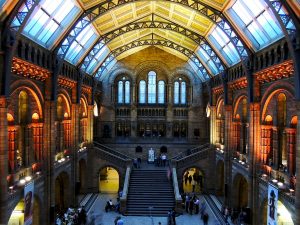
The Natural History Museum (London) — or, a Temple to Darwinism

29th December 2018

    At least, that’s what I prefer to call it, even though it is meant to be a science museum, and seemingly once was. I am going to begin a series of posts which will describe its transformation, and therefore explain my reasons for calling it that. This should interest anyone following the debate between Darwinian evolutionary theory and theistic alternatives, including Intelligent Design. This is just a brief introduction.

    In my opinion the Darwinian theory of evolution has become equivalent to a religion. Its believers do not think that, obviously, because they have convinced themselves that it is science. It perhaps takes an outsider to see what is going on, hence the philosopher Mary Midgley’s book Evolution as a Religion (1). Words like dogma, creeds, heresy, Inquisition have become relevant, as I hope to show.

    In 2009 there was a special Darwin exhibition there, timed to coincide with the bicentenary of his birth. My wife and I decided to visit it, and naïvely assumed that we would be able to just turn up and get in; after all, it wasn’t going to be a sell-out, or so we thought. To our surprise, it was fully pre-booked and we couldn’t get in. We therefore spent the time looking at the exhibits in the rest of the Museum. As a sceptic, I found the experience an oppressive attempt at indoctrination, and would probably have felt the same if I had managed to get into the exhibition, since one review described it as having “an unambiguous militant tone” (2).

    The Museum was founded in 1881. Richard Owen was the person primarily responsible and its first director. He was an outstanding naturalist, comparative anatomist, and a lifelong opponent of Darwin’s theory. He was apparently a devout Christian, which may have influenced his views; it is also possible that his religious views were inspired by his observations. Owen agreed with Darwin that evolution occurred, but saw nature as a series of experiments by a Creator. (Divine Imagination! You don’t have to be a conventional Christian to believe that.) For at least part of his career Owen believed that living matter had an “organising energy”, a life-force that directed the growth of tissues, a viewpoint that is called vitalism. In case anyone thinks this is an antiquated idea, smacking of mysticism and the supernatural, let me assure you that the debate continues. As recently as 1989, physicist Paul Davies, not someone likely to indulge in fanciful speculation, while not himself endorsing vitalism or animism, nevertheless outlined in The Cosmic Blueprint (3) the difficulties encountered when trying to explain life, specifically morphogenesis, by ordinary physical laws, and included vitalism and animism as part of the discussion.

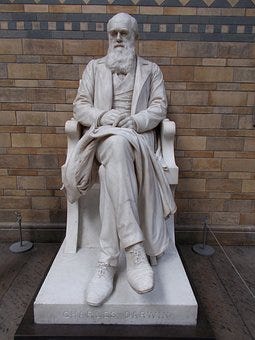
    I am not saying that this science museum began under the influence of Christianity, but I do think that it was a genuine science museum, i.e. open-minded and objective, showing exhibits, not promoting one particular line of thought. In the following articles, I’ll relate some of the moments which were significant in its transformation into a Temple of Darwinism. For the time being I’ll just note that at the time of the exhibition in 2009, the statue of the founder Richard Owen was replaced by one of Darwin, at which time the transformation from museum to temple was complete.

Footnotes:

(1) Routledge, 1985, new edition 2002

(2) Darwin review http://www.victorianweb.org/science/darwin/capet.html.                                                         I believe the reviewer thought this approach appropriate

(3) Unwin Hyman Ltd., 1989


· Evolution

Poets Know Better Than Scientists – Number Two

27th December 2018

    At the end of the first post in this series I quoted William Wordsworth from his poem Intimations of Immortality from Recollections of Early Childhood. He obviously understands the nature of incarnation, and how the soul forgets its pre-existence:

Our birth is but a sleep and a forgetting:                                                                                                                        The Soul that rises with us, our life’s Star,                                                                                                                      Hath had elsewhere its setting,                                                                                                                                        And cometh from afar:                                                                                                                                                        Not in entire forgetfulness,                                                                                                                                                  And not in utter nakedness,                                                                                                                                              But trailing clouds of glory do we come                                                                                                                          From God, who is our home:                                                                                                                                            Heaven lies about us in our infancy!

    He goes on to say that the soul later becomes trapped in the “shades of the prison-house”.

    Here is Robert Browning writing in similar vein, from his epic poem Paracelsus:

Truth is within ourselves: it takes no rise                                                                                                                  From outward things, whate’er we may believe.                                                                                                            There is an inmost centre in us all                                                                                                                              Where Truth abides in fullness: and around                                                                                                                  Wall upon wall, the gross flesh hems it in.                                                                                                                That perfect clear perception – which is truth.                                                                                                                A baffling and perverting carnal mesh                                                                                                                              Binds it, and makes all error: and, to KNOW,                                                                                                                Rather consists in opening out a way                                                                                                                  Whence the imprisoned splendour may escape,                                                                                                          Than in effecting entry for a light                                                                                                                                      Supposed to be without.

    So here we have two poets who understand the spiritual truth that we as humans are a consciousness (which I choose to call the soul), which has become imprisoned in flesh and subject to error and illusion. Consciousness is therefore separate from and independent of the brain which, as I have argued previously, is an organ which acts as a reducing-valve, and limits consciousness.

    What do modern, materialist scientists have to say? Their question is, how is the physical brain capable of producing consciousness, a conscious self? This is called the ‘hard question’, because it is seemingly impossible to answer. Richard Dawkins, when presented with statements about religion or the paranormal, is fond of replying “where is the evidence?” I therefore ask, where is the evidence that the brain produces consciousness? My own answer is that there isn’t any, and not only that, but there can never be any such evidence, because the statement is not true.

    None of this has any effect upon materialist scientists because they are locked into their myth, which has become a reality for them, so that they no longer realise that it is only one worldview amongst others. They are incapable of understanding that their question is based on an assumption which is possibly and arguably illusory.

    New Scientist magazine makes frequent reference to this problem; here are some examples:

  • “Consciousness: The what, why and how… There are a lot of hard problems in the world, but only one of them gets to call itself ‘the hard problem’. And that is the problem of consciousness — how a kilogram or so of nerve cells conjures up the seamless kaleidoscope of sensations, thoughts, memories and emotions that occupy every waking moment” (1).
  • “What makes you conscious — and where is it in your brain? Is turning on consciousness more like pressing a button, or operating a dimmer switch? The whys and hows of awareness are maddeningly hard to pin down” (2).

    One common claim is that the self, because no scientific explanation can be found for it, is actually an illusion. I have discussed this in previous articles (3). Here are some further examples, which are also headlines from New Scientist magazine:

  • “Metaphysics special: What is consciousness? How does something as physical as the brain create something as immaterial as your sense of self? It could all just be one big trick of the mind” (4).
  • “Consciousness evolved for the greater good, not just the self. The unconscious mind tricks you into believing in a sense of self, argue two psychologists. And it does this for an unexpected reason” (5).

    When will these scientists ever learn? Perhaps they should read more poetry.


Footnotes:

(1) headline from their website

(2) from an online version of an article by Linda Geddes, issue 3065, March 19th 2016

(3) see the previous posts: The Folly of Modern Neuroscience, Is the Self an Illusion? – Part 1, and Part 2. There is also a series of articles, see under Consciousness on the Articles Index page.

(4) by Anil Ananthaswamy, issue 3089, September 3rd 2016

(5) by Peter Halligan and David Oakley, issue 3034, August 15th 2015

· Science

The Earth as a Superorganism — Further Thoughts

25th December 2018

    This post follows on from several articles on this theme, for details of which see footnote (1).

    The idea of the earth as a superorganism re-emerged in modern times with the work of the independent scientist James Lovelock and his Gaia hypothesis (2). This was developed further by the spiritually oriented writer Peter Russell in The Awakening Earth (3).

    When Lovelock published the first edition, where he described the Earth as a kind of self-regulating, living organism, he was attacked by biologists who said that this could not have emerged through a process of natural selection, thus contradicting Darwinian theory, the dominant biological paradigm. Even worse, “one critic referred to it scathingly as a fairy story about a Greek goddess” (4). These are statements typical of modern materialist, Enlightenment science for, as Lovelock says, “the idea of Mother Earth or, as the Greeks called her, Gaia, has been widely held throughout history and has been the basis of a belief that coexists with the great religions” (5).

    Nature at the time was seen as “red in tooth and claw”, and “survival of the fittest” was a key idea in a struggle for survival. This viewpoint may seem true at one level to a casual observer. From a higher perspective, however, taking into account the whole picture from the point of view of Gaia, this brutality can perhaps be seen as cooperation in nature; the death of one creature enabling another to survive would be an essential ingredient in the ongoing process of life. Lynn Margulis, a colleague of Lovelock and fierce critic of Darwinism, believed something along those lines, and developed the concept of symbiosis, or cooperation in nature.

    New material on this theme is now being added. Peter Wohlleben has recently written The Secret Network of Nature (6). Here are some quotes from his introduction:

  • “Nature is like a giant clockwork mechanism. Everything is neatly arranged and interconnected. Everything has its place and its function”.
  • “All animals and plants are part of a delicate equilibrium, and every entity has its purpose and role in its ecosystem”.
  • “Nature is much more complex than a clock. In nature, not only does one cog connect with another: everything is connected in a network so intricate that we will probably never grasp it in its entirety” (his italics).

    As an example, he describes the role of wolves in Yellowstone National Park. They may appear as murdering predators to us (red in tooth and claw), but Wohlleben shows how they play an essential role in maintaining the balance in the ecosystem (symbiosis). They were eradicated from the park in response to pressure from ranchers. This enabled the elk population to increase, the consequence of which was that “large areas of the park were stripped bare by the voracious animals. Riverbanks were particularly hard hit. The juicy grass by the river disappeared, along with all the saplings growing there. Now this desolate landscape didn’t provide enough food even for birds, and the number of species declined drastically”, for example, beavers disappeared. When wolves were reintroduced, they again preyed on the elks, and things began to return to normal (pp5–6).

    This just goes to show what happens when ignorant humans, who understand nothing of the above, and who have lost all sense of their connection to nature, are allowed to act, motivated purely by their own selfish interests.

    If the Earth is indeed this intricate superorganism, it is hard to see how this could have arisen through the blind, random, purposeless processes that neo-Darwinians assure us are the reality of evolution. That is obviously the reason why those biologists reacted so strongly to Lovelock’s hypothesis. If each individual planetary citizen recognises that he or she is the equivalent of one of its brain cells, we can act accordingly, and start to take responsibility for the healing of Gaia.

Footnotes:

(1) Relevant articles:

The first one is preparatory: The Superorganism – a Challenge to Materialist Science

More important are: Is the Earth a Superorganism?

and: Humanity as Part of the Superorganism

    If you’ve read as far as that, you might also be interested in: The Role of the Citizen in a Spiritual Society

(2) Gaia: a New Look at Life on Earth, first edition 1979, second edition 1987, reissued 1995, OUP

(3) Routledge & Kegan Paul, 1982

(4) 1995 edition, Pxii

(5) 1995, Pxiv

(6) translated by Jane Billinghurst, The Bodley Head, 2018

· Evolution

  • Newer Posts
  • 1
  • …
  • 5
  • 6
  • 7
  • 8
  • 9
  • Older Posts

Recent Posts

  • Quantum Physics and No Spirituality — Carlo Rovelli and Helgoland
  • Quantum Physics and Spirituality — Danah Zohar and a Quantum Worldview
  • Quantum Physics and Spirituality — Danah Zohar and a New Society, part 8
  • Quantum Physics and Spirituality — Danah Zohar and a New Society, part 7, Quantum Relationships
  • Quantum Physics and Spirituality — Danah Zohar and a New Society, part 6

Copyright © 2026 · Simply Pro Theme by Bloom Blog Shop.