Spirituality In Politics

  • Home
  • Intro
  • Articles Index
    • Introductory
      • 1. Metaphysics in a Spiritual Society
      • 2. The Spirit of Guidance
      • 3. Divination
      • 4. Raynor C. Johnson: The Imprisoned Splendour
    • Articles 2: Headline Policies for a Spiritual Society
      • Education
        • The Importance of Fairy Tales
        • The Importance of Fairy Tales, Part 2 – Fairy Tales and Feminists
        • Fairy Tales and Feminism – the Story of Psyche
        • Fairy Tales and Feminism — the Story of Psyche, Interpretation
        • Save Our Fairy Tales — Concluding Remarks
    • ARTICLES 3: MORE DETAILED IDEAS
      • Politics from a Taoist Perspective – Arguing for the Centre
      • Politics from the Centre — Is that the only way forward?
      • Changing the World – Spirituality or Socialism?
      • The Superorganism – a Challenge to Materialist Science
      • Is the Earth a Superorganism?
      • Humanity as Part of the Superorganism
    • Articles 4 The Role of the Citizen
      • The Role of the Citizen in a Spiritual Society
      • Reflections on Eastern and Western Spirituality
    • The Superorganism Question and the European Union
    • A Vision for a Spiritual United Kingdom Outside the European Union
    • Consciousness
      • Is the Self an Illusion – Series Introduction
        • Is the Self an Illusion? – Neuroscience, Gurdjieff and Buddhism
        • Is the Self an Illusion? – The Opposing Viewpoint
        • Is the Self an Illusion? — Yes and No
        • Is the Self an Illusion? — Summary and Conclusions
      • The Hidden, Deeper Self - Introduction
        • The Hidden, Deeper Self - Freudian Slips
        • The Hidden, Deeper Self - Dreams
        • The Hidden, Deeper Self – Synchronicity
        • The Hidden, Deeper Self - Automatic Writing
        • The Hidden, Deeper Self – Divination
    • Why Christianity Must Change or Die – Introduction
      • Christianity Must Change or Die — Gnosticism and Carl Jung
      • Significant Moments in Church History – Introduction
        • Number 1, The Council of Nicaea, 325AD
        • Number 2 – The Anathema Against Origen, 553 A.D.
          • Reincarnation and Christianity
    • Was Jesus Divine? – Introduction
      • Was Jesus Divine, the Son of God? – 1. The Adoptionist Problem
      • 2. The Jewish Messiah
      • 3. The Eschatological Prophet
      • 4. Shakespeare’s Heretical Play
      • 5. The Resurrection of Jesus – part 1
      • Was Jesus Divine, the Son of God? - Summary and Conclusions so far
      • 6. Was Jesus Married?
      • 7. Was Jesus Married? — part 2
      • 8. Was Jesus Married? — part 3
  • Blog Introduction
    • Blog Index
    • Religion and Spirituality
    • Politics
    • Science
    • Mythology
    • Miscellaneous
  • Contact

The Folly of Modern Neuroscience

25th July 2017

    Modern (materialist) science says many things which are, to say the least, counterintuitive and highly controversial. Neuroscience’s significant contributions are the following:

    Consciousness is a by-product (epiphenomenon) of the brain, and therefore the self (our sense of personal identity) is an illusion.

    There is no free will (or at least much less than we think). Here are some examples:

    Nobel-prize winner Francis Crick opens his book on his “scientific search for the soul” with these words: “The Astonishing Hypothesis (the title) is that ‘You’, your joys and your sorrows, your memories and your ambitions, your sense of identity and free will, are in fact no more than the behaviours of a vast assembly of nerve cells and their associated molecules” (1).

    David Eagleman is a neuroscientist and author. In 2016 he presented a series for BBC4 called The Brain (2) (he has also written a book, The Brain: the Story of You). Here are some quotes from the TV series:

    “For the past 20 years I’ve been trying to understand how what happens in three pounds of jelly-like material somehow becomes us”. (Programme 1, 21/1/16)

    “Somehow all this weird biological stuff results in the experience of you being you”.

    “For a long time the answer was an immortal soul, or spirit, something that goes beyond mere matter and gives you your life and your identity. But the modern study of the brain tells a different story. Who we are can only be understood in terms of the three-pound organ in our heads” (both from programme 2, 28/1/16).  (My emphasis. Clearly not true, since alternative explanations are available, especially the one he rejects.)

    In programme 3 (4/2/16) he turned his attention to the question of free will: “Who’s in control of what you do? It sounds like a simple question but the facts (my emphasis, he does not say his opinions) might surprise you. Almost every action that you take, and every decision that you make, and every belief that you hold, these are driven by parts of your brain that you have no access to. We call this hidden world the unconscious, and it runs much more of your life than you would ever imagine”.

    The psychologist Susan Blackmore has become an enthusiastic convert to such ideas; she has apparently succeeded in freeing herself from the bizarre delusions that we ordinary members of the public suffer from. She was asked to contribute to John Brockman’s book What We Believe but Cannot Prove, where she quotes Samuel Johnson: “All theory is against freedom of the will; all experience for it”, then comments: “With recent developments in neuroscience and theories of consciousness, theory is even more against it than it was in his time. So I long ago set about systematically changing the experience. I now have no feeling of acting with free will, although the feeling took many years to ebb away” (p41). “As for giving up the sense of an inner conscious self altogether – this is very much harder. I just keep on seeming to exist. But though I cannot prove it, I think it is true that I don’t” (p42). She had previously told her story in In Search of the Light, and also featured in programme nine of a BBC Radio4 series The Uncommon Senses, The Sense of Self (30/3/2017). As a student she had had an out-of-body experience, which convinced her that she was “a spirit or a soul, and I will live forever, and I am much more important than this temporary body”. This led her to become very interested in parapsychology, and to do much research in that area. Failing to obtain any meaningful results, however, she eventually became disillusioned and moved to “the complete reverse”. She now believes: “This amazing, evolved, clever organism is constructing an illusion about an inner being, that doesn’t really exist”, and, following some recent research, that “it seems the out-of-body experience is a failure of your brain” (3).

    Here is another striking example. Former surgeon Henry Marsh’s book Admissions: a Life in Brain Surgery was serialised as Book of the Week on BBC Radio4. In the final programme (19/5/2017) he said this: “I am a neurosurgeon. I know that everything I am, everything I think and feel, consciously or unconsciously, is the electrochemical activity of my billions of brain cells, joined together with a near infinite number of synapses, or however many of them are left as I get older. When my brain dies, I will die. I am a transient electrochemical dance, made of myriad bits of information. And information, as the physicists tell us, is physical”. (It’s not clear why he thinks that, which physicists he has been reading. Most physicists I read assure me that nothing is physical!)

    If you would like further examples, New Scientist magazine has joined this campaign. Issue 2905 (20/2/2013) had the headline on the front cover: The SELF: the greatest trick your mind ever played. Inside there was an introduction, or possibly an editorial, which had the heading THE GREAT ILLUSION OF THE SELF, and contained the following: “This intuitive sense of self… is nothing more than an elaborate illusion”. There followed a series of articles containing statements by Graham Lawton, Anil Ananthaswamy, and Richard Fisher, similar to those above. Nowhere were these statements called hypotheses or opinions, but were presented as facts. More recently, issue 3125 (13/5/2017) had the headline on the front cover: WHAT’S THE POINT OF CONSCIOUSNESS? The accidental evolution of our unique minds. (Both issues are available online.)

    Such ideas appear to be total nonsense from the point of view of the general public, which is why the scientists have to make desperate appeals for their ideas to be accepted. Francis Crick follows his quote above with this: “This hypothesis is so alien to the ideas of most people alive today that it can truly be called astonishing”.

    So could the public be right and the neuroscientists wrong? Lyall Watson, an open-minded biologist, expressed the public’s position very eloquently in these terms: “People always agree that within their bodies there exists a spirit, an entity conscious of its own existence and of its continuity in time, a creature that feels and perceives and wants. We all suspect that somewhere inside there is an I, an inner self. All people of all the human cultures we know about agree on this; there’s my body and then there is me. It is the I that wills that body to move, that makes patterns of incoming sensations, that knows passion, that feels pleasure. There is universal agreement about such a dichotomy and not a shred of evidence to prove that it exists. There is nothing to explain the fantasy except a certainty that it is so” (4).

    The obvious question to ask is, why do these neuroscientists believe the extraordinary things they do? One possible answer is that the combination of two dominant “scientific” paradigms, the Big Bang and neo-Darwinism, makes such conclusions inevitable. At the beginning of the universe, there was no life or consciousness, therefore life must be a by-product of inanimate matter. It is assumed that bacteria and single-celled organisms had no consciousness, therefore consciousness must be an (unexplained and unnecessary) by-product of evolutionary processes.

    Of course, the simple rules of logic tell us that if one’s assumptions and preconceptions are false, this will almost inevitably lead to false conclusions. I suspect that this is what is going on here. If neuroscientists were willing to examine their assumptions and establish their truth before embarking on research, they might avoid conclusions that seem so counterintuitive and hard to accept. (Let me note in passing that a spiritual understanding of the nature of the universe does not lead to these conclusions.)

    For example, if they had read carefully one of my seminal texts Beyond Physicalism (by Edward Kelly et al.) (5), some doubt (hopefully) might have entered their minds. Kelly’s well-argued assertion is that the brain does not generate consciousness, it is an organ which limits it. It is therefore at least possible that consciousness is independent of the brain. The problem is that the neuroscientists I have mentioned are so addicted to materialist science that they are unwilling even to contemplate this possibility.

    Fortunately there is some hope, since some neuroscientists are beginning to see the light, something, it seems, Susan Blackmore is unlikely to do despite the title of her book. As early as 1977 Sir John Eccles and Karl Popper swam against the current and wrote The Self and Its Brain. More recent publications are:

    Beauregard, Mario & O’Leary, Denyse: The Spiritual Brain, A Neuroscientist’s Case for the Existence of the Soul, HarperOne, 2007

   Noë, Alva: Out of Our Heads, Why You Are Not Your Brain, and Other Lessons from the Biology of Consciousness, Hill and Wang, 2009

It’s a shame that the BBC does not find time to make programmes about their ideas.

Footnotes:

1. The Astonishing Hypothesis, Simon & Schuster, 1994, p3

2. BBC 4, six weekly programmes commencing 21/1/16

3. All quotes from the Radio4 programme

4. The Biology of Being: a Natural History of Consciousness, in The Spirit of Science, David Lorimer (ed.), Floris Books, 1998, p165

5. Listed in my main article, Metaphysics in a Spiritual Society

References:

Blackmore, Susan: In Search of the Light, Prometheus Books, 1996

Brockman, John: What We Believe but Cannot Prove, HarperCollins, 2006

Crick, Francis: The Astonishing Hypothesis, Simon & Schuster, 1994, p3
· Science

Alfred Russel Wallace

25th July 2017

    The orthodox story is that he came up with the theory of evolution by natural selection about the same time as Darwin, therefore deserving equal credit. He was not given this recognition at the time, and has therefore been to some extent lost in the historical account. Two BBC programmes supporting this version of events were:

    a) an edition of radio 4’s In Our Time, 21/3/2013.

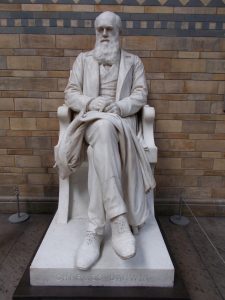
    b) Bill Bailey’s Jungle Hero (two episodes, 21 and 28/4/2013), in which the comedian, a big fan of Wallace, embarks on a mission to rehabilitate his reputation, and give him the recognition he deserves. He achieves his ambition, the climax being a statue of Wallace at the Natural History Museum alongside the statue of Darwin.

    Also, on the occasion of the centenary of Wallace’s death, there was an article by Stephanie Pain in New Scientist magazine (1) under the heading “…it is time to put him in his proper place – as Charles Darwin’s evolutionary equal”.


    What is the true story? Whatever Wallace may or may not have thought in the late 1850s, by the end of his life he was a firm believer in God and Intelligent Design, as is clearly shown by the title of his 1914 book The World of Life: a Manifestation of Creative Power, Directive Mind and Ultimate Purpose. In it he states his view that the purpose (that scientific heresy teleology!) of evolution is “the development of Man, the one crowning product of the whole cosmic process” (1). It is also interesting to note that in his book Darwinism he had previously included a section entitled Independent Proof that the Mathematical, Musical, and Artistic Faculties have not been Developed under the Law of Natural Selection (which are of course what we would describe as more spiritual aspects of humanity) (2). He was also a firm believer in spiritualism, as evidenced by his book Miracles and Modern Spiritualism. (All three books are available as free online downloads.)

    Neither BBC programme found the time to mention any of this, even though the first was specifically meant to be an account of the life of Wallace. If we listen to an edition of In Our Time, we should be able to expect a reasonably complete presentation of the topic under consideration. Melvyn Bragg, however, made no mention of these facts, and concentrated exclusively on the orthodox story. It was left to one of the guests, geneticist Steve Jones, to allude briefly, if somewhat vaguely, to this when he said: “There was lots of speculation (of where species came from) … It got frightfully, terribly close to philosophy, which is always a sign that science is sinking into the morass. Darwin and Wallace rescued it from that, although… Wallace later in his life began to push it back in that direction” (my italics). This statement clearly does not do justice to the subject matter; Jones chose to call “philosophical speculation” what in reality were statements of religious faith and Intelligent Design (derived, it must be emphasised, from his observations of the natural world, not from a reading of the Bible!)

    One can argue that Bill Bailey had the right to choose what to put into his programmes, but I would prefer a more complete, and therefore more honest, picture of the subject at hand. He described the theory of evolution by natural selection as “one of the greatest scientific ideas of all time”, but failed to mention any of the above. He even said that Wallace had taken “a path which would ultimately lead him to deny God”, which is either ignorance on an extraordinary scale, if he has studied Wallace as deeply as he claims, or a blatant lie.

    Stephanie Pain, also a big fan of and knowledgeable about Wallace, is aware that he “was a prolific and successful writer”, yet fails to mention the books mentioned above, although she surely ought to have been aware of them. She therefore leaves her readers with a false impression of Wallace. She does mention his interest in spiritualism, but says that this is something discovered from a reading of his letters, thus downplaying its importance, when in fact he was interested enough to write a whole book about it, in which he bravely declared his belief in it, despite the criticism he received.

Postscript:

    Along similar lines we can also note Richard Dawkins’s opening to his preface of The Blind Watchmaker. There he says that the mystery of our existence has now been solved. “Darwin and Wallace solved it, though we shall continue to add footnotes to their solution for a while yet” (3). Again this is very misleading, since Dawkins’s understanding of Wallace’s “solution” is in direct contradiction to what Wallace thought himself.

Footnotes:

1. Issue 2942, November 9th, 2013                                                                                                                                     2. Preface, Pvii                                                                                                                                                                           3. 1889 edition, p 469                                                                                                                                                             4. Penguin, 1988, Pxiii

· Evolution

The BBC and Science

25th July 2017

    The BBC is widely respected around the world, and is held up as a broadcasting standard to aspire to. Such respect places a heavy responsibility upon it to do everything within its power to ensure that this is deserved.

    In matters political, the BBC has a duty and a desire to be rigorously balanced. There are strict rules in place and, despite occasional claims of left-wing bias by the right-wing press, and right-wing bias by the left, it makes a pretty good job of it. It’s a shame therefore that in matters scientific it does not feel the need to apply the same standards. Here are some programmes I have noticed down the years which promote the orthodox viewpoint, and which are therefore misleading because they ignore important relevant material:

    In 2016, neuroscientist David Eagleman presented a series for BBC4 called The Brain (1). During the series he presented his unsubstantiated opinions as facts – he considered them to be facts because he was operating from a purely materialist preconception. (For details see my post The Folly of Modern Neuroscience.)

    The Big Bang. This is of course the widely accepted orthodox view of the origin of the universe. It may be true, but it is based on some very dodgy science (a post will follow to explain this), and therefore should remain controversial. Despite this, in 2016 Jim al-Khalili presented two programmes in quick succession, telling the orthodox version of the story. The first was on 17/1/16 (2). If we didn’t get the message the first time, a new version a few weeks later went over exactly the same material (3). Since BBC4 is very keen on repeats, one wonders why they couldn’t have just repeated the first one, at no extra cost.

    David Attenborough, admittedly a national treasure, loved for his excellent programmes about the natural world, is allowed free rein to express his uncritical enthusiasm for Darwin. The most obvious example is Charles Darwin and the Tree of Life, first shown 1/2/2009 and subsequently repeated. In it he states that “two hundred years ago a man was born who was to explain this astonishing diversity of life. In doing so, he revolutionised the way in which we see the world and our place in it” (my italics). So we are led to believe that this is a fact, not something that, despite widespread acceptance by many, remains very controversial. A more accurate description, I believe, of his work is given by Francis Hitching, himself a producer of TV documentaries. Quoting Attenborough’s account of the evolution of fish in Life on Earth (a book based on a BBC series), Hitching says: “Such accounts are really not much more helpful than a line of plausible patter before a conjuror says abracadabra and produces a rabbit out of a hat” (4).

    The case of Alfred Russel Wallace.

    The orthodox story is that he came up with the theory of evolution by natural selection about the same time as Darwin, therefore deserving equal credit. He was not given recognition at the time, and has therefore been to some extent lost in the historical account. Two BBC programmes supporting this version of events were:

    a) an edition of radio 4’s In Our Time, 21/3/2013.

    b) A two-part TV series entitled Bill Bailey’s Jungle Hero (21 and 28/4/2013), in which the comedian, a big fan of Wallace, embarks on a mission to rehabilitate his reputation, and give him the recognition he deserves. He achieves his ambition, the climax being a portrait of Wallace at the Natural History Museum alongside the statue of Darwin.

    What is the true story? Whatever Wallace may have thought in the late 1850s, by the end of his life he was a firm believer in God and Intelligent Design, as is clearly shown by the title of his book The World of Life: a Manifestation of Creative Power, Directive Mind and Ultimate Purpose. In it he states his view that the purpose of evolution is “the development of Man, the one crowning product of the whole cosmic process” (5). He was also a firm believer in spiritualism, as evidenced by his book Miracles and Modern Spiritualism. (Both are available as free online downloads.) Neither BBC programme found the time to mention any of this, even though the first was specifically meant to be an account of the life of Wallace. (For more details, see my post Alfred Russel Wallace.)

    Radio 4 broadcast a series of five programmes called Our Dreams: Our Selves, written and presented by Lucy Powell (6). This was described as a general history of dreams, and yet there was not one mention (even if critical) of Carl Jung, who developed a whole therapeutic system based upon dream interpretation. There was, however, a whole programme devoted to Sigmund Freud. Apart from his one major insight that dreams are “the royal road to the unconscious”, just about everything else he said about dreams was, in my opinion, wrong or at least highly controversial. In the history of dream interpretation Jung is a far more significant figure than Freud (7). 

    First shown on BBC4 on 2/11/14 was a very sympathetic portrayal of James Randi entitled Exposed: Magicians, Psychics and Frauds. As you might guess from the title, the programme left the viewer with the impression that all psychics are frauds. There is no doubt that Randi is a highly talented magician, escapologist and, as the programme demonstrated, has done some excellent work in exposing some frauds. However, his general attitude towards ESP (psi) seriously lacks credibility. An obvious example of this is the subtitle to his book Flim-Flam: Psychics, ESP, Unicorns and other Delusions (8). He obviously does not have an open-minded, objective, “scientific” approach to the study of the reality of ESP, which has been proved beyond all reasonable doubt (9). It is interesting that over ten years before the publication of Randi’s book (1969) the (American) Parapsychological Association became affiliated with the American Society for the Advancement of Science, not exactly a radical or revolutionary organisation. This development gave such research an obvious stamp of credibility, but Randi did not take the hint and gave vent to his rage (10).     [On this occasion, the BBC had provided some balance by showing an interesting documentary The Secret Life of Uri Geller (11).]

    So these were several examples where the BBC has accepted without question scientific orthodoxy, even when this is highly debatable and controversial once one digs a little deeper. The presenters of all these programmes are very likeable; they are enthusiastic, speak with conviction, thus giving the impression that they can be trusted – after all they have been employed by the BBC! But, as I hope I have shown, they often provide incomplete and therefore misleading portrayals of the subject matter. Are they given a free rein? Do not editors and producers have a duty to do some checking and step in?

    What should we do about all this? I’m not going to start a campaign myself, but would be happy if anyone reading this felt such an urge. In the meantime, be wary of what you watch and keep checking!

(For further related material, see my post Genius of the Modern World.)

Footnotes:

1. BBC 4, six weekly programmes commencing 21/1/16                                                                                                  2. Horizon, BBC4, Lost Horizons: the Big Bang                                                                                                                                  3. Programme 1 of The Beginning and the End of the Universe, BBC4, 22/3/16                                                            4. The Neck of the Giraffe or Where Darwin Went Wrong, Pan 1982, p24                                                                          5. Preface, Pvii                                                                                                                                                                        6. 23-27 September, 2013                                                                                                                                                    7. For a true account of Jung’s importance and the role of dreams, see Jung, the Wisdom of the Dream by Stephen Segaller and Merrill Berger, which accompanied their Channel 4 programme The Wisdom of the Dream.                                                                                                                                                                                          8. Prometheus Books, 1982                                                                                                                                                    9. See, for example, the books of Dean Radin, especially The Conscious Universe: The Scientific Truth of Psychic Phenomena, HarperCollins, 1997. He actually says that both Randi and Geller are “irrelevant to the scientific evaluation of psi” and therefore “not a single experiment involving either person is included among the thousand studies reviewed in the meta-analyses” in his book (p267).                                            10. Flim-Flam, p230f                                                                                                                                                                11. BBC2, 21/7/13

· Science

  • Newer Posts
  • 1
  • …
  • 7
  • 8
  • 9

Recent Posts

  • Quantum Physics and No Spirituality — Carlo Rovelli and Helgoland
  • Quantum Physics and Spirituality — Danah Zohar and a Quantum Worldview
  • Quantum Physics and Spirituality — Danah Zohar and a New Society, part 8
  • Quantum Physics and Spirituality — Danah Zohar and a New Society, part 7, Quantum Relationships
  • Quantum Physics and Spirituality — Danah Zohar and a New Society, part 6

Copyright © 2026 · Simply Pro Theme by Bloom Blog Shop.